Pop-arts and Quotidian culture
as aspects of everyday life
in the 19th and 20th centuries
SAC LOOP on "pop-art"
SAC LOOP on 19th-20th century "everyday
life"
Unexpected reading on tobacco
<>1860s:1870s; Europe-wide popular organization of leisure
time grew in significance, in clubs and other sodalities
*1880:LND|>Escott,Thomas Hay Sweet|>England: Her People, Polity, and
Pursuits [TXT
with index at end | F/Popular Amusements/]
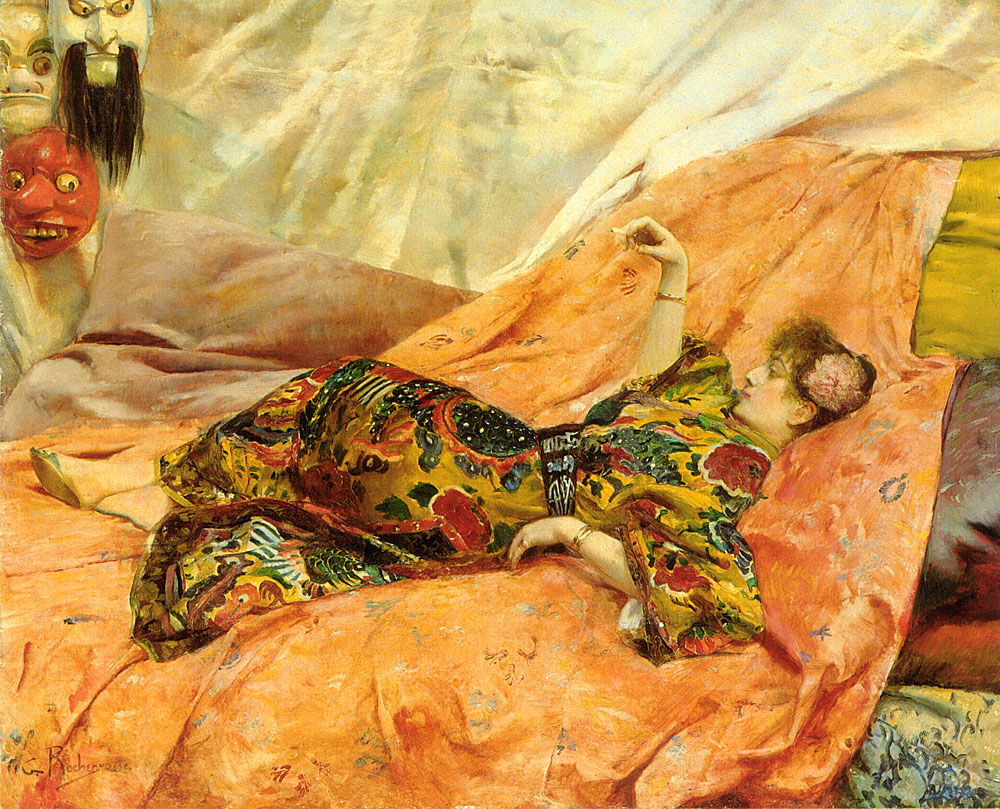
<>1884my:Paris | Sarah Bernhardt (1844-1923 [ID]) thrilled audiences with her popular portrayal of Lady Macbeth in a stunning French translation of the Shakespeare tragedy [pix]
<>1886:Russian musician
Vasilii Andreev began to appear in public with his popular
balalaika orchestra. The balalaika was largely created by Andreev, based on an
instrument occasionally found in the Russian village over the previous century
or so. The balalaika is a stringed instrument somewhat similar to the mandolin (in
its current form only about a century older than the balalaika). It is sounded
by the right hand strumming or plucking three metal strings (two of them tuned
to the same note!). Melodies are produced by the left hand working the strings
against the fretted neck that extends from the triangular shaped sounding body
[EG#1 |
EG#2
| EG#3
| EG#4]
*1890s:1910s; Music Hall Songs about love and sex [BRW:140-43]
*--We are often surprised to learn that many characteristic national cultural
expressions and cherished "timeless" traditions, in Russia and elsewhere, are of
relatively recent origin, and have often been the product of modern "pop-arts"
\\
*--Entertaining
tsarist Russia: Tales, Songs, Plays, Movies, Jokes, Ads, and Images from Russian
Urban Life, 1779-1917 with an illustrative
Compact
Disk
<>1911:Russia experienced a
wave of cultural nostalgia for the old ways of the
village. A fine folk choir, the Piatnitskii Ensemble, was created in these years
and evolved toward the sort of pop-art ensemble that more recent times have
witnessed in foot stomping Irish or "Celtic nostalgia" ensembles
*--Similarly in
USA, the Norman Luboff choir sang negro slave spirituals
[EG]
and nurtured an unexpected nostalgia for the slave-owning rural south, "Dixie",
which was refurbished in a recent YouTube video which tried to dissolve the
irony by running short messages of Christian egalitarianism over the top of
scenes of neo-classical slave-owner manses
[EG]
*--The Lawrence Welk
orchestra "covered" (imitated) New Orleans jazz and "Old Man River"
[EG]
*--An early
21st-century amateur contest fully meshed Russian village song with hip-hop when
a jiving group of babushkas took the stage
[EG]
*--The
Piatnitskii ensemble prospered into the massively transformational years of Soviet collectivization
[ID].
It was kept alive in successor groups through WW2 and into the late Soviet
period [YouTube |
Video]. Its memory has been
revived with a huge wave of cultural nostalgia for the old Soviet days and even
older days when real Russians were rural
folk, peasants living in villages
*1911:USA, NYC| Young Belarus Jewish émigré Irving Berlin had his first
great success as a song writer
"Folk art" and "pop-art" flourished together, but were not the same thing
*--RETURN TO SAC LOOP on "pop-art"
<>1920s+:The
first great epoch of electronic media in the popular commercial arts
[EG]
\\
*--Tim Wu on the media, radio compared to internet [TXT]
<>1934au:USSR Union of Soviet Writers held its first Congress and "Socialist Realism" became state doctrine
The mechanics of making a best-seller in Russia are much the same as in capitalist countries, the difference being that social content and an affirmation of incorruptible conviction, rather than an adventurous or salacious story, form the basis of mass appeal. In the U.S. (and in the West, in general) large sections of the public seek in books primarily entertainment, or escape, but the Russians have been so conditioned by tradition and by the Revolution as to expect in their reading an echo of their own thoughts and an answer to their perplexities and anxieties or at least an indication of what is good or evil. New audiences in the Soviet Union, less sophisticated than those of the pre-revolutionary epoch, yet much more numerous, demand moral and social inspiration from works of fiction hence the fact, that while second- or third-rate Western literature offers simple trash, poor Soviet literature produces tendentious and didactic trash
*--It is too simple to reduce the problem of "social responsibility of art" down
to "art for art's sake" vs. propaganda. English poet (and later USA émigré, then
citizen after 1946) W.H. Auden spoke of "parable-art" and opposed it to both "escape-art"
and propaganda. See his 1940 poem celebrating the Enlightenment
[ID]
and its everyday struggle against deception and injustice = "Voltaire at Ferney", with the words
in the second stanza, "Yes, the fight / Against the false and the unfair / Was always worth it"
[TXT |
CWC:464-5]
*--Website collection of outstanding Soviet propaganda posters
[W]
\\
*--Thomas Doherty,
Pre-Code Hollywood:
Sex, Immorality and Insurrection in American Cinema, 1930-1934
<>1987ja09:NYT| Bill Keller, "MOSCOW TRIES A NEW LULLABY: HEAVY METAL ROCK"
A leading Soviet jazz-rock composer today extolled the virtues of heavy-metal rock music as a way for young working-class Russians to work out their resentment toward more affluent members of Soviet society.
"They just like to wave their hands and then calm down," said Aleksei Kozlov, saxophonist and composer for the jazz-rock group Arsenal. "If we forbid this music, they will display their aggressiveness in other forms."
+This lecture on rock's role in abating class tensions was not delivered in a surreptitious interview in an artist's apartment, but at an officially organized news conference at the Soviet Foreign Ministry on "the problems of contemporary Soviet rock."
Flanked by two Foreign Ministry officials, Mr. Kozlov, whose group has long had Government approval, went on to call for greater candor in Soviet rock lyrics and urged that young people be allowed to dance at rock concerts - despite the complaints of some concert hall managers that the more avid heavy-metal fans have a tendency to smash the furniture. On Prime-Time Television
Once derided in the press as a product of Western dissolution, rock music has become the latest tool for stimulating a younger generation bored and disaffected by the traditional run of youth activities offered by the Soviet state.
The Young Communist League, long disdained by many young Russians for its pedantic weekly lectures on Leninism, now sponsors break-dancing contests and discotheques. Heavy-metal groups with such names as Cruise and Black Coffee, often decked out in studded leather regalia, are booked into sports arenas and concert halls where the usual fare used to be the Red Army Band.
Rock videos and break-dancing displays have blossomed on prime-time television. The Government record company, Melodiya, has begun producing records by groups that, a year or two ago, were confined to invitation-only performances in underground clubs.
Dmitri Shavyrin, who edits a semimonthly rock music page in the newspaper of the Moscow Young Communist League, said in an interview today that within the last year the official attitude toward hard rock had changed dramatically.
As evidence he pointed to the fact that on Tuesday the Moscow Institute of International Affairs, a prestigious training ground for future diplomats, rang with the screaming electric chords of a heavy-metal rock festival. Michael Jackson on TV
Western rock is also being broadcast more freely here. A popular television game show recently featured a video of Michael Jackson moonwalking through his 1982 hit "Billy Jean" - the same Michael Jackson who was scorned two years ago in the newspaper Sovetskaya Kultura as the embodiment of Western corruption.
But the official emphasis is on giving new attention to home-grown talent.
Youth-oriented newspapers and television, openly criticizing the bland Soviet pop music that has won official favor in the past, have demanded more adventuresome fare.
Last month on Soviet television a satirical troupe poked fun at the denatured quality of official pop music and official censorship of rock.
In a skit about the workings of an "artistic council," a group of bureaucrats enthusiastically whittled away at a list of Western performers approved for Soviet consumption. "Let's go through the names." "Pink Floyd?" "Cross it out." "Queen?" "Cross it out." A young man concluded, "Let them give us Soviet music, we shall like it even better."
The rock music that has won new official sanction is largely devoid of themes of youthful rebellion and the bitter political and social commentary common to Western lyrics. There are no calls to drop out and none of the sexual innuendoes that have driven American parents to organize lobby groups against record labels. 'More Acute Texts' Urged
While the music itself is sometimes defiant, political content is limited to calls for peace and disarmament and social commentary to cries against drinking and drugs. Occasionally there are jokes about food lines and overcrowded buses.
Mr. Kozlov said he would favor more pointed lyrics in Soviet rock. Referring to the growing candor of the Soviet press, he said: "I wish that our rock musicians were at the same level of openness. They very often sing about nothing."
The suburbs of the
"They look at the youths from well-to-do families, who have everything from the day of their birth. From the day of their birth they have tape recorders, radios and cars. They have clothing, the latest fashions. Between these youths, who have everything, and the heavy metalists, there exists a subconscious antagonism, and this situation is not well understood. It is expressed in the desire to listen to heavy metal."
Aside from the heavy-metal fans, audiences at concerts tend to be much more clean-cut and sedate than the groups they come to hear. At a recent rock show at the Izmailov Sports Palace, a 6,000-seat arena built for the Olympics, Rondo's lead singer, made up in rouge and glittered hair, cartwheeled across the stage as strobe lights flashed while two voluptuous back-up singers gyrated in miniskirt versions of Soviet school uniforms. Warm applause.
"You can display more emotion if you want," exhorted the master of ceremonies, a middle-aged man in a black satin jacket emblazoned with the logo of Pink Floyd. "Rock back and forth in your seats."
When the group broke into a Chuck Berry-style dance tune, half a dozen young men ran down the aisle and began twisting frantically in front of the stage. After a few minutes they were quietly asked to return to their seats and there were no further outbursts of spontaneity.
While the Soviet state has decided to make the best of it, the proliferation of rock has not won universal approval from Soviet parents. "It used to be parents could say to their kids, 'That's off limits,' " said one Moscow woman, who feels that rock is undermining the great Russian heritage of classical music and opera. "Now, unfortunately, we can't do that."
<>1989my:Library of Congress official website [Source] =
The rhythms and sounds of rock and roll appealed mainly to the young. In the 1980s, the popularity of the once leading rock bands Winds of Change and The Time Machine faded in favor of younger groups. Leningrad rock groups such as Boris Grebenshchikov and his band Aquarium and the group Avia, which incorporated slogans, speeches, loud sounds, unorthodox mixtures of instruments, and screams, provided an important outlet for youth. Some of their music supported themes along the lines of Gorbachev's policies, expressing a desire for change in society. Rock-and-roll lyrics sometimes exceeded the boundaries of the politically permissible. Yet, the leadership realized that this music could not be eliminated or even censored for long because it not only appealed to many citizens but also could help disseminate the leadership's policies.
For many youth, rock and roll served as a means to live out dreams and desires that might not be possible in daily life. Aspiring rock or popular musicians expressed themselves publicly in the more open political environment during the late 1980s. In that period, Moscow and Leningrad permitted performances of music by punki (punk fans) and metallisti (heavy metal fans), whose loud, raucous music appealed to alienated and rebellious youth. Most rock music, however, portrayed the artist as explorer and expressed the desire for new styles and forms.
<>2011ap07:NYR:22-3, a review article by Steve Coll, "The Internet: For Better or for Worse", based largely on Tim Wu's The Master Switch: The Rise and Fall of Information Empires. a brilliant interpretive history of American media and communications technology during the last century. SAC editor has inserted bold-face font and some hypertext links to SAC in order to position this review in connection with our course =
Wu writes =
Early radio was, before the Internet, the greatest open medium in the twentieth century, and perhaps the most important example since the early days of newspaper of what an open, unrestricted communications economy looks like.
In radio’s early amateur phase, from around 1912 until the late 1920s, low economic barriers and diverse voices gave rise to an almost limitless sense of possibility. Churches, clubs, oddballs, gadget hounds, and sports entrepreneurs launched radio stations that could reach listeners over a few square miles. By the end of 1924, American manufacturers had sold more than two million radio sets capable of broadcasting. Dense urban areas such as Manhattan tuned in to a cacophony on the airwaves. Nikola Tesla [ID], who helped to commercialize electricity, believed that because of radio, “the entire earth will be converted into a huge brain, as it were, capable of response in every one of its parts.” Waldemar Kaempffert [ID], the editor of Scientific American, imagined how the technology might build a new social cohesion and change American politics:
Look at a map of the United States and try to conjure up a picture of what home radio will eventually mean. All these disconnected communities and houses will be united through radio as they were never united by the telegraph and the telephone.
We know now that these hopes were unfounded. Radio affected American culture in important ways but it did not improve and broaden American democracy from the bottom up. Nor did the space for free speech expand in the United States; rather, in comparison to the heyday of amateur radio broadcasting, that space steadily contracted until the 1960s.
Wu chronicles with verve and outrage how Russian emigre David Sarnoff’s monopolizing ambition at the Radio Corporation of America (RCA) snuffed out radio’s initial diversity fast [W#1 | W#2]. By the 1930s, on the radio airwaves, Wu writes, “what was once a wide-open medium…was now poised to become big business, dominated by a Radio Trust; what was once an unregulated technology would now come under the strict command and control of a federal agency,” the nascent FCC [ID]. What RCA accomplished in a free-market system, Hitler and Stalin imitated in their much darker ways; radio in Nazi Germany became, under Joseph Goebbels [ID], “a central instrument in achieving Volksgemeinschaft, the unified national community.”
There were many reasons for the shrinking of the American public square between the 1930s and the 1960s. A subsuming national effort was required to win World War II, only to be followed by the Red Scare. Throughout, however, the industrial and federal management of communication technology—which favored control over diversity, and consensus over marginal or dangerous speech—played a reinforcing role.
Monopolizing radio networks blocked the deployment of television technology. Monopolizing film studios, pressured by the Catholic Church (whose censors were scandalized by Mae West’s performance in I’m No Angel [EG]), adopted the self-censoring Production Code. As a result, for decades, Americans saw only films in which, for example, “an individual judge or policeman could be dishonest, but not the whole judicial system.” It was, he writes, “the combination of the Church and the Hollywood studio system that produced one of the most dramatic regimes of censorship in American history.” He concludes that “industry structure,” more than the technical properties of a communications system, “is what determines the freedom of expression in the underlying medium.” This is an insight of great importance, and it has obvious relevance for the future of the Internet as a social, cultural, and political medium, in the United States and globally.
[At this point the reviewer shifts (with Wu) from the past to the future = ]
The Master Switch’s account of the rise and fall of information technologies and industries during the twentieth century is fascinating, balanced, and rigorous—a tour de force. Yet Wu’s central concern is not history; it is the contested future of the Internet. Wu is a professor of law at Columbia University; he is perhaps best known for having coined the phrase “net neutrality,” a principle, or aspiration, meant to assure that the Internet remains an open system where anyone can publish or connect, and where pricing and technical rules are never biased to favor one user over another, even if that user is a very large and wealthy corporation.
In essence, Wu is concerned that large corporations—AT&T, Comcast, Verizon, Apple, and perhaps Google—may be on the verge of carving the Internet into an oligopoly, gradually shutting off equal and free access, much as RCA did to radio and the Bell System did to telephony. By implication, his arguments make plain that if corporations do gradually take control of the American Internet, and use tolls and technical rules to build a new hierarchy of access, then Russia, China, and other authoritarian states wielding even greater relative power within their borders will be sure to follow that model.
Wu labels the pattern of oscillation between open and closed information systems “the Cycle.” As it reaches the present day, his account frames what he calls the “central question” about communications systems in our time. It is essentially the same question that Mozorov [ID], Clinton, and the State Department’s Internet thinkers have wrestled with in their different ways: “Was the Internet truly different, a real revolution?”
If the answer is yes, he suggests, much of the reason lies in the Internet’s design. Its “priority was human augmentation rather than the system itself,” as Wu puts it. “The aim was therefore an effort to create a decentralized network, and one that would stay that way.” The accidental birth of computers as communications devices, connected through a network that could pass through other networks, has been recounted before. Wu elegantly and briefly describes the features of the Internet’s technical design that have contributed to its layered, redundant, self-protecting structure. Because they lacked a communications infrastructure of their own, or the capital to create one, the Internet’s founders—J.C.R. Licklider, Douglas Engelbart, Vincent Cerf, and others—”were forced, however fortunate the effect may now seem, to invent a protocol that took account of the existence of many networks,” for example, commercial telephone lines and closed government systems, “over which they had limited power.” These workarounds produced a design striking for “its resemblance to other decentralized systems, such as the federal system of the United States.”
Wu adds:
For many people, the Internet’s structure was—indeed remains—deeply counterintuitive. This is because it defies every expectation one has developed from experience of other media industries, which are all predicated on control of the customer.
The Internet’s distributed structure contributes to the impact it has had on speech, assembly, and politics—it has lowered economic barriers to entry for publishers and activists alike, and it has enabled peer-to-peer or many-to-many audience strategies (“going viral,” as it is known) that seem to favor bottom-up political activity.
This is not to suggest that political command and control of the Internet is impossible, only that it is harder than, say, control of a national broadcast television network. “The feat requires such power and resources as belong uniquely to the state: access to the very choke points of a nation’s communications infrastructure, its Master Switch,” Wu writes. States have occasionally undertaken direct technical interventions—narrowing the system’s choke points enough to turn the entire Internet off, as China has done periodically to control protests in its restive Xinjiang province, and as Egypt did for a few days during the recent uprising. More effective, as Morozov documents, are strategies that infect and influence the Internet’s open streams. Arguably, as he shows, the governments of China, Russia, Iran, and Venezuela have controlled their people’s access to the Internet adequately enough to protect their power.
The question at home and abroad, then, is whether the decentralized, redundant, distributed shape of the Internet will tip that balance further in favor of centralized powers by yielding to the Cycle—the consolidating patterns of monopoly and state control that shaped radio and television—or whether the Internet will remain a radically open system, biased toward users over authorities. “The individual holds more power than at any time in the past century, and literally in the palm of his hand,” Wu writes. “Whether or not he can hold on to it is another matter.”
Wu posits that in the United States, two competing coalitions of multinational corporations are now battling to determine whether commerce, publishing, speech, politics, and design will take place over the Internet within an open system or a closed one. On one side, the business models of Google, Amazon, eBay, Facebook, and nonprofits such as Wikipedia gave them incentives to try to “convert as much of the world as they can into something that looks like the Internet: a clear, free path between any two points, with no hierarchy or preferential treatment.” (This may be somewhat hopeful about, say, the Google Books project and its proposed deal with publishers and authors.) On the other side, the business models of Apple, AT&T, Verizon, Comcast, Disney, and other conglomerates gave them incentives to lobby at the FCC and Congress for “a rational regime of access and flow of information” based on ownership of the wires, cables, and spectrum over which the Internet flows—infrastructure that some of these companies paid to build, and that others are prepared to pay to control. “If this side has its way,” Wu forecasts, “the twenty-first-century world of information will look, as much as possible, like that of the twentieth century, except that the screens that consumers are glued to will be easier to carry.”
It is not at all clear how this struggle will turn out. The FCC’s authority to impose openness on the Internet is being contested in the courts. The relatively limited amount of data that wireless systems can carry has led industry and the FCC to consider proposals to limit equal access. The rationale is technical, to control system-degrading “data hogs” bent on downloading information-dense video entertainment and the like, but the potential for creeping restrictions to shelter corporate profit is plain.
Ultimately, the preservation of an open Internet, and of the empowerment of individuals it promises—the preservation of virtual public spaces—will require its beneficiaries to fight to keep it. It will require “the cultivation of a popular ethic concerning our society’s relation to information, an ethic consistent with the importance of information in our individual and collective lives,” one that is grounded in “awareness of the imminent perils of a closed system.” Whether sufficient numbers of people will acquire such awareness and act on it is not at all clear. But Wu’s insights are entirely convincing. The greatest single contribution that Western societies can make to the Internet’s potential to empower repressed populations abroad would be to preserve at home the very openness of social media that has inspired the likes of Wael Ghonim.
<>2012ja13:TLS:18|>BRESNICK,ADAM review of Alice Goldfarb Marquis
[JANUS], THE POP REVOLUTION| 232pp. Museum of Fine Arts Publications
I grew up in an American culture awash with reproductions of Andy Warhol's reproductions of images of Marilyn Monroe
[ID] and Campbell's Soup cans
[ID], but I was never that much taken with them. It was only a few years ago, when I saw an enormous greenish Mao and a black-and-white Elvis Presley diptych at the Hamburger Bahnhof Museum of Contemporary Art in Berlin, that I experienced the frisson of recognition that is the hallmark of aesthetic delight. In a city filled with the pathos of the remnants of German high culture and the tragic legacy of Nazi barbarism, I saw how Warhol had put himself at the forefront of contemporary art by channelling the dynamism of Cold War American popular culture and commercialism, and for the first time, I "got" what his art was about.
As Alice Goldfarb Marquis shows in her history of Pop Art, such moments of pre-critical rapture continue to be essential, even in a movement as resolutely anti-transcendental as Pop. Leo Castelli, the Central European emigre from Trieste, who, along with the working-class Pittsburgh transplant Warhol, is the joint hero of Marquis's narrative, was so mesmerized by Jasper Johns's "Green Target" that he gave the unknown artist his inaugural show in 1958. Ivan Karp, an art critic for the fledgling Village Voice [ID??] who worked as a talent scout for Castelli, describes his first visit to the New York townhouse of the already well-heeled commercial illustrator Andy Warhol, whom Women's Wear Daily had called the "Leonardo Da Vinci of Madison Avenue": "[I was] very much taken .. . and astonished . . . and refreshed . . . and amazed ... and affronted ... all at the same time". Karp was so taken aback by Warhol's images that he described himself as living for the next several weeks in "a state of thralldom , . . experiencing tremors day and night". These tremors led Karp to plan the first display of what would turn out to be a billion-dollar artistic and commercial enterprise.
At least since the time of Aristotle, the duty of the artist has been to astonish, and the responsibility of the spectator has been to remain open to the possibility of experiencing what the Greeks called thauma, the sense of wonder. Marquis is good at conveying Pop's resolute search for what Robert Hughes called the "Shock of the New", and her narrative conveys the aesthetic excitement of New York in the late 1950s and early 60s as various versions of bohemia sought control of the cultural field. Pop Art set itself up in opposition to Abstract Expressionism, but what united the two movements was their commitment to thauma.
Pop brought with it various kinds of rhetorical excess, and Marquis presents a chorus of critical voices both for and against. Castelli, Karp, and Henry Geldzahler promoted the new art, while the champions of Abstract Expressionism, such as Clement Greenberg, Harold Rosenberg and Peter Selz defended what they took to be the avant-garde in terms that now sound rear-guard. Max Kozloff warned that "art galleries are being invaded by the pin-headed and contemptible style of gum-chewers, bobby-soxers, and worse, delinquents". Willem de Kooning was exasperated by the success of Castelli's stable: "That son-of-a-bitch", he remarked of the dealer; "You could give him two beer cans and he could sell them." Taking up the challenge, Johns prepared two castings of Ballantine beer cans, which Castelli promptly sold.
What Pop had done, to the annoyance of the proponents of Modernism, was to undo the essential European distinction between high and low art. Whereas for the Romantic tradition
[ID], of which Abstract Expressionism is a late variant, works of art were artefacts supposedly in touch with the sublime, Pop artists understood art in an anthropological and commercial sense, as an activity more or less like any other. Marquis quotes Dave Hickey, who suggests that the real blasphemy of the Pop artists "derives from the crisp analogy they draw between our appetite for 'fine art' and our appetite for food, sex, and glamour". To paraphrase Johns, Pop artists took objects from daily experience, did something to them, and then did something else to them. Ordinary objects were given the cachet of art or, more precisely, of money, for it was with Pop that the market for contemporary art exploded. When collectors such as the New York taxi cab kingpin Robert Scull invested in Pop and reaped the rewards from auctions at Sotheby's, art was on its way to becoming a blue-chip commodity.
Critics like Greenberg, who proposed grand Ideological narratives for the avant-garde, finally gave way to the gallery owners and curators who controlled what would be shown and bought and sold. In an aside, Marquis notes that in the end, Pop can be construed less as a revolution than as a reformation. "In the sixteenth century", she writes,
the Protestant reformers had affirmed each individual's right to commune directly with God without clerics' intervention; in the latter part of the twentieth, individuals were encouraged to commune directly with art, without critical mediation.In the new world of image reproduction, words no longer carried their former prestige, and the great intellectual authorities of yesteryear could no longer pretend to control the discussion of art.
Andy wanted to keep the human element out of his art and to avoid it, he had to resort to silk screens, stencils, and other kinds of automatic reproduction. But still the Art would always find a way of creeping in. A smudge here, a bad silk screen there, and unintended cropping. Andy was always anti-smudge. To smudge is human.In a final twist, Warhol turned out to have been a devout Christian who had an audience with the Pope and received a Catholic burial at St Patrick's Cathedral in Manhattan on April Fool's Day, 1987, attended by 2,000 people. What could be more Pop than that?
=======
The dubious weed
ROY PORTER a TLS rvw (no date) =
Jordan Goodman, TOBACCO IN HISTORY: The cultures of dependence (1993)
Tobacco, argues Jordan Goodman, has produced dependence among its consumers, but equally it has created dependence among its producers. This shrewd insight provides the unifying theme for his ambitious and accomplished survey. Tobacco in History, which ranges confidently from pre-Columbian Amerindians to Marlboro Man.
Consumers dominate the earlier sections of the book. Goodman opens by establishing the prominent role of tobacco within the cosmologies and sacred ceremonials of Amerindian tribes. Widely used as a psychotropic drug, even as a hallucinogen, its smoke could be deified as a go-between, linking the everyday world with the spirits. If voyagers, from Columbus onwards, misconstrued and mistrusted tobacco's magico-rcligious properties, they could certainly carry it back to the Old World and retail it, in good conscience, for iis medicinal virtues, even as a panacea. For within official Galenic medical theory, was it not plain that the inhaling of lobacco smoke would dry up superfluous phlegmy humours, or in other words fumigate the lungs? Though James I demurred, leading medical authorities confidently pronounced lobacco a sovereign cure for melancholy and wasting diseases, not least cancer.
As Sidney Mintz stressed in Sweetness and Power (1985), sugar, coffee, tea and many other habit-forming substances first made their way in Europe as medicines, before winning acceptance as pleasures and symbols of social prestige. This was also true of tobacco. Prices tumbled, and public use spread. By the seventeenth century, all classes were smoking it in pipes. Snuffing, far from being exclusive 10 rococo fops, remained a significant mode of consumption in many nations until the present century. Chewing was long preferred in America; and cigars, of course, have always had their aficionados, from the Spanish to Sigmund Freud. But the past hundred years have been the century of the cigarette: sales have rocketed, nicotine addiction has been probed, links wilh cancer and heart disease established, and (he weed has continued to be promoted, by multinationals, governments and the World Bank, long after demonstration of its lethal nature.
Such mailers - the fatal ambiguities of tobacco as big business - lead Goodman to the second of his "cultures of dependence": the subjection of producers. For a variety of reasons connected with soil and husbandry, Nicoiiana labacum and Nicoiiana rustica (unlike sugar cane) readily lent themselves lo small, independent production units. Bui the political economy of the Chesapeake and the Caribbean favoured lhe implantation of more dependent forms of labour - indentured servants, African slaves. Where they survived, pelly proprietors fell in due course under the sway of giant dealers (Glaswegians were among the first great lobacco barons). In more recent times, Third World peasant cultivators, nolably in East Africa, have come under the thumb of British American Tobacco (BAT) and world agribusiness.
Smoking, chewing and snuffing were adequately served by a host of local, petty capitalists. The mass-produced, mass-advertised and mass-marketed cigarette changed all that, and with astonishing speed. Negligible in 1860, cigarettes were taking over the West by the 1920s, thanks to mechanization of production. By 1890, James Duke was king of the American cigarette industry, and by the 1920s, Camels, Lucky Strikes and Chesterfields enjoyed an 80 per cent share of the American market. Marlboro now lead the world for Philip Morris, today the world's fourteenth largest company, and graced by Lady Thatchcr as their adviser. Cigarettes blazed the trail for oligopoly. Tobacco in History thus explores capitalism's success in creating subordination in producers and consumers alike, through marketing a commodity both addictive and toxic. One wishes Goodman had pursued these insights further. What does the tobacco story tell us about the attitudes of business and governments, past and present, to other addictive substances? In view of the concerns signalled in his subtitle, it is a pity that he did not explore in greater depth the specific mechanisms by which cigarettes captured the market, how the world became hooked. After its initial boom, tobacco consumption reached a ceiling by around 1730. But, a century and a half later, mass-produced cigarettes rocketed through it. So why precisely did this new commodity catch on, and become, alongside Coke and jeans, the universal signifier and hottest commodity of Western consumer culture?
Instead of addressing such key issues head-on, Goodman tends to go off at tangents, lavishing space on rather repetitive accounts of planter culture and merchandising circuits - fascinating topics, without a doubt, in the hands of an expert economic historian, but slightly marginal to a global survey dedicated to explaining how a dubious drug became the world's largest nonfood crop (China now consumes an astounding 1,500 billion cigarettes a year).
Overall, however, congratulation, not criticism, is in order. Read alongside Victor Kiernan's more personal yet also more political Tobacco: A history (1991), Goodman's study greatly enhances our grasp of the creation of the commodities that dominate the modern world.
![[pix]](images/BernhardtS.jpg)