|







|
|
PROJECT
SUMMARY
INTL 240 Perspectives on International Development
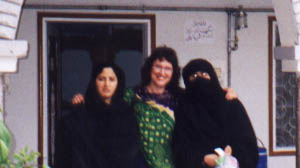
Professor Weiss with Pakistani representatives
from SUNGI, a grassroots NGO in Haripur, NWFP.
|
This project seeks to create a hands-on learning environment by
providing a series of web-based modular research components that will augment traditional
lectures and discussions in the classroom (see below course outline).
The proposed project has five main goals to enhance the student learning experience:
i) to foster greater understanding of the structure and effects of the global system by
providing research opportunities at the undergraduate level;
ii) to strengthen student abilities to conduct international research via the Internet;
iii) to create an innovative web-based curriculum module for large-lecture classes that
can be easily replicated among faculty in this and other departments' programs;
iv) to increase faculty incentive in the use of instructional technology through
established partnerships and through example; and
v) to lay the foundation for a development-oriented participatory research group at the
University of Oregon through the creation of the International Studies Program Group
(ISPG) online research database.
This redesigned course, scheduled for Fall 1999 and taught
recurrently each year, will initiate cooperative learning among faculty, students,
international development professionals and instructional technology staff. The course
will be partially web-based and will provide the research materials necessary for learning
the course material via dynamic web delivery interface: syllabus, modular research
exercises, links to primary research documents, an interactive discussion forum, and
published research findings. This course will offer students the opportunity to engage in
practical and meaningful research in a format that allows modular learning with support
from peer-to-peer interaction and classroom lectures and discussion.
Through resources available on the Internet, students will gain access to diverse
perspectives on human rights through analysis of international human rights documents. The
linking of human rights concerns to development has become a central issue within the
international community today. The process of development itself at worst results in human
rights abuses, though at best accentuates pre-existing inequalities between constituent
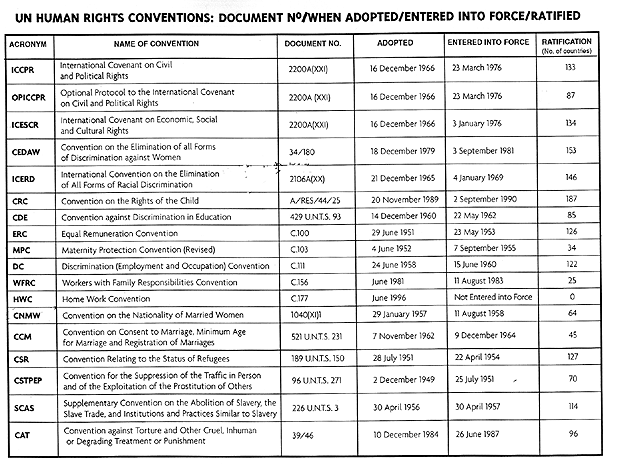
groups. The UN Human Rights chart reviews the major human rights
instruments that the research module process will be built around (additional links to
primary resources are listed under each Module Summary).
As the course takes an applied approach towards development research, student
participation in lectures and discussions is essential. A web-based, modular approach to
student research provides a dynamic opportunity to engage students in cutting-edge
international research while also promoting interactive discussion between peers and with
the professor. The proposed research module exercises will take students step by step
through (1) multilateral and bilateral views on development and human rights; (2) global
human rights instruments and their development and gender implications; (3) third world
states' development and human rights records; and (4) responses by non-governmental and
community groups to human rights issues. The final product will be a searchable website
that researchers can utilize to track a given state's human rights record; implications of
that record on its development agenda and, in particular, for women in that country;
responses by northern and southern NGOs (non-government organizations) to the country's
human rights situation; and analyses of how a given human rights instrument is being
implemented. In conducting her own research, Professor Weiss would have found this kind of
website of enormous benefit as will others.
This final product of an internationally accessible website will, importantly feed back
into Professor Weiss' research on gender and human rights. It will extend her focus on
Islamic states to third world states in general. Professor Weiss may lead a workshop based
both on the process of teaching the course and the actual research findings at an annual
meeting of appropriate professional societies of which she is a member, notably the
American Sociological Association (ASA), the Association for Asian Studies (AAS), the
International Studies Association (ISA), or the Middle East Studies Association (MESA).
This proposal is coming at a critical juncture in the international studies research
arena as advanced research techniques become more computer-based, requiring faculty and
students to master cutting-edge technology. Contemporary research on other countries, in
particular, has been largely unavailable to undergraduate students who often lack the
initiative or support resources necessary to conduct research internationally. For this
reason, it is important and exciting that faculty actively involved in international field
research find innovative means of mentoring undergraduate students in the mechanics and
issues related to international research. Likewise, faculty will gain skills critical for
engaging students in course materials while providing avenues for student research to feed
back into the faculty member's own research process.
Since I have been at the University of Oregon, I have sought to have my courses include
applied as well as theoretical issues and have initiated various 'cutting edge' courses.
Prior to receiving tenure, I had transformed the International Studies seminar in World
Value Systems into a timely, interaction-based course that looks at global trends in
values such as human rights, environmental sustainability and global popular culture. In
Aid to Developing Countries, I introduced an aid consortium simulation, where student
groups -- either as donor agencies or aid-receiving countries -- have to interact with
each other to determine funding levels. Such kinds of innovative group projects greatly
enhance students' learning experiences as well as facilitate cooperative group efforts
necessary in 'the real world.' The last time I taught this class (Spring 1998), I
experimented with placing some of the class materials on a course website, including the
syllabus, project description and group project reports. This term (Spring 1999), I have
placed even more of the class materials on the course website, including reading materials
and group project reports.
I have not been satisfied with the structure of INTL 240, and have endeavored to make
it timely, interactive and appealing to freshmen and sophomores, the largest constituency
who enrolls for the course. In the past, I have incorporated a group project with the goal
to provide students with diverse groups' insights into a fictional country's development
dilemmas through a role-playing process. However, group projects in such a large course
have proved problematic as students are confronted with a range of competing priorities.
Bright, interested students have been frustrated by the lack of commitment of some
students to the group process. This modular research process would enable those who are
interested to acquire salient research skills along with key insights to the social
dimensions of the development process, while also engaging less committed students by
requiring that they submit their own work.
Research Focus
The impetus for this project is derived from my current research interests. My research
today is focused in two purposeful directions: global policies being developed to empower
women, and Muslim views on women's international human rights. I am particularly
interested in the ways in which global instruments -- such as the Platform for Action
which was debated at the U.N.'s Fourth World Forum for Women in Beijing -- influence state
actions, particularly in Muslim states. These concerns meld closely when we look at Muslim
views of women's empowerment that were voiced at the Vienna Human Rights conference in
1993, the UNDP Population & Development conference in Cairo in September 1994, as well
as at the Beijing Forum. Much of my time conducting fieldwork in Pakistan in 1997 was
concerned with these issues, which has resulted in a journal article entitled "Women,
Civil Society and Politics in Pakistan" in Citizenship Studies (3,1, 1999:
141-150). My earlier research on home-based labor and the ILO's efforts to regulate
it led me to realize that work -- having access to it, as well as safeguards -- is itself
a part of the larger development and human rights framework and is currently a pressing
discourse throughout the Muslim world as well
I received a prestigious CAORC (Consortium of American Overseas Research Centers) grant
to conduct field research in Pakistan and Tunisia in 1999 for this project,which has been
enhanced by my receiving a Freeman grant to support expanding this research to Malaysia. I
am building upon the work I have conducted in Pakistan by doing a comparative study with
these two other Muslim states. This research is investigating how Malaysia, Pakistan and
Tunisia are incorporating international human rights agreements, specifically those
affecting women, in their national laws, policy planning processes and related
institutions. In addition to looking at legal reforms affecting family laws, which are
obviously affected by views on human rights, I will also look at other actions being taken
to enhance women's political and economic empowerment as a means of further securing their
essential human rights. These actions are significant in that they are examples of how
states can promote viable means of resolving paradoxes that often prevent engendering
human rights in Muslim contexts.
What follows is a prospective course outline, which will be subject to
substantial change as the collaborative partners work on it during the first half of
summer term, with support from this grant.
Prospective Course
Outline and
Accompanying Research Module Exercises
Required texts:
John Isbister Promises not Kept: the Betrayal of Social Change in the Third World
4th edition, Kumarian Press, 1998
United Nations Development Program Human Development Report, 1999 Oxford
University Press, 1999
David J. Whittaker United Nations in the Contemporary World Routledge 1997 [This
reading has been used before, but may be omitted in favor of students being required to
read overviews of the U.N. and specific agencies which would have hotlinks to the course
website.]
(One more text to be selected with an explicit social development and human rights
focus)
Course requirements: Percentage of Final Grade
(These will be reviewed before finalized)
1. In-class mid-term exam, (Tuesday, October): 25%
2. Four Research Module exercises, for a total of: 65%
3. Discussion section participation: 10%
Course Outline
WEEK I, September 28 - 30
Introduction
Topics to Explore: concepts of development and human
development; characteristics of aid-receiving countries and regions; controversy
concerning term Third World; clarification of research module process
Film: "Water of Ayole"
Required Readings:
Isbister, pp. 1-30
UNDP, pp.
(TBA)
WEEK II, October 5-7
Key Actors and Issues in Development Processes
Topics to Explore: colonialism and integration of colonial
economies into emergent global economic system; public need, action and accountability;
national and international pressures; the emergent role of the United Nations
Required Readings:
Isbister, pp. 68-102, 104-147
Whittaker, pp. 2-13, 14-27, 28-41
Module 1:
The U.N., Bilateral and other Multilateral Development Organizations |
| Goals |
Identify development organizations, their perspectives on development, and where human
rights fits in with their perspectives. Research donor attitudes towards linking the
administering of aid with human rights records. |
| Format |
Lecture will clarify terminology and identify key players; texts and web-based sources
for research. The course website will have links to primary research documents produced by
international development organizations including:
[list will be expanded in Summer 1999]
Students will submit their research to the course's interactive discussion forum by
Friday, October 9th. When multiple students opt to report on the same agency, these
reports will be grouped together (though not as 'one voice'). |
| Results |
Web-based reports and discussion will be available for a wide range of donor agencies,
underscoring various perspectives on development as well as on linking assistance with
human rights records. |
| Other |
Web Intern and SSIL Student Assistants will work together with students to
post analytical questions and discussion comments on course website. SSIL Staff will work
with Professor Weiss and course GTFs on moderating online discussion forums and using
technology interface to lead students through the mechanics of technology services. |
WEEKS III and IV, October 12-14, 19-21
Local Culture and Development Processes: Historic and Theoretical Foundations
Topics to Explore: tradition, modernity and
westernization; overview of major theoretical approaches to development; nationalist
movements and basis of post-colonial political systems; focus on human rights as an
emergent development concern
Required Readings:
Isbister, pp. 33-66, 68-102, 104-147 (?)
Whittaker, pp.
(TBA)
Module 2:
Identify UN Human Rights Instruments and
their Gender Components |
| Goals |
Identify a principal human rights instrument, and analyze:
1) what development concerns does it address;
2) its potential impact on development processes; and
3) its potential differential impact on men and women |
| Format |
The course website will have links to primary research documentsas noted
on the UN Human Rights chart; students will do additional
Internet and library-based research. Students will submit their research to the course's
interactive discussion forum by Friday, October 22nd. When multiple students opt
to report on the same instrument, these reports will be grouped together (though not as
'one voice.') |
| Results |
Web-based reports and discussion will be available for the various human
rights instruments. At the completion of this module, students will have used the Internet
to analyze major human rights documents and instruments. Students will have contributed a
second report to the eventual web-database of student-conducted research on human rights
agreements and subsequent implementations. |
| Other |
SSIL staff, GTF and Web Intern will work closely with students to
integrate research reports into searchable formats for the web database. SSIL will staff
additional student assistants during blocked class time for INTL 240 students. |
WEEK V, October 26-28
Economic Growth and Human Development: Key Indicators and Causes of Inequality and
Inequity
Topics to Explore: key indicators and measures: GNP/, GDP,
HDI, GDI, GEM; data collection issues; debt crisis, deregulation and structural
adjustment; effects of NAFTA and MAI on development concerns
Required Readings:
Isbister, pp. 149-155
UNDP, pp.
(TBA)
In-class Mid-term Examination:
Tuesday, November 2nd
The in-class mid-term examination provides a fair opportunity for students to sit before
the professor at the same time, and respond to specific questions in a designated time
period under similar conditions, revealing their understanding of the course materials
presented thus far. It remains an important incentive for students to progress through
each module and to follow required readings as outlined in the syllabus.
WEEKS VI & VII, November 4, 9-11
Economic Growth and Human Development: Global Influences on Local Concerns and
Fighting Back
Topics to Explore: collective action; more on escalation
of inequality and inequity in the development process; the role of the state and
kleptocracies; changing roles of men and women in the process of development; population
control as a human rights concern and related sustainable development issues
Film: "Something Like a War"
Required Readings:
Isbister, pp. 155-191, 193-233
UNDP, pp.
Whittaker, pp. 68-79, 80-88
Module 3:
Research Examples of State Perspectives on
Development Assistance and Human Rights |
| Goals |
Identify various countries' stances on human rights as a development
concern: which human rights instruments have been ratified; what have they done since
ratification? |
| Format |
Lecture will clarify terminology and identify key concerns; texts and
web-based sources for research. The course website will have links to primary research
documents (e.g. various countries' homepages; U.S. State Department
Human Rights Reports). Each student will select a country in their respective
discussion section. To add diversity, each GTF will allow no overlaps within their two
discussion sections. Students will be asked to select a country from a list of potential
choices provided via the course website. The course website will have links to primary
research documents; students will do additional Internet research to complement their
findings. Students will submit their research to the course's interactive discussion forum
by Friday, November 12th. When multiple students (with different GTFs) opt to report on
the same country, these reports will be grouped together (though not as 'one voice.') |
| Results |
Web-based equivalent reports and discussion will be available for the
various countries concerned. At the completion of this module, students will contribute
research findings on specific countries to the web-database of human rights sanctions and
agreements. |
| Other |
SSIL staff, GTF and Web Intern will work closely with students to
integrate research reports into searchable formats for the web database. SSIL will staff
additional student assistants during blocked class time for INTL 240 students. |
WEEKS VIII & IX, November 16-18, 23
Community Development and Empowerment: Grassroots Organizing and Human Development
Topics to Explore: rise in influence of NGOs; community
organizing, domestic violence and human security as development concerns; social effects
of aid; civil society and human rights
Required Readings:
UNDP, pp.
Whittaker, pp. 89-99
Module 4:
Alternative Views on Development and Human Rights |
| Goals |
Identify northern/international NGOs' stance on gender and human rights in
the country covered in Module 3; identify and analyze local actions by southern NGOs/CBOs
(community based organizations) to rectify human rights abuses; and any linkages any of
these organizations may have made to the development process. |
| Format |
The course website will have links to primary research documents released
by some northern NGOs such as:
Students will do additional Internet research to complement their findings and to
contribute to a database of diverse perspectives from NGOs. Students will submit their
research to the course's interactive discussion forum by Wednesday, November 23rd. When
multiple students (with different GTFs) opt to report on the same country, these reports
will be grouped together (though not as 'one voice.') |
| Results |
Web-based reports and discussion will be available for the various
countries concerned. These reports will be added to the database. |
| Other |
SSIL staff, GTF and Web Intern will work closely with students to
integrate research reports into searchable formats for the web database. SSIL will staff
additional student assistants during blocked class time for INTL 240 students. |
WEEK X: November 30-December 2
Development Agendas in the Future:
Expanding Opportunities in a World of Limits
Topics to Explore: local empowerment in response to global
concerns; the future of aid and development goals; opportunity to discuss the research
module process and its findings
Required Readings:
Isbister, pp. 236-247
UNDP pp.
Whittaker, pp. 116-12
Module 5:
Presentation of Research |
| Goals |
Students can see results of research in newly created accessible database.
Students learn to work collaboratively to make decisions as a team, simulating real-world
experience. Students will be exposed to different orientations towards human rights
instruments and presentation of data to targeted audience. |
| Format |
Research is published on course website. Professor Weiss, in collaboration
with instructional technology staff, will finalize the presentation of students' primary
research findings on a course website designed to enhance visibility of the project and to
encourage information exchange. |
| Results |
Internationally-accessible database will be launched. Human rights actions
can be searched using categorical sorting such as 'by country', 'by human rights
instrument', and 'by topic'. |
| Other |
SSIL staff, GTF and Web Intern will work closely with students to
integrate research reports into searchable formats for the web database. Web Intern will
collaborate with Professor Weiss to launch website for international access. |
Benefits for Students
Students move through course material as a cohort;
Interactive discussion is available even when students are not in a
traditional classroom setting;
Encourages group collaboration in research design and analysis;
Develops mentoring relationship between faculty and students through
shared research;
Allows for flexibility of scheduling;
Provides valuable academic experiences such as research design, project
planning and presentation skills that can also be transferred to employment opportunities;
The end result of a searchable database of countries' human rights and
development activities is a tangible goal that will likely inspire and excite students.
Benefits for Faculty
Encourages through example a success model for dynamic delivery of
teaching materials;
Faculty participate in the learning process of conducting professional
research using online resources;
Professor Weiss' research will be stimulated by fresh insights which
students will have into this arena of research;
Faculty gain new technology skills that can be transferred to future
courses within the department's curriculum;
Student research findings can be shared with colleagues at professional
meetings.
Benefits for Instructional Technology
Organization (SSIL)
Student employees will gain professional experience providing technical
support to students;
Establishes collaborative partnerships between faculty and instructional
technology support resources;
Encourages, through example, the innovative use of technology to engage
faculty and students in hands-on research;
Provides opportunity for student internships in educational technology;
Exposes students to diverse projects on university campus.
Sustainability of Project
The goal of this project is to create an interactive model that uses both hands-on
research and technological tools to enhance the learning environment for undergraduate
students. This project is highly sustainable after the grant period given that:
The course is a core component in the International Studies (INTL) major
and is taught at least once during the academic year. There is potential for the course to
be replicated each year with a revolving theme. Suggested future topics and their relation
to development, based on research Professor Weiss intends to pursue in connection with her
current research and where this research will lead, include domestic violence, women in
the labor force, and democratization and civil society.
The research reported on the course website will have a life of its own,
and students, scholars, development professionals and government policy makers will be
able to access it, worldwide.
Fundamental relationships between departmental faculty, undergraduate
students and instructional technology staff will form a support base for hands-on
experience and research at the undergraduate level.
Based on a model implemented by the Institute
for Development Studies at the University of Sussex, this project's collaborative
partners will create a website--the International Studies Participation Group (ISPG)--that
will serve as a University of Oregon-based student research database for students and
faculty to discuss interactively current issues in international research via an online
interface.
In addition to furthering discussion locally, this innovative course
will also be a recruitment tool for undergraduate and, more likely, graduate students who
will want to participate in this discussion.
Since 1992, the Social Science Instructional Lab has experienced
significant increases in the number of students and classes using computer-based
technology for the purpose of class instruction. SSIL reports that distance education
students in the social sciences have indicated, through course evaluations, that demand is
increasing for courses that combine cutting-edge technology with scheduling flexibility.
This proposal provides the impetus and opportunity for developing course models that
students find engaging. |