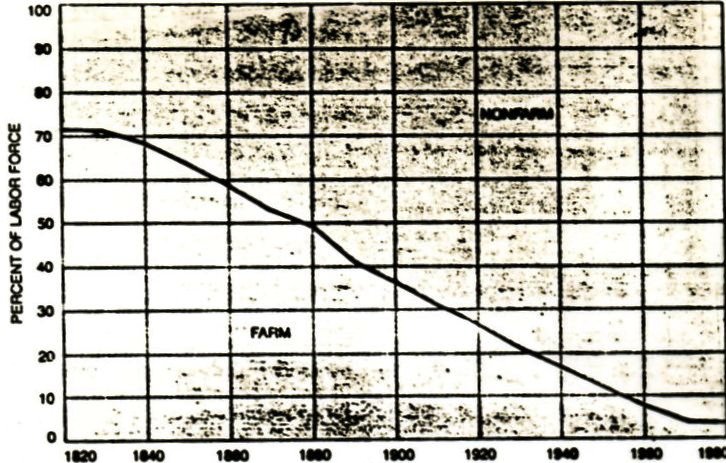
<>1680:1730; Southern
New World colonies (future USA) | In this half century,
black slaves became the backbone of a profitable agricultural economy tightly
connected with growing world markets for tobacco and slaves
*--Over the previous century and a half, economic
globalization entered world history and expanded dramatically
- Slavery was not the only form of bound labor in the New World [USA]
- Indentured, or bonded, servants were of near equal importance
to slaves in the earlier history of labor in the Americas
- Indentured servants were European immigrants who, in return for passage to America, bound themselves
to work there for a number of years, after which time they were to be freed
- Some have said that the practice was closely related to the tradition of apprenticeship, in which a youth was
assigned to work for a master in a certain trade and in return was taught the skills of the trade
- But a better relationship is to slavery or serfdom
- Indentured servitude was a form of bound labor in which the time duration of the condition was clearer and generally briefer
- Gottlieb Mittelberger came to Pennsylvania from Germany in 1750. He later published a description of
his experience as indentured servant [TXT]
- Mittelberger fared better than most. His "serfdom" was as schoolmaster and organist in Philadelphia. He
returned to Germany in 1754
- "Portuguese, Spanish, Netherlander, French, and English colonists resorted to
varying forms of peonage and indentured servitude before settling on slavery as
the institution most suitable to developing the economic potential of newly
acquired lands in the Americas" [Kolchin:2]
- Convicts were also an important source of colonial labor
- Thousands of English "criminals" were sentenced to labor in the colonies for a specified period,
after which time they might be freed
- In the late 1600s, "Liberal" progress at home and un-liberal colonial imperialism abroad was becoming a
"Western" pattern
- Slavery and serfdom were disappearing in the domestic life of west Europe
- Slavery and other forms of bound labor in colonial possessions abroad substituted to partially fill the
economic needs of the increasingly serf-free west- and central-European colonial powers at home
- The 17th century was the century of thriving global markets for bound human labor
- And not just in USA and Russia
- In Russia serfdom and the power of noble "serf owners" flourished in this half century (1680-1730)
- Serfdom waxed in Russia in just those decades when slavery and indentured
bound labor waxed in the New World, and bound labor declined in west Europe
- North Africa in that century held nearly one million Europeans in slavery [2004no16:TLS:33]
- How should we think about two abiding "Western" contradictions observable from these years forward?
- The emerging modern world, 1500 to the present, based itself on a new globalized
economic/administrative foundation of mercantilist imperialism, at just the time that parochial forms of
exclusivity waxed strong in emerging European sovereign "nation-states"
- In more recent times, the economic argument in favor of slavery has been
nullified by the moral and humanitarian argument against it
- Do societies always allow moral and humanitarian arguments to trump economic interests? Consider
the persistence of slavery into contemporary times
[E-TXT]
- Also consider economic arguments against environmentalism ("oil and gas are the bases of our economy")
\\
- Kolchin, 1-17 provides a brief combined
account of the origins of slavery and serfdom
- Robin Blackburn, The American Crucible: Slavery, Emancipation and Human Rights (2011),
describes how African slavery was a stunning economic success story. The slave trade created a perfect
"supply-and-demand" triangle =
- Manufactured trading goods from, say, England were shipped to Africa
- There the emptied trading vessels filled with African natives to be
shipped to The New World and sold into slavery, to work on plantations and
other extractive enterprises. Then, finally =
- Again empty, these trading vessels could be filled with the products of cheap slave
labor for sale back home, EG=tobacco, coffee, cotton, rum, gold, and silver
- Steven Hahn, The Political Worlds of Slavery and Freedom (2009) argues
that the righteous distinction drawn in USA between the "free" North and "slave" South is much
exaggerated. That geographical line is "illusory and indistinct" =
- Slavery thrived in the north, and lived on longer than our text-book histories like to
admit (in New Jersey until 1860)
- Northerners generally observed their obligations under the Fugitive Slave
Law which extended the power of slaveholders and slave-catchers far
into the North
- And, then, just how "free" were the free blacks of the North?
- Hahn may exaggerate the number and the meaning of manumission (liberation of slaves) in the South
- But there is some wisdom in his suggestion that it is best to think of USA having a variety of
"geopolitical zones" of slavery and freedom where freedom and bondage were balanced in many different ways
- Robert William Fogel and Stanley L. Engerman, Time on the Cross: The Economics of American
Negro Slavery (1974) [E449.F65], chapter one "The International Context of U.S. Slavery":13-37
- George M. Fredrickson, White Supremacy: A Comparative Study in American & South African History
(1981):3-28 [E184.A1F73]
- Seymour Drescher, Abolition: A History of Slavery and Anti-slavery
(2009) argues that only some 5 per cent of slaves carried across the Atlantic wound
up in North America. The rest were placed in Caribbean or Latin America
- As late as the 1770s, exports from North America, expressed in per-capita terms of the white population,
amounted to only 2% of exports from the Caribbean
- The traditional view of New World settlement as essentially a European achievement needs modification or augmentation =
- Over the 300 years up to 1820, Africans arriving in the New World were five times as numerous as Europeans
- The New World was built as much, or more, by African slaves as by European "pioneers"
- "Europeans provided the initiative, capital and transport, but the driving
force behind the entire enterprise was black
slavery." [2010fe05:TLS:9, reviewers comment]
- Reviewer continues = "To no small degree the prosperity of early modern Europe -- and so, by extension, our own
well-being today -- derives from the involuntary labor of African slaves"
- [We might ask, with no grouchy intent, couldn't an identical argument be made about entrepreneurs', capitalists'
and owners' relationship to the millions of wage-laborers in the subsequent industrial revolution?
- And, by extension, could not an identical argument be made about the relationship of "Western prosperity" to the energies and
natural resources of the imperialized world?]
- Drescher (above) makes a vital interpretive point about slavery and the anti-slavery
movement =
- Progressive Europe in the 17th and 18th centuries made an essential distinction between what happened at the
domestic nation-state level and what happened "abroad"
- Progressive anti-slavery at home did not compel anti-slavery on the world market
- This became most clear as "globalization" of markets came to
dominate the 18th and 19th century world
- For this reason, much the same can been said about the expansion of Adam Smithian doctrines [ID] within
the domestic laissez-faire economies in modernizing European nation states =
- The expansion of liberal or progressive doctrines at home in no way restrained the imposition of utterly opposite doctrines abroad
- European enterprise in the wider world in these imperialist decades bore little resemblance to laissez-faire
- A pair of stark contrasts present us two great conundrums of the modern European --
"The Western" -- experience
=
- The contrast between Euro-American liberties and Afro-American slavery, and
- The contrast between domestic political liberalization and global imperialism
- A lively and significant debate continues on the question of profitability in the slave trade
and in the use of slave labor
- This debate gives supplementary answer to the historiographical question "Why is the history of slavery significant"
- EG=E-TXT
about contemporary Dubai. F/this is a lie/ and read the 16 short paragraphs headed "Hidden in plain view"
- Dubai is the functional headquarters of the "USA" transnational corporation Halliburton
[ID]
- "Travel to Africa and witness first-hand accounts of the Atlantic slave trade"
[YouTube]
- 2009de17:NYR:72, David Brion Davis, "The Universal Attractions of Slavery"
[TXT = First 3 paragraphs]
- The essay goes on to emphasize the vital historical fact that slavery (quite unlike serfdom)
was economically viable
- The essay ends with sorrowful emphasis on the rebirth of bound labor in
the late 20th and early 21st centuries
- Much of the debate centers on the "old-fashioned" Marxist interpretation made most powerfully by Eric
Williams, Capitalism and Slavery
- EG=Barbara Solow article in *2012ja12:NYR
[E-TXT]
- 2016au16: Al Jazeera | "Modern-day slavery: The numbers"
[E-TXT]
- 2016my02: Al Jazeera | "Britain's Modern Slave Trade" |
[E-TXT]
- 2017se19: Al Jazeera | "Forty million victims of modern slavery in 2016: report" |
[E-TXT]
- 2018: "Global Slavery Index" [E-TXT]
- 2018mr03: Al Jazeera | "Modern slavery: Are we all to blame? Slavery is a reality for millions of people, and
the blame doesn't stop with traffickers"
[E-TXT]
- 2018ap16: BBC News | "North Korea's secret slave gangs"
[E-TXT]
- 2018se20: The Guardian | "US steps up fight against slave labor 'to safeguard American jobs'"
[E-TXT]
- 2018se22: The Guardian | "As Glasgow University owns up to slavery wealth, others urged to follow"
[E-TXT]
*--LOOP on "Imperialism and Revolution"
*--LOOP on Slavery
<>1682ja12: Mestnichestvo [ancestral hierarchy
among noble state servitors to the tsarist throne in Moscow] was
abolished [VSB,1:238-40]
- Muscovite mestnichestvo was related to, but
not to be confused with, Kievan mestnichestvo before the Mongol invasion
- This much older Kievan mestnichestvo system
regulated relationships among several main fortress and trade cities and their
"contract" princes
- Muscovite mestnichestvo signified a hierarchy at the court of the Moscow
grand princes, a hierarchy that defined the status of noble votchinniki [patrimonial princes], especially the boyar
elite in the deliberative assembly known as the "Boyar Duma" [ID]
- Abolition of Muscovite mestnichestvo weakened aristocratic power and strengthening the hand of the tsar
- The tsar sought to appoint noble government servitors as he wished, according to his
needs and interests rather than in accordance with rank among aristocratic
elites
- The demise of mestnichestvo foretold the demise of the Boyar Duma
- Indeed, the decline of votchinniki served the interests of pomeshchiki, but the larger trend was toward
the eventual abolition, for all practical purposes, of this two-tiered medieval elite formation
- The practical distinction between heritable noble (votchinnik) and service
noble (pomeshchik) was disappearing, though the distinction between noble and
commoner would survive until the 1917 Soviet.Revolution| GO 1722ja24:Table of Ranks
\\
*--Kliuchevskii,4(4) reviews the Muscovite
service-based class structure
*--Blum:137-8 describes the mestnichestvo system
<>1682ap14:Old-Ritualist Archpriest Avvakum burned at stake on
orders of Orthodox Church
- Avvakum's autobiography became a classic of early Russian cultural history =
The Archpriest Avvakum, the Life Written by Himself [BX605.a8a3] Excerpts: FTS:134-181 |
ZMR2:399-448 | RRC2,1:128-40 |
VSB,1:259f | DMR2:322-31 |
DMR3:479-88 | ZMR1:320-70 |
BL&T:90f |
E-TXT
after long unnecessary intro
- The most intense years of Old-Ritualist resistance and dissent were over
- The official Orthodox Church was unable to win them over, but it was
able to defeat them
- And the effects of this great cultural rift, the Raskol [Schism], resonated
on down the centuries
<>1682ap27:Russian tsar Fedor died. Several weeks of
dynastic disorder followed before Sofiia was proclaimed Regent, ruling in the place of the two young heirs,
Peter and Ivan
\\
*--Bushkovitch:80-125 (on era of Fedor)
<>1682my15:my19;
Strel'tsy [Musketeers]
[ID] rebelled [VSB,1:240-1]
*--The great Boyar diplomat Artamon Matveev was killed in this rebellion
\\
*--Bushkovitch:49-80 (on Matveev and the
rebellion)
<>1682je:1689se;
Sofiia reigned as Regent for youthful co-tsars Ivan V (her brother) & Peter I
(her half-brother) for seven years
- Sofiia's close adviser, Vasilii Golitsyn (some want
to call him a "Westernizer") was an ambitious but unsuccessful military
leader against the Ottoman Turks in the Pontic steppes
- 1723:Prince B. I. Kurakin remembered young Peter [VSB,2:311-13]
\\
*--Florinsky,1(12)
*--Kliuchevskii,4(1)
*--Bushkovitch:127-70 (on era of Sofiia); 170-213 (on co-tsar Peter's first years)
*--Hughes:1-21 (Sofiia)
*--Lindsey Hughes, Russia and the west : the life of a seventeenth-century westernizer, Prince Vasily Vasilevich
Golitsyn (1643-1714) [DK114.5.G58H83]
*--Aleksei N. Tolstoy, Peter the Great [a novel about Peter's early life | DK131.T6]
<>1683:Vienna, capital city of the
diminished Austrian Empire, came under siege by
Ottoman Turks but survived with difficulty
<>1685:Siberian Amur River valley |
Albazin ostrog [frontier fortress] created
*--Albazin was a bold and unprecedented projection of Russian Voevoda power into the Amur River basin
*--Tensions between the Chinese Empire
and Russia mounted in SE Siberia
<>1686:Poland and Russia settled long conflict.
Vasilii Golitsyn played a key diplomatic role
- Kiev & Smolensk now formally within the boundaries of Russian tsarist authority
- Russian conflicts at its periphery were increasingly spread along three main imperialist
frontiers
- Westward [facing a European empire]
- Eastward [opening a north Asian and new-world empire]
- Southward [opening a Central Asian empire])
- Russia had good reason to bring quiet to the western frontier
\\
Main Periods of [Polish] History [in Polish]
<>1687:Moscow Slavic-Greek-Latin Academy founded [Slaviano-greko-latinskaia akademiia or SGL;
original name = Ellino-grecheskaia akad.] [VSB,1:248]
- Simeon Polotskii was founder, much inspired by Mohyla Academy [ID]
- Polotskii expanding an existing Bogoiavlenskii Monastery school
into an all-soslovie (i.e., socially unrestricted) higher educational institution, first such ever in Moscow
- The purpose was to train talented youths for positions in state or church
- The Academy also housed the office for censorship of religious publications and a court with jurisdiction over
cases of apostasy from Orthodoxy
- 1701:1775; Renamed Slavic-Latin Academy [Slaviano-latinskaia akad.] when Stefan Yavorskii became director
- Yavorskii much expanded the curriculum (and thus the “mission”) of the Academy when he added Latin and other foreign
languages (German, French), as well as medicine, physics, and philosophy
- The student body was made up of youths from privileged social formations, but also from ranks of merchants and villagers
- Mikhail Lomonosov and many other leading lights of Russian 18th-century high culture were students there
- Students came to the Academy from all over eastern Europe
- The student body climbed from original 100 to 600 (1700) and then to 1600 (1800)
- 1755:When Moscow University was created, SGL declined as general liberal-arts institution of higher
learning. SGL shifted steadily toward pure theological education for professional life in the Church
as Moscow University took over the task of modern secular higher education
- LOOP on Censorship
- 1775:Academy took full title, SGL
- 1814:SGL reconstituted as Moscow Theological Academy and moved to the Trinity-St.Sergius Monastery
<>1687:England | Isaac Newton published
Philosophiae naturalis principia
mathematica
- Newtonian discoveries & theories (e.g., gravity, calculus)
were fundamental contributions to the "scientific revolution"
- Newton thus also contributed to the broader and startling shifts in
world view subsumed under the term "the Enlightenment" (the age of rationalism
and empiricism)
- A few years later, on a wild tour through western European
capitals [ID], Russian tsar Peter I arrived
in London and went straight to a meeting, not with English royalty or other grandees of the British realm, but with
the scientist Isaac Newton
\\
*--Wagar on rationalism in the Enlightenment [TXT]
*2016my20:New Republic| Jacob Soll, "The Culture of Criticism: What do we owe the Enlightenment?"
[E-TXT]
<>1689ja:1689fe; English Convention Parliament
issued two declarations that constitute what the English like to call "The
Glorious Revolution" [W#1 | W#2]=
(1) Parliament declared
That king James II, having endeavored to subvert the
constitution of the kingdom by breaking the original contract between king and
people, and by the advice of Jesuits and other wicked persons having violated
the fundamental laws, and having withdrawn himself out of the kingdom, has
abdicated the government, and that the throne is vacant
(2) Parliament issued "The Declaration of Rights" which established the "true, ancient, and indubitable rights of the people of this
realm", especially that any law issued or suspended without the consent of Parliament was henceforth illegal
[TXT]
*--500 years of general European exploration of
various notions of deliberative and/or representative assemblies, "parliaments"
reached a certain apex at this point, though the history of parliaments was far
from complete
<>1689au27:Siberia | Nerchinsk Treaty
signed by Russia & China [DMR2:331-3]
- Fedor Alekseevich Golovin was the Russian ambassador
- Event described by Jesuit translator in Chinese service, Thomas Pereira [Lensen,Eastward:47-9
quotes from Sebes, Jesuits]
- Until now, Russian expansion in Siberia met no serious resistance. Now
Russia came against a powerful third party = China
- The Nerchinsk Treaty conceded the following
to China =
- The left and right bank watersheds of the Amur River basin
[g]
- The Ili River system in Central-Asia (modern-day Kazakhstan) [g]
- Chinese power extended into Outer Mongolia
- Nerchinsk Treaty honored until 1843
- However, contemporary People's Republic of China holds that the Nerchinsk settlement is still in force
- Thus Russia and Kazakhstan are currently thought to occupy about 600,000 sq. miles of Chinese
territory (=Area of CA OR & WA times 2)
- "Bouncing" off China in 1689, Russia looked harder
at NE Siberia and across the North Pacific, but very
tentatively, with no urgent plans
- The indigenous, contiguous or continental phase of
Russian expansion temporarily came to an end in far SE Siberia
- A century would pass before imperialist Russia would attempt anything
beyond is continental frontiers
- Imitation of contemporary
European overseas corporations, was
beyond its power at this time
- Urgency seemed to come from the south where ambitions were a natural extension of long term trends
of frontier and imperialist expansion
\\
*--Bushkovitch:213-55 (on Golovin and other early favorites of youthful Peter I)
*--Mark Mancall,Russia and China: Their Diplomatic Relations to 1728 (1971) [DK68.7.C5M29]
<>1689se:1695; Regency of Sofiia replaced by
regency of Peter I's mother
<>1690mr17:Patriarch of the Russian
Orthodox Church Joachim issued testament [VSB,2:361-3]
<>1692:New World colonies (future USA)
MA Salem witch trials targeted certain women accused of being in league with Satan;
result: a score of "witches" executed
<>1694:1696;
tsar Peter I and Ivan V co-tsars for two years under regency of Peter's mother
- 1694:Peter began Russian navy [W]. He was
looking south toward the dominions of the Ottoman Turks and their allies, the Crimean Tatars
- 1695:1696; Azov, port at the mouth of Don River [g], captured in two campaigns
against Ottoman Turks, but navy weak and success very unstable
- Folksong celebrated the event [WAL:176-7]
\\
*--B. H. Sumner, Peter the Great and the Ottoman Empire [DK135.S8]
*--Hughes:22-6
<>1696:1725;
tsar Peter I assumed sole authority upon death of Ivan V and reigned for 29 years
- Beginnings of Petrine transformation of old Russia [NB! avoid the term "
Westernization"]
- Peter and his vigorous plans for Russian modernization did not appear out of nowhere =
- The reign of tsar Aleksei Mikhailovich (1645-1676)
- The 14 years immediately preceding 1696
- Patrick Gordon, a Scot military leader who went into Russian service, Passages from the Diary…in the Years 1635-1699
[DK114.5.G6a33+1]
- Early 20th-century Russian historian Pavel Miliukov [ID] assessed the legacy of Peter I
[E-TXT]
- Peter I was the world's first vigorous and conscious modernizer, and this at a time when all those historical features associated
with cultural trends called "modernism" [Wki-ID] were making their first concerted appearance
- Modernism was just getting underway also in what is popularly labeled "The West"
- And the process is popularly labeled "Westernization"
- Thus we find ourself at the beginning of a major and expanding global transition toward the creation of the modern world
- We have to remember that there was a "Westernization" of "The West"
\\
*--Mironov,2:366-380 [HN523.M547] compares Russia with Europe, 1700-1917, to illustrate parallels in their
transitions from "tradition" to "modernity", the mutual "Westernization" of east and west Europe
*--Lindsey Hughes, Peter the Great: A Biography (2002) [DK131.H838+2].
A series of highly readable brief essays on the leading issues and moments
*--See also his Russia in the Age of Peter the Great (1998) [DK131.H84+1]
*--Raeff:69-76 compares Peter I's and Catherine II's institutional reforms
*--Kliuchevskii,4(2) describes Peter's character
*--Some notes on the Vladimir Petrov movie about "Peter I"
<>1697:Siberia | Russian frontier/imperialist expansion to Kamchatka
Peninsula [g] [DC&V,2 (documents cover 1700:1797)]
- Vladimir Vasilievich Atlasov [Volodimer Otlasov], a Cossack or Ukrainian of Ustiug peasant origins, set
out for Siberia where he became one of Russia's toughest and most resolute explorers
- In Yakutsk [Sakha] [g] he registered to serve with the Cossacks until he was 50 years old
- 1695:Anadyr ostrog [Kamchatka frontier fortress] | Atlasov was named prikashchik [overseer, technical administrator, officer
of a Prikaz] with credentials of broad and loose implication
- On the basis of information from a Cossack named Luk Morozko, Atlasov led a hundred or so indigenous yasak natives against
Koriak ostrozhki [little ostrogs] and set the Russian Orthodox cross on Kanuch R. banks [BrE,3:432]
- "Because this venture was richly rewarding, beyond anyone’s expectations, the
government sanctioned it immediately. Thus there was created a solid link between private
and national interests. While at time these interests were at odds, for the most part they
cooperated very closely, not only in the Russian drive across northern Asia, but also in
the North Pacific and in North America" [Dmytryshyn"Russian Expansion:7]
- 1700:Siberia, Yakutsk | Atlasov reported to Moscow on
Kuril Islands [g] and their proximity to Japan [SIE,1:926]
- Atlasov came across Japanese sailor-adventurer Dembei whose vessel was cast ashore
[KEJ,6:340| SHJ,3:201-2| Beasley,MHJ:39-40]
- Dembei represents the 1st of at least sixteen ships over the next century &
half that ran aground in Russian territory [by accident or design]
- These "accidents" were a source of quickening contact and understanding between Russia
and Japan
- 1711:Kamchatka | Atlasov was killed by workers fed up with his cruelties
- Atlasov might stand for the hundreds of nameless Cossack peasant adventurers,
active for a century, since the time of Yermak, a "motley band
of restless riffraff", Muscovite and non-Muscovite, who crossed the Urals, defeated the forces of Siberian
khan Kuchum, Imposed payment of yasak [tribute; sometimes "iasak"] on the
indigenous peoples they encountered, and laid Muscovy's claim to their territories in Siberia
\\
- G.A. Lenson, The Russian Push Toward Japan: Russo-Japanese Relations, 1697-1875
- SIE,1:926
- Kisaki Tyohei, Eiju-maru Rosia Hyoryu Ki (TOK:1982):20-25, cited in
Togawa,"Russian and Slavic...":4
- BBL/Plummer
<>1697mr:1698su; Russia sent a
large delegation, "the Grand Embassy", to visit west European capitals [g],
led by Lefort and including tsar Peter as lowly ensign
- The Grand Embassy toured the German-, Hollands- [Dutch-] and English-speaking capitals of northern Europe
in pursuit of allies against the Ottoman Turks
- Tsar Peter also intended to observe, learn, and recruit [CF: second
great tour of Europe]
- Peter's own 1717 version of this sojourn [VSB,2:313]
- Sophia of Hanover described Peter's visit [VSB,2:313-]
- To the east, expansion slackened while more peaceful trade-related
relationships flourished. Peter looked south =
- Two directions of Russian imperialist expansion (south and
west) were still closely entangled
- Russian ambitions or defense needs to the south required peace and cooperation along western borders
- Peter sought that, but "The West" was not going to grant that to Russia
- In Vienna, about to head south to Venice, tsar Peter got word of yet another Strel’tsy
revolt and dashed home to Moscow, his Grand Embassy interrupted [G/1698su]
\\
*--The English historian, long a Professor at Oxford University, B.H. Sumner,
in Peter the Great and the Emergence of Russia, wrote the following about what Peter I learned
and didn't learn from his Grand Embassy =
He returned [...] with the ineffaceable impression of what wealth, trade, manufactures, and knowledge
meant to a country in terms of power and prosperity. He had known at second hand that Muscovy was backward [NB!]
in these respects, but his journey to the West [NB!] was a turning-point, in that now he had personal,
concrete experience of the material superiority of the West [NB!]. At the same time he had an equally
strong conviction that Russians could learn, and learn rapidly, to match the West [NB!]. He did not
explore the springs [NB!] and motive forces [NB!] of this western achievement [NB!
"West" not now capitalized]; he did not seek to understand the workings of financial,
political, or administrative institutions; and he had little or no conception of the slow and varied
stages by which England or Holland had grown to be what they were. What never left his mind was
the forest of masts on the watersides of Amsterdam and London, symbols of enriching trade reaching
out to the Indies and all parts of the world; the clusters of busy towns, the creation of that
independent, middle class, rich in invention, industry and initiative, which his own country so much lacked.
- As the 17th century wore on, the long-term "springs and motive forces"
of Western achievement (as described by B.H. Sumner above) were not as natural, eternal and settled
as Sumner implies
- The traditions of west European civilization were coming under serious tangible or
physical assault from within, from that very same "forest of masts on the watersides" of
Amsterdam, London, and elsewhere, everywhere the European metropol was projecting its
new overseas global power
- At the same time, these traditions were coming under serious intellectual
assault from "Enlightened" thinkers like Newton [ID] and Pierre Bayle =
<>1697:Netherlands, Amsterdam| French philosopher Pierre Bayle had to publish
his massive and influential, but very controversial, Dictionnaire historique et critique [Historical
and Critical Dictionary] in Amsterdam where he had been forced into religious exile from his
homeland [UO library holds an abridged English translation]
*--Russian tsar Peter I also in a sense fled to Amsterdam to see the emerging new world up close
*--Many Europeans were distressed by "the Westernization" of "The West",
but young tsar Peter was not. Au contraire [to the contrary -- as we are about to see]
\\
*--W#1 |
W#2
<>1698su: Strel'tsy [Musketeers] rebelled [DIR2:1-12
| DIR3:1-13] causing Peter, once back from Vienna, to respond in a decisive and cruel fashion
- The suppression of the Strel'tsy was a heavy blow against
the old guard of the Muscovite military
- Peter's most trusted associate Fedor
Yur'evich Romodanovskii became the main policeman and executioner
- Romodanovskii moving into a
more or less permanent role as "assistant tsar" and head of security
- Patrick Gordon's diary chronicled Romodanovskii's central role in military suppression of
the Strel'tsy revolt [TXT]
- 1698se05:1699fe04; Austrian imperial envoy to Moscow Johann George Korb
described Strel'tsy suppression and other court events [VSB,2:314-16]
- After 150 years of existence, the institution of elite Strel'tsy
palace guards faded from the scene
<>1699:tsar Peter I gave Nev'ianskii zavod [factory] in
Urals to Nikita Demidov
*--Demidov was a famous Tula area blacksmith, a commoner whose talents appealed to Peter
*--Demidov took Peter's grants of mines and metallurgical factories in Siberia,
developed them, became rich, and was ennobled by Peter
<>1699:1700; First
intense period of Russian tsar Peter's radical "dress code", grooming laws, and
other behavioral regulations
- Peter personally and publicly sheared old-fashioned beards. Romodanovskii [ID] was
subjected to this humiliation
- Peter ordered elites to remove the old long-sleeved Russian costumes and to dress in the Hungarian
or German fashion. He himself wore "French" clothes
- In these years Russian subjects were fascinated and appalled by this
outrageous side of tsar Peter
- Street-sheets portrayed the shaving of beards. These sheets were called Lubki [lubok in
singular, meaning a broadside, chapbook, print, or advertisement based on popular
imagery] [pix]
- Peter's dress-code and grooming laws threatened traditional identity as it forced leading figures
to change their whole appearance
- Note that Peter lacked any serious interest in how merchants, peasants, or other lesser urbanites dressed or
groomed themselves. These laws aimed at state-servitor elites
- So, another effect followed. The extreme gap between elites and the great majority of the population
was exacerbated =
- The great majority interpreted as sacrilege Peter's secularization
(a critical component of modernization)
- Rumors spread far and wide that the real tsar Peter was murdered while in Europe on the Grand Embassy [ID]
- And the anti-Christ or the Devil replaced him. Thus Russia was no longer ruled by a legitimate tsar
- These rumors seemed confirmed in Peter's superficial but shocking "dress
code" and grooming policies
- Peter was toying with appearances, yes, but was that really "superficial"?
- Russia was a highly ritualistic culture
- The corrosive effects of the now 40-year-old Raskol [Schism] and the anti-modernist
fears of bearded and traditionally dressed Old-Ritualists rendered explosive even "superficial"
forms
of modernism
- The groundwork was laid for the broadly held Russian cultural presumption that, while Moscow was
the seat of holy Russia, the new seat of ruling power, St. Petersburg, which was founded
by Peter I in these years, was not Russian; it was an alien or foreign city filled with
alien or foreign folk
- Peter's reforms had a definite "everyday life" quality to them, but their effects were
profound even when they involved the apparent superficialities of dress and grooming. EG women's issues=
- 1687:Andrei Bezobrazov's wife wrote him letters, revealing aspects of everyday life and
the experiences of an educated Russian woman [KRR:213-6]
- 1704c:Anna Menshikova, Letter to Peter I [BRW:215f]
- 1716fa:Correspondence of Tsaritsas Ekaterina and Praskovia about their
property [BRW:207-8]
- 1722de18:Vasilii Tatishchev's Note to His Daughter [BRW:173-4]
- 1722my:Tsaritsa Praskovia, On Pregnancy and Female Health [BRW:111f]
- Is it possible to say that the medieval historical experience of Russian women
[LOOP back] was now being transformed into something that could be called the modern
historical experience of women? [LOOP forward]
- Petrine transformation documents = [VSB,2:363-8]
\\
*--Hughes:248-98 (monarchical everyday life),
357-90 (Peter's personality)
*--Florinsky,1(14) deals with Peter's administrative reforms
*--Claes Peterson, Peter the Great's Administrative and Judicial Reforms: Swedish
Antecedents and the Process of Reception
*--Marc Raeff, ed., Peter the Great: Reformer or Revolutionary? [DK131.B14]
*--B. H. Sumner, Peter the Great and the Emergence of Russia [DK131.59]
*--Kazimierz Waliszewski, Peter the Great
*2017:Russia Beyond | " 'Don’t eat like a pig' and other rules of etiquette from Peter the Great"
[
E-TXT]
<>1700:Moscow | At the death of
Adrian, Patriarch of the Russian Orthodox Church, tsar
Peter refused to allow appointment of a replacement
*--In this year tsar Peter did reform the Russian calendar, replacing the old
Orthodox calendar with the Julian Calendar [DIR3:14]
*--Now secular Russia was at least in the same
century and almost always in the same year as the other European nations
*--While the Julian Calendar was more in line with European norms, Europe
was at this time moving away from the Julian Calendar in favor of the Gregorian
*--Every century the Julian Calendar fell one day behind the Gregorian, and as of 1700
it was eleven days behind [more on Russian calendar]
<>1700:1721; Sweden and Russia fought
the "Great Northern war" for 21 years
- Two young monarchs, Swedish King Charles XII & Russian tsar Peter I, wasted themselves and
their nations in a struggle that compromised the futures of both
- More broadly the struggle embittered Russian/west European relations for
decades and hindered modernizing reforms in both regions
- Sweden suffered the most severe damage
- Poland was caught between and declined [g]
\\
*--Kliuchevskii,4(3) summarized the diplomatic and
military situation as a result of "Western" aggression = "Peter found
himself in an awkward situation. His work at Voronezh had been completely destroyed; the
fleet which had cost so much in money and effort, and which had been intended for the Black
Sea, was left to rot in the ports of Azov. He had been unable to acquire Kerch, and was not
firmly established in the Crimea. The canal
which was to have linked the Volga with the Don, and which had been started by thousands
of workmen, was abandoned [not to be completed until 1952,
nearly 160 years later in the Soviet period of Russian history!]; the newly awakened
aspirations of the Balkan Christians were ignored [and this situation festered for more
than a century and played its role in causing WW1]; the security of southern Russia, which was
menaced by the [Ottoman] Turks, was neglected. Peter had suddenly
to change fronts and move from the south to the Baltic, where a coalition against Sweden
had been formed. The latest combination of events in Europe threw him, like a skittle in
a game of bowls [a pin struck by a bowling ball], from the mouth of the Don to Narva
and the Neva, where absolutely nothing had been organized" [61, see 151 for detail
on the Volga-Don Canal project and 152 for information on the Neva-Volga project].
Kliuchevskii helps us see just how the Great Northern War undermined
Russian hopes in the south and distracted Russian imperialist
expansion from its opportunities to the east
*--Hughes:26-57
*--Christopher Duffy, Russia's Military Way to the West: Origins and Nature of
Russia's Military power, 1700-1800
*--English-language website of the Russian Navy explains the role of sea power in the Great
Northern War and the naval legacy of Peter I [W]
<>1702:Moscow | Japanese castaway Dembei
[ID] met tsar Peter, who greeted and hired him to teach Japanese
- Peter ordered collection of information on Japan for purposes of expanded trade
- For the next quarter-century, Cossacks, hunters and government agents
searched Kuril Islands looking for Japan [KEJ,6:340]
- Increased frequency of Russian-Japanese ventures [SHJ,3:202]
- No doubt the full story of Russian/Japanese interaction has not been recorded in surviving documents
- For one thing, the stingy Russian mercantilist approach to Siberian expansion made unofficial
acts of exploration and trade illegal
- For another, Japanese "National Seclusion" policy, their own form of mercantilist
control over international commerce, restricted independent Japanese adventurers
- These two national policies punished individual efforts to profit from
an opening frontier in far eastern Siberia
- Russian and Japanese entrepreneurs had to be cagey and secretive [Bychkov lecture]
<>1702de16:Saint Petersburg Vedomosti [News] became
first Russian newspaper [BL&T:50f]
- Russia now took its place among other European peoples entering the era of print-media in the public sphere =
- 1556+:Italy | Venetian city officials posted Notizie scritte which
were later printed and sold for a small coin called gazzetta, an early forerunner of the newspaper,
available to an emerging literate "public" and affordable by all but the poorest
- 1622:1641; English writer Nathaniel Butter published Weekly Newes, but it was
suppressed in times of trouble [ID]
- 1690s:Whig [name of a liberal political association]
Junto [W]
- 1702:+; England | First daily newspaper, Daily Courant
- From the very beginning journalism was associated either with official propaganda or,
more characteristically, with the rise of independent public opinion
- The printing press was the natal technology assisting at the birth of modern civil society
- 1709:1712; England | Joseph Addison and Richard Steele published popular
and controversial newspapers Tatler and Spectator
- Addison and Steele gathered associates and engaged in various forms of
publicly relevant sociability, not in churches or chanceries, not in the salons
of private homes, but in taverns and clubs ("public places"; the English abbreviated that as "pubs")
- They were active in a volunteer association that called itself the Kit-Cat
Club (Kit-Kat Club) [ID]
- Addison was the son of an Anglican clergyman, but he now set off on a very modern
and secular career
- 1709:LND| Edward Ward, Secret History of Clubs
- 1713:LND| Whig Junto in English Parliament
[W]
- Compare these early 17th-century English trends with
mid 19th-century Russian trends
\\
*1872:LND| John Timbs, Clubs and Club Life in London with Anecdotes of Its Famous Coffee-Houses, Hostelries,
and Taverns from the Seventeenth Century to the Present Time, pp. 47-53 and 511-12
<>1703:Saint Petersburg declared the new city
to be the new capital of a new Empire [W]
[VIDEOTAPE+05449]
*--Tsar Peter I shifted from the old heartland capital Moscow to the shores of the Gulf of
Finland and fast by the Baltic Sea [g]
*--Peter opened his "window to the West", and the Petrine transformation was
in full swing [DIR2:12-21]
*--But the Great
Northern War delayed construction of the new capital city for two decades
\\
Hughes:203-48
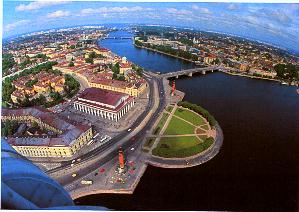
Petersburg | The Stock-Exchange embankment on the Neva River
<>1705:+; Bashkir steppes again animated by a movement to
promote Muslim grandeur
- A Bashkir leader declared self Holy Sultan. Visited Istanbul and got support of Caucasus peoples (EG: Chechens)
- Cossacks & Old-Ritualists joined with these
Bashkir insurgents
- Fortress outposts Ufa, Samara, etc. under siege. Islamic forces approached Kazan. Russia was occupied with the
Great Northern War
- Buddhist Kalmyks played an ambiguous role in this era
\\
*--Michael Khodarkovsky, Where two worlds met: the Russian state and the Kalmyk nomads, 1600-1771 [DK34.K14K48]
<>1707mr25:Russian decree against peasant serfs fleeing
their villages and obligations [DIR2:125 | DIR3:139]
- On military recruitment in villages [VSB,2:327-8]
- Peter endorsed the most severe serfdom in all of Europe, that found on the estates
where Germanic Baltic baronial power lorded over indigenous Estonian and Latvian villagers.
Peter sought to lure these colonial feudal lords away from Sweden or Poland [VSB,2:334]
- There is some reason to believe that Peter did not intend to build his new empire on
the basis of serf labor
- As the Great Northern War wound down, he sought to limit noble abuse of peasants [VSB,2:354]
- However, Petrine transformation required mobilization of limited resources,
especially as the demands of the Great Northern War pressed in on Russia,
and that forced harsh measures. Conditions worsened for serfs
<>1709je27:Russia, on the southern frontier (Ukraine), 200
miles SE from Kiev (!!) [g], near the city Poltava
| Russia delivered first decisive
military defeat to invading Swedish armies
- Swedish King Charles XII fled to Turkey
- Russian-Ukrainian relations with Cossacks strained
- Old ally of Russia, Cossack Ivan Mazepa, Hetman from 1687-1708, defected to Turkey
- So, Russian-Ottoman Turkish relationship heated up [VSB,2:330-6]
- Wasteful war of imperialist expansion was not settled for another 12 years
\\
*--Ukrainian encyclopedia entry on Mazepa [W]
*2017mr21:Независимая газета| "Порошенко назвал гетмана Мазепу настоящим символом Украины"
[E-TXT]
<>1710:English envoy Charles Whitworth described Peter [VSB,2:316].
Other first-hand accounts [321-6]
<>1711:London | "South Sea Co." was
chartered
- This corporation was capitalized with massive shareholding initiative
and governmental subsidies
- Managers of the company took the capital and
invested in whaling ships
- Over the next half century, they failed as whalers,
but they did help extend British imperial authority over the globe
- Huge mercantilist overseas corporate organizational design did not seem to suit the
needs of the whaling industry, here at the dawn of the age of energy politics
- However, the corporation was to play some role in the international struggle for
dominance in the whale-oil era
<>1711fe22:Russian tsar Peter I issued a short ukaz =
"WE appoint the governing Senate to administer in OUR absence"
[VSB,2:336-7 | Russian TXT PiB 11,1:100 |
DIR3:15]
*--Tsar Peter just then set off to the south, deep within Russian territory, on a campaign against
the so-far very successful invading armies of the powerful early-modern "Western" monarch, Swedish King
Charles XII, who was now teamed up against Russia with a new Ottoman Turkish ally
<>1713:1714; Kuril Islands (stretching out to sea from the southern tip
of the Kamchatka Peninsula toward the NE corner of the Japanese island Hokkaido
[g]) explored by Russian adventurers. They made land
fall on Sakhalin Island
[Sansom,WWJ:212]
<>1713:Russian political-economist Fedor Saltykov wrote
Propozitsii
[Proposition]
- 1714:Saltykov followed with Iz"iavleniia pribytochnye gosudarstvu [Profitable
Testimony to the State]
- Saltykov was alert to the benefits England reaped from its mercantilist and imperialist policies
- He urged Russia to develop its southern and eastern markets and take advantage of its Eurasian location
- Russia was earlier the target of one of the earliest examples of organized
mercantilist aggression [ID]
- Now Saltykov recommended that Russia itself take charge of that eastward mercantilist mission
- Very little could be done to realize Saltykov's recommendations
- Petrine "domestic" economic development of manufactures
bore some resemblance to mercantilist corporatism
- But Russian international economic development did not take the mercantilist turn until after
the Russian trans-Pacific discovery of Alaska
- Then the Russian-America Co. was created, an overseas mercantilist
corporation for exploitation of imperial dominions.
<>1714:Saint Petersburg | Peter I decrees on
building of new capital [BL&T:16]
<>1714fe14:By decree, Peter I made education
compulsory for the Russian nobility [DIR3:15]
- 1714mr23:Decree on primogeniture [DIR3:16].
Owners of heritable property in land had to pass
it on to a single heir designated by the owner
- In other words, Peter sought to bring an end to ruinous inheritance
practices among landed gentry
- Traditional practices divided estates among all
heirs, slowly whittling them down below a size that could support the Russian
social elite, the nobility
- Inheritance by the oldest son (rarely, but sometimes, the oldest daughter) is called
"primogeniture"
- This practice was common among European landed elites
- But it was extremely rare in the Russian tradition [EG], at least until tsar Peter I
- Peter sought also to encourage "second sons" ( or daughters, for that matter) to seek their fortune elsewhere than
on the rural estate, perhaps in the technical fields and other useful pursuits so much needed in a modernizing Russian empire
(e.g., navigation [DIR3:18])
- 1715fa:1716wi; Peter corresponded with his own reluctant son Son Aleksei, calling
on him to step up to his responsibilities as heir apparent
- As Peter prepared a new round of extensive national transformation, he asked Aleksei to show more effort to learn
martial and other arts and skills necessary for a monarch in a time of thoroughgoing modernization
- Aleksei continued to drag his feet. In late 1716, as the Great Northern War with Sweden dragged on, and while Peter was
involved in his second European tour, Aleksei fled abroad to Austria [DIR3:24-28]
- Petrine transformation, something of a "revolution from above",
reached into the Russian social structure, but no clear Petrine economic policy
yet emerged, aside from those designed to meet the pressing contingencies of war
<>1716fe:1717oc; tsar Peter I made his
second European tour (CF=first great trip abroad)
*--Tour lasted one year and nine months! That's a long time for an early modern absolute monarch to be
away from the homeland throne
*--The first months were in German-speaking central Europe, the winter of
1716-1717 in The Netherlands and Belgium, and the spring in France
*--The "Aleksei crisis" drew Peter back from western Europe
\\
*2017je22:Novaia gazeta | "Пётр Первый в розлив из бочки. В Бельгии отпраздновали трехсотую годовщину великого посольства
Петра Первого в Европу [E-TXT]
*2017:Russia Beyond | "The first Romanov political exile: How Peter the Great's son fled Russia"
[
E-TXT]
<>1716:London | John Perry published The State of Russia under the Present Czar[sic]
covering events and personalities between 1689-1712, including information on the Volga-Don Canal
project [W-TXT | Excerpts = VSB,2:316-20 | RRC2]
<>1717:Russian Vice-Chancellor (high diplomatic post)
Petr Shafirov, who was a close confidant of Peter I, published Discourse Concerning the
First Causes of the War between Sweden and Russia [DK136.S45+1]
<>1717de11:tsar
Peter I, fresh from his second European tour, decreed new imperial
administrative institutional reforms [VSB,2:337-8]
- Peter restructured Muscovite Russian government under nine colleges
- "Colleges" in this case meant something like "ministries"
- Peter was taking steps toward creation of a systematic definition of governmental
functions and distribution of responsibilities out to various appropriate departments
- With this project Peter moved systematically beyond the institutional reforms of
his father tsar Aleksei Mikhailovich [ID]
- The colleges were =
- Foreign Affairs
- State Revenues
- Justice
- State Accounting
- Military
- Admiralty
- Commerce
- State Expenses
- Mines and Manufacture
- Detailed webpage
<>1718je:Tsar Peter I authorized (and probably took part in) torture and
death of his son Aleksei [DIR2:25-30 |
DIR3:28-33 | More correspondence of Peter and
Aleksei, etc.= VSB,2:338-41]
- A Russian folk legend had it that son Aleksei died when he failed to respond
properly to Peter's efforts to make him an accomplished ship carpenter =
- Peter wanted him to continue the building of wooden ships for Russia, so
said this folk legend
- But this was not his talent
- He just couldn't get the beams square
- In a rage, Peter broke his skull with a hammer
- Of course, the legend is not "accurate"
- But at some level of cultural significance, it was right on the mark
\\
*--Nikolai
Ge's painting of Peter I interrogating his son Aleksei
*--Bushkovitch:339-426
*--Dmitrii Merezhkovskii’s novel Peter and Alexis [PG3467.M4+K513]
<>1718:Neva River-Volga River canal project which
stretched along the banks of Lake Ladoga [g] (begun in 1702), moved into final phase
*--Menshikov was put in charge with the usual meager results
*--After 1721, the project was handed over to Burkhard von Münnich.
He completed the task, but not until after Peter's death
<>1719de10:Peter I issued decree on College of
Mining
*--Others followed in which the state chartered private enterprise in
heavy industrial sector
[VSB,2:354-5 and 357-8]
*--Economic as well as institutional modernization were
all a part of the Petrine plan, but every action was under the pressure of
war-time crisis
*--As the Great Northern War wound down, the
Petrine
transformation was able to extend its reach into neglected areas of
"civilian" or non-military need
\\
*--Hughes:135-59
*--Florinsky,1(13) deals with the war and the economy
under Peter
*--Raeff:89-92 summarizes Peter I's economic policies
<>1720:1722; Siberia, SE slopes of the Ural
Mountains, at edge of Bashkir steppes | Governmental official, Vasilii Tatishchev, founded & directed factories and mines
- Tatishchev set up Uktusskii zavod [factory], moved it to site of future Ekaterinburg, a frontier fortress
city [g]
- Delegated merchants to the tasks of establishing a market and building roads
- Established two mining schools and legal courts
- Introduced regulations on forestry
- 1721ja18:Decree authorized factories to buy villages of serfs [DIR3:18]
- 1720:Bashkir people signed treaty with Russia
- Bashkirs still independent, but must repatriate (send back) all Russians who flee into Bashkir
lands & accept no more refugees
- Over the next 2 years, 4965 families (ca.20,000
persons) were sent back to Russia [Russian BrE]
- Tatishchev clashed with the entrepreneur Nikita Demidov on the question of what role the
state should play in the frontier economy
- Demidov depended on Peter's royal favor to get his start, but wished thereafter to operate
without restraint
- Tatishchev wished to impose state regulations on free-wheeling exploitation of the regions natural resources
and labor
- Genik was sent from Saint Petersburg to settle the dispute and found in Tatishchev’s favor
- By the middle of the 18th century, the Demidov factories produced 40% of all
Russia's iron. Western Siberia was becoming a vital
component of Russian national economic security
- Something like a coherent Petrine economic policy was
emerging
- The following persons were leading supporters of mercantilist
policy in Russia's Eastward expansion, following after Tatishchev =
Ostermann,A.I.
Sukin,FI(Ober-scy SNT)
Nepliuev,I.I.
Also industrialists and merchants =
Bazhenov,F.I.
Korzhavin,V.N.
Tverdyshev,I.B.
\\
*--MERSH,9:46-54
*--Hugh Hudson, Jr., Rise of the Demidov Family and the Russian Iron Industry in the Eighteenth Century (1986)
*--Thomas Owen,Russian Corporate Capitalism [HC335.O83+1], chapter 3: "Corporations in the Russian Empire,
1700-1914" (pp. 16-49)
<>1720:Saint Petersburg described [BL&T:17-18]
<>1720fe28:tsar Peter I issued the
General
Regulation which reformed government procedure
*--Peter denied himself and his
Senate the authority to issue verbal laws
*--Only written laws
would henceforward be recognized as legitimate
<>1721:Siberian port city Okhotsk
[g] was the point of departure for a Russian expedition to find
Japan via Kuril Islands [SHJ, 3:202]
*--In these years, 1719-1721, Ivan Evreinov and F. Luzhin completed a geological
and cartographic exploration of Kamchatka and the Kuril islands at the furthest
NE extreme of Siberia
<>1721ja16:Peter I decree on municipal administration
[VSB,2:346 and 355-7]
*--This reform built on early efforts that had slackened during wartime
*--Peter returned again to this important institutional/administrative project again before his death
<>1721ja25:Peter I issued "The Spiritual
Regulation" for the administration of the Russian Orthodox Church [KM.S759 | Excerpts =
VSB,2:370-1 | KRR:334-6 | DIR3:34-42]
- The Holy Synod was created to assume the role of bureaucratic administration over the Church
- 1723:1729; Thomas Consett described the present state and regulations of the Church of Russia, For God and
Peter the Great: The Works of Thomas Consett... [DK129.P73+1]
- "The Spiritual Regulation" might be taken to mark the end of the first
epoch (1632-1721) of the Raskol [Schism]
- Old-Ritualist alarm peaked in this time
- "The Spiritual Regulation" reinforced the fears of many traditional Russian believers
that Satan and the Anti-Christ were subverting the True Faith
- To their way of thinking, the diabolical nature of the Petrine transformation was amply confirmed by the
astonishing, bigger-than-life person of tsar Peter I himself
- For Russia there would be almost two centuries of ruinous cultural fissure, pitting supposed spiritual traditionalists
against evident secularist modernizers
- No further significant legislative action was to be taken with respect to the Orthodox Church until after the fall of
the Romanov Dynasty and the establishment of Soviet power =
- On the one hand. the Patriarchate was restored after the Soviet Revolution
- On the other hand, the Petrine secularist legacy (to speak colloquially=) was put on
steroids [ID]
- Russia had long ago experienced the first jolts of reasonably
standard pan-European varieties of modern secularization
- In the two centuries to come, secularization was the most volatile of the intellectual
characteristics of what is so often called "Westernization"
\\
*--Hughes:332-57 (on religion under Peter I)
*--Florovsky,5:116-22
*--Raeff:123-30 summarizes church history, 1682-1825
*--Florinsky,1(15) deals with school and church
*--Serge Bolshakov, Russian Nonconformity: The Story of Unofficial Religion in Russia
*--James Cracraft, The Church Reform of Peter the Great
*--John Shelton Curtiss, Church and State in Russia: The Last Years of the Empire, 1900-1917 (NYC:1940)
*--Gregory L. Freeze, The Parish Clergy in Nineteenth-Century Russia: Crisis, Reform, Counter-Reform (Princeton:1983)
<>1721au20:Sweden and Russia ended the "Great
Northern War" with Nystadt Treaty [VSB,2:342|
ORW:11]
- The war was over, but the bills were not yet fully paid. Heavy war-time
taxation continued to be a burden [VSB,2:345-53]
- Sweden lost its bid for status as world power
- Russian imperialist and frontier expansion, for
two decades bogged down in the west and for the time being stymied in
the south, made slow recovery in the east
<>1721oc22:Petersburg Trinity Cathedral | Russia commenced formal
celebration of the Nystadt Treaty and victory over Sweden
- STRICTLY SPEAKING, THIS WAS THE BEGINNING OF RUSSIAN IMPERIAL HISTORY =
- Senate bestowed on tsar Peter I the titles "Emperor", "the Great" and "Father of
the Fatherland" [VSB,2:342-3]
- Peter delivered his carefully composed and broadly significant statement of
thanks to the nation
- He warned against complacency after victory. Byzantium fell for that reason
- Russia must now move beyond those praiseworthy accomplishments that brought military victory
- Russia must now take up those areas of need neglected in time of war
- Peter outlined a comprehensive plan for post-war transformation of Russian institutional and social life in the
direction of relief for the people and quickening of broad economic ties with other nations, a goal he summarized
as "utility and gain for all" [pol'za i pribytok obshchii] [N.A.Voskresenskii, Zakonodatel'nye akty...:213-14]
- This statement was widely distributed throughout Europe
- He clearly wanted the wider world to know that he projected a great time of change
ahead, perhaps greater in ambition than anything before
- Peter had only four more years of life after 21 years of wasteful war
<>1722:Russian theologian and imperial political advisor
Feofan
Prokopovich, "Sermon on Royal Authority.... [Raeff3:14-30 |
VSB,2:342-3]
- Peter the Great's reforms brought the Russian Orthodox Church under direct state administration,
in imitation of certain northern European trends
- Peter reached far beyond anything implied in the Byzantine concept of church-state symphonia
- Peter's church policy directly contradicted Pope Gelasius's "Letter" which
sought twelve-hundred years earlier to distinguish sharply between the
institutions of church and state
- 1725:Prokopovich's sermon at funeral of Peter I
\\
*--Florovsky,5:122-48 presents harsh portrait of
Prokopovich and his legacy in Russian spiritual life
<>1722ja24:Systematic categories of state service
set by a formal, institutional Table of Ranks [VSB,2:328-9 |
DSD,2:4-14 | KRR:228-9 |
DSD,1:4-14 | DIR2:17-19 |
DIR3:19] =
- civilian
- military
- church
- royal court
- Peter strove to open service careers to people of talent and ability, rather
than birth status
- His Table of Ranks, by implication, established a new rational system for rewarding talent (as
exercised within state service)
- It linked successful and talented state service with social status
- But Peter failed to disassemble the old soslovie system with its
recognizable European feudal hierarchical compartmentalization =
- clergy
- aristocracy
- merchants
- petty-burghers
- peasants
- Thus he created a tense and contradictory relationship between inherited social estates
[sosloviia or "natal" identity (ID)] and civil service rank
("assigned" and skill-based identity)
- The service hierarchy set by the Table of Ranks introduced new tensions and contradictions
into an already compromised social hierarchy
- Peter's Table-of-Ranks reform extended the trends earlier embodied in the rise and fall of the tsarist system
of "mestnichestvo" [ID], but still Peter's reforms were a jolt
- From the time of Peter I, the Russian social hierarchy (singular) was transformed into a clumsy amalgamated stack
of hierarchies (plural) =
- Soslovie and the Table of Ranks chafed against one another as a new era of "social/service hierarchies"
moved forward
- And while Peter I tried to open things up so that talent could thrive, he refused to grant any broader
or spontaneous opening in the bureaucratic and stiffly enforced social/service hierarchies
- Forty years after the Table of Ranks was put in place, Peter III and then Catherine II addressed
one of the sources of tension within the ranks of the noble soslovie, the plight of the
two-tiered medieval social formation of aristocratic elites, but with limited success
- The dysfunctional amalgam of natal and assigned identity shaped Russian political and social
history to the very end of the Russian old regime [EG]
- Tensions within social/service hierarchies continued
- Contradiction between "insider advantage" and "careers open to talent" was palpable in the lives of many
- One outstanding example of Petrine "egalitarianism" was the career of
Petr Shafirov, the son of a commoner, a converted Jew
- Shafirov met Peter I in the famous "German [foreign] quarter" of Moscow
- In his early years, Peter met many in the "German quarter" who later became close advisers
and powerful figures in his reign (EG=Menshikov)
- Some were "Russian", some were not. That distinction was not very important to Peter
- Peter sought ability and experience with very little regard for the quintessential feudal
social distinctions. He was an imperial monarch, not an old feudal or newer nationalistic monarch
- Shafirov joined Peter on the Grand Embassy [ID] as a trained and
talented diplomatic translator
- He rose quickly to become Privy Secretary to Peter, then Director of the Foreign Office, then Vice-Chancellor with the noble
title "Baron"
- Shafirov was an epitome of those who flourished in the Petrine social/service heirarchy
- In 1722, Shafirov was condemned to death by beheading after his old
associate Menshikov accused him of corruption
[in a classic example of the pot calling the kettle black!]
- In the end, Shafirov was sent to Siberia rather than to the scaffold
- As the Great Northern War came to an end, and as Peter turned his energies again to neglected "civilian"
projects [ID], the Petrine transformation took on new life
- But popular reaction intensified
\\
*--Hughes:159-203
*--Raeff:103-122 summarizes social history, 1682-1825
*--Kliuchevskii,4:101-2
<>1723:1727; Frenchmen
Bernard Picart and Jean Frederic Bernard produced the massive 7-folio-volume
Religious Ceremonies of the World...
- The publication was the very model of Enlightenment insistence on rational
and tolerant approaches to the vast and diverse phenomenon religion
- It did not limit itself to the dominant local faiths, Catholicism and Protestantism
- In an unusually even-handed fashion, it explored specific diversities among the
whole world's prominent "established" religions
- But it also hinted at an anthropological uniformity which underpinned this rich
and altogether human diversity
\\
*--Lynn Hunt, Margaret C. Jacob and Wijnand Mijnhardt, The Book that Changed Europe
*--LOOP on Protestant Reformation
<>1724:Russian political-economist and state servitor
(of peasant origins) Ivan Pososhkov (1652-1726) wrote a critical analysis of Russian problems and
submitted it to Peter I = Book on Poverty and Wealth [HN523.K56613+1] (written a half-century before Adam
Smith's Wealth of Nations but not published until 1842) [Excerpts =
VSB,2:326-7 and 358-61 | KRR:312-18 |
DIR2:31-6 | DIR3:42-49]
- Pososhkov's book criticized raw mercantilist policy
- It does not appear that Peter ever saw Pososhkov's book. The Emperor died in the next year
- Pososhkov himself was arrested and, in 1726, died in the Peter-Paul Fortress prison
- There was much for Pososhkov to criticize, though his criticism was intended to be constructive
\\
A challenging analysis of Pososhkov = [
E-TXT]. See especially pp. 541-553. The author's intention is to place Pososhkov in two contexts =
- Russian intellectual/religious history, with reference especially to Domostroi
[ID] and the Old-Ritualist movement, and
- The west European Reformation, especially Puritanism and the rise of economic modernization
("capitalism", as seen by the widely influential early-20th c. sociologist Max Weber
[ID])
<>Peter's economic policies in two decades of mercantilist war exhausted Russia
- Near constant warfare against a more advanced economy (Sweden) inspired the need for Russian
economic reform, and it shaped the developing Russian economy to the needs of survival in the
emerging modern imperialist European world
- Somewhere between 75% and 80% of all Russian government revenue was spent on war
- Taxes rose 100% between 1682 and the outbreak of the Great Northern War with Sweden
- By the way, the war also broke the back of earlier powerful and mercantilist Sweden;
it would not regain its dominant position in northern Protestant Europe
- 1724:After a seven-year effort to gather population figures -- a primitive census, and a series
of "revisions" of those early faulty efforts -- Peter introduced the Poll Tax [podushnaia podat',
a "head tax"]
- Poll tax is the most "regressive" of all taxes, levied equally on members of the Imperial lower
or "non-privileged" sosloviia [formal social estates] without regard for ability to pay
- The tax was extracted from all male adult peasant "souls", as they were named in the legislation
[a term that shocked Pososhkov]
- Clergy, nobility and merchants -- the privileged sosloviia [ID] -- were exempted
from the Poll Tax
- On the basis of the Poll Tax, state revenue jumped to nearly six times the revenue collected in 1680
- Service egalitarianism was easily subverted by the claims of social privilege and exemption
- The Empire moved toward funding itself out of the hides of the poorest social strata, a
characteristic of all "non-progressive" taxations
- Thus serious contradictions were embedded in Peter's reform of the Russian imperial
social/service hierarchies
- Nonetheless, serious developments in the direction of European economic modernization got under way =
- Canals were dug, opening up regions to internal maritime transport
- Mining industry got its start, and iron mills began production
- In 1695, there were 17 iron works in Muscovy
- At Peter's death, there were 52
- Thirteen of these were in the Urals, an indication of the importance of frontier expansion
to modernization policies [EG]
- At this time, coal production equaled that of England and iron production was greater
- By the reign of Catherine the Great, four decades after Peter's death, Russia was the world leader in
coal production
- Foreign trade increased four-fold and exhibited a great favorable balance
- But much of this was made possible by a military procurement system which emphasized state budgeting, state
purchase of production, largely military in application, and outright state ownership of productive enterprises
- Peter laid the foundations of a modernizing industrial economy, but he did so in the form of military mobilization
- Modernization under Peter was largely for weapons, naval fittings, sails and uniforms
- Between 200 and 300 industries were established in Peter's time, and 43% of them were owned by the government
- The workforce was pressed into even more severe conditions of unfree labor, of serfdom
- A weak glimmering of a coherent Petrine economic policy can be seen in the final ten years
of his reign, but little was firmly accomplished here at the heart of the great "riddle of backwardness"
- Here at this time and place, the world was introduced to what was to become a central feature of global history
\\
*--Hughes:63-92 (on Peter's military/industrial policies)
*--Blum:463-8 describes the notorious Petrine "soul tax"
*--Blum:277-307 (general survey of economic development from Peter I to Alexander II)
*--Alexander Gerschenkron, in Economic Backwardness...:17 (a chapter
written in 1952) [HC335.G386], defined a "peculiar series of sequences" which seemed to characterize every subsequent
attempt to modernize the Russian economy, and he placed this series in a significant global context =
- The state, moved by military needs, assumed the role of propelling agent of economic progress
- Therefore, economic development was always linked to military needs. Economic development mirrored
the irregular rhythms of war rather than the smoother pace of productive and distributive growth. Economic
policy vibrated between panicked wartime crisis and peacetime torpor
- Movement in fits and starts meant that great economic burdens were placed on the unfortunate generation
which had to "modernize" to support the military needs of their time
- In order to assure that this unfortunate generation responded properly to these
state needs, severe measures of oppression were necessary to prevent shirking or
escape
- The long periods of stagnation between military needs were made even deeper and more
abysmal since the sacrifices of the crisis period were always so devastating
- Gerschenkron doesn't mention it, but it might also be said that this "peculiar series of
sequences" suppressed the evolution of a spontaneous cooperation and exchange between
state, society and the economy (what some call "civil society" [ID])
and promoted the evolution of social atomization, isolation, and hostility. Especially this last
deficiency inspired Ivan Pososhkov's remarkable analysis [above]
<>1725:Bashkir lands contained state
zavody
[factories] worked by 5422 male serfs. Russia exploited
Bashkir steppes in support of economic modernization
<>1725:Russian Imperial Academy of Sciences founded after Peter’s death, but
on a plan he ordered [VSB,2:368-9 | DIR2:19-20 |
DIR3:21-2 |BL&T:108]
- Here too the Petrine transformation was "top heavy" = There would be a Russian Academy
of Sciences, but there was no Russian university or even elementary school
- 1660s, sixty-five years earlier, the English Royal Society was created, today the oldest continuous "academy of sciences" in the world.
Independent of church or university administration, and without building on any form of national educational system,
an "invisible college" of natural philosophers, hardly less "top heavy" than
the later Russian Academy, began meeting to discuss the new philosophy of promoting knowledge of
the natural world through observation and experiment, which we now call science. The Royal Society's very moderenist motto
was "Nullius in verba", roughly translated as "take nobody's word for it" [CF=Francis Bacon | CF=Bazarov]. It is a
very modernist expression of the determination of
Fellows to withstand the domination of authority and to verify all statements by an appeal to facts determined
by experiment, one of the essential foundations of modern notions of "science"
[W]
\\
*--Hughes:298-332 (on education)
<>1725ja28:1762je28; Russia entered a 37-year ERA BETWEEN "GREATS"
from the death of Emperor Peter I "the Great" until Empress Catherine II "the Great"
<>1726fe08: Supreme Privy Council [Verkhovnyi
tainyi sovet] for a short while became the central autocratic authority [VSB,2:377]
- Prince Dmitrii Golitsyn (1665:1737)
was a major figure in the new Council
- Educated in Italy, he served as an ambassador to Turkey in 1701
- Between 1711 and 1721, he was governor of the Kievan region (and drew close to the scholarly monks at the
spiritual academy there)
- He was extremely learned, having amassed a personal library of over 6000 books
- From 1722 he was a prominent figure in the Petrine Senate (representing a small faction of
progressive-minded old boyar nobles)
- At the death of Peter I, he conspired without success to bring the infant son (also named Peter) to the throne, with
the mother, Catherine and the Senate acting as regents
- A.D. Menshikov joined Golitsyn in the Supreme Privy Council, even though he was a quintessential
representative of the new Petrine service elite and in stark contrast to Golitsyn
- Legend had it that Peter met Menshikov in Moscow in the time of their youth. Menshikov
was a footloose waif who sold pies on Moscow streets
- He was a hell-raiser, and that suited Peter exactly. Menshikov in a sense never left Peter's side
- Peter appointed him to various high and responsible posts, but he was a notorious
thief, embezzler and organized crook
- Many times Peter had to slap him down. Once Peter fined him half his whole fortune, which had grown immense through
procurement fraud (e.g., pocketing half the budget for military uniforms)
- Still he remained a millionaire and always able to work his way back from exile into Peter's favor
- Now he conspired with success to have Catherine crowned Empress
- This success prevented a new ascendancy of Dmitrii Golitsyn and
his associates who promoted Peter's infant son as Emperor
- In this Menshikov was supported by certain officers ready to use force if they did not get their way
- The Council thus combined an unlikely team of old and new elites, with their base in the Senate but with no
desire to elevate the Senate to a central position
- On the contrary, they preferred an irregular institution through which they could wield personal influence
- And Catherine, a serious alcoholic and in all other ways unsuited to the
responsibilities of rule, presented them no obstacle
- They sought to reverse certain Petrine reforms, to build down some of the unwieldy Petrine
institutions
- However, they did not want to end the reforms altogether = Continue the modernization, but at a slower
pace, an elitist "Senatorial" pace
- The Petrine transformation, now nearly thirty years under way, was in
for some hard years, but the Supreme Privy Council did not last long
\\
*--Hughes:416-45 (on Menshikov and other "new men" elevated to positions under
Peter I); 445-71 (legacy of Peter I)
*--Isabella De Madariaga, Politics and Culture in Eighteenth-century Russia:57-77 [DK127.D4+1]
on Dmitrii Golitsyn
*--Bushkovitch:426:45 (summary of Peter's reign)
<>1727:Siberia | Kiakhta Treaty between Russia and China
continued cooperative relations among these two powers on the Siberian frontier
- In this same year, China moved with vigor on its own southern frontier =
- 1727:TIBET in grip of struggle between secular and
religious authorities
- The Chinese Emperor imposed his military authority over region
- *1764:Dublin. John Bell's travel account describes some of these events [excerpt in Lensen,Eastward:49-51]
<>1728:Moscow | Bashkir delegation led by Yarnei Yanchurin
*--Bashkir steppe brought under more regular Russian administration when Ufa guberniia was separated from Kazan
*--Ufa region called "provintsiia" under authority of Senate
*--Population there not required to render military service
<>1730ja19:Russian Senatorial party, led by
Dmitrii Golitsyn, imposed "Conditions" on Empress Anna [TXT]
[Raeff2:44-52 | VSB,2:378 |
DIR2:36-43
| DIR3:49-56]
- The Conditions imposed the following restrictions on Anna's power. Each prohibition implied a concluding phrase
"...on her own arbitrary authority" =
1. Not to start war with anyone
2. Not to conclude peace
3. Not to burden loyal subjects with new taxes
4a. Not to promote individuals to the sixth or higher rungs of the Table of Ranks, and
4b. To hand over command of Guard and other elite regiments to the Supreme Privy Council
5. Not to deprive nobles of life, property or honor without trial
6. Not to grant patrimonial estates [votchiny] and villages [in serf bondage]
7. Not to promote individuals to court service positions
8. Not to spend state revenue
- 1730fe28:1740; Russian Empress Anna
might have been presumed weak by Golitsyn and his associates because she was
a woman. But when Anna assumed the throne, tore up "Conditions", abolished the
Supreme Privy Council, restored the Governing
Senate, and decreed autocracy restored. She reigned for ten years
- Favorites Ernests Johans Bîrens [Latvian-born; Russian= Biron], Ostermann
[Russian= Osterman], &
Münnich [Russian= Mennikh] were much resented
among Russian noble elite
- [In the secondary west-European historical literature, their names are
usually spelled in the non-Russian way to emphasize their foreign family
roots. Sac does that too
- These favorites of Anna made some Russians nostalgic for Golitsyn and Menshikov.
Menshikov's long career as Peter's graft ridden crony was now
ameliorated in some minds by the fact that he was, after all, "Russian" and he did represent the
Petrine legacy which was evaporating altogether in an era of national slump and opportunistic
"foreign" elitism
- Yet it wasn't that simple. A further factional division widened between those, like Golitsyn,
who represented the civilian face of the Petrine legacy, and those, like Münnich,
who represented the military face
- Anna introduced many measures to ease the plight of grandee nobles (without much
improving the status of rural gentry) [VSB,2:378-81]
Some historians like to think of this as a rebirth of the Russian nobility
after decades of decline into a subordinate service condition. But the
statist quality of this "noble renaissance" is suggested by the following =
- 1736,
Dmitrii Golitsyn was arrested for malfeasance in office. In prison he soon died. His
great library was confiscated and parceled out
- Russian statesman V.N. Tatishchev published "...Assembled Russian Nobility about the State
Government" [DSD,1:15-27]
\\
*--Florinsky,1(16) deals with the eras of Empresses Anna and Elizabeth
*--Miner Curtis, A Forgotten Empress: Anna Ivanovna and Her Era, 1730-1740 NYC:1974
*--Philip Longworth, Autocracy and Aristocracy: The Russian Service Elite of 1730
<>1730:Bashkir lands in western Siberian
steppes [g] administered by A.P. Volynskii who opposed the idea of an independent
territory. He was antagonistic toward the Muslim faith, but his concept was at heart imperialist rather than
religious. He built more fortresses, refurbished old. Mapped the region. Exploited Bashkir
territory, claiming the right of a superior civilization over the civilization of Islamic "infidels"
\\
*--Michael Khodarkovsky, Russia's Steppe Frontier: The Making of a Colonial Empire, 1500-1800 [DK43.K485]
<>1730c:Siberia, Kamchatka Peninsula [g] |
Russian Academy of Sciences explorer Stepan Krasheninnikov described indigenous rebellion observed during the
first Kamchatka expedition [Lensen,Eastward:30-3]
*--Stepan Krasheninikov, Explorations of Kamchatka, North Pacific scimitar; report of a journey made to
explore eastern Siberia in 1735-1741, by order of the Russian Imperial Government [DK771.K2K813+1]
*1731:1733; Ivan Kirilov organized second Kamchatka expedition, revived Petrine mercantilist concept. Closer to home =
*1731:Petersburg-Lake Ladoga canal, started by Peter I, was finally completed
<>1732:Russian government ordered Vitus
Bering to explore Siberian waters for Japan
*--It was made clear that Asia terminated in the far NE at the shores of the
straits now called "Bering Straits" [DIR3:143-7]
<>1734:1737; Siberia, southern Ural Mountains
[g] | Vasilii Tatishchev was dispatched to create
more zavody [factory strong points]
- Tatishchev used his authority with much success to restrict zavody run by individual "entrepreneurs"
- The mercantilist state needed metals from these mines and found
it best if it ran the mines and zavody itself
- Administration of yasak [tax tribute] was shifted from yasak officials to Bashkir elders
- 1734:Siberia, southern Ural Mountains| The
creation of the Orenburg expedition extended Russian power further into Bashkir lands
- Ivan Kirilov led the expedition [Demikova,NF in SIE,10:608 lists no particular scholar
attached to this expedition]
- Orenburg is situated at the confluence of Ori & Ural rivers [g]
- Orenburg received many exemptions from usual imperial restrictions. Other
nationalities could live there. Christians, Muslims and other faiths were not excluded
- These fortress settlements were to serve as strong points and retreats for Cossack,
Kalmyk and other allies in the struggle against the Kazakh Tatars [the Kirghiz-Kaisets] who
roamed the region from the Altai highlands to Bukhara south of the Aral Sea
- This was an era of near constant war with the Bashkirs, but also a time of growing contact with
them
- Bashkirs no longer sought to create Islamic unity in their regions, but they still feared
for their land
- All Russian concessions, including a degree of Bashkir self-government, left the
land question open. Indeed the land surrounding Orenburg was taken from them
- Russian factories spread into the Ekaterinburg region. All forests fell under imperial
control
- The official Russian goal may have been trade, but the military ways
continued from the Peter-I era and influenced Russian behavior
- Bashkirs were put on an oppositional footing
- 1735:1736; Bashkir leader il'miak-Abyz led a rebellion in an effort
to protect Bashkir lands from Russian expansion
- Aleksandr Rumiantsev was sent to put down the rebellion with Russian troops mustered from
Perm and other Siberian factories under Tatishchev's management
- 1736:The rebellion was crushed. The lands of rebels were taken
- Other native peoples who had not rebelled were invited to share in the spoils, e.g., the Meshcheriaki who
had earlier rented lands from the Bashkirs and now were offered these lands as their own
- An unusual phenomenon in the history of European colonial/imperialist
expansion developed here on the steppes =
- In the west of Europe, many states were at the beginning of two contradictory phases =
(1) a "progressive" phase in domestic politics and
(2) a regressive phase in foreign politics - As liberal ideas and movements entered European
political culture at home, imperialistic projection of exploitative
economic, administrative and militaristic dominion spread from European
homelands out into the wider world [EG]
- But for the Russian Empire, imperialist rule beyond "Russia" was a lot like Russian imperialist rule in Russia itself =
- Out on the Siberian steppes, those who came over to the Russian side and
made pioneers of themselves, living along the line of Russian forts that
stretched ever eastward and southward into Siberia and the dry prairies of the
lower Volga drainage, were officially designated "peasants"
- This was the bottom of the formal imperial social/service hierarchies, but it was a form of
social generosity unusual among European colonial powers in their dealings with
indigenous peoples
- The door was left open for Bashkirs to accept a similar offer
<>1736:Persian (Iranian) Safavid dynasty at an end
<>1736ap25:Russian decree against fleeing peasant
serfs [DIR2:125-6
| DIR3:140]
<>1737:Siberian Department established
by the Russian state to administer
imperialist expansion to the Pacific Ocean
*--Bering and Steller charted the
northern Siberian coastline
<>1737ap14:Siberia, Orenburg | Kirilov dismissed. Later directors of the Orenburg Expedition in
Bashkir
territory =
*1737:1739; Vasilii Tatishchev
*1739:1742; V.A. Urusov [noBrE]
*1742:1744; I.I. Nepliuev (44:60; Governor)
<>1738:Russian ballet school founded in Petersburg
<>1738:Bering's first expedition into Siberian waters in search of Japan.
It was slow going, but then =
- 1739je27:Japan, Amatsu village, Awa Province (Chiba Prefecture) | Second expedition
of Vitus Bering disembarked from its Siberian port, led by Martin Petrovich Spanberg (Danish
by birth), William Walton, and Aleksei Il'ich Chirikov
- They located Japan & went ashore briefly
- Spanberg, Walton & Chirikov reported, but they were not believed back home
- The expedition was sighted by the
Japanese off Shimoda (later one of USA
Commodore Matthew Perry's ports) [Sansom,WWJ:213]
- Behind and just out of sight of all this official exploration, an on-going unofficial Russian
contact had been established and kept up with the Ainu (indigenous peoples, now driven to
the northernmost extreme by Japanese frontier expansion in the Kuril Islands) &
with Japanese in Kurils [ibid:213]
\\
Lensen,Russian Push:50-5
<>1738:1739; Russia and
Ottoman Turkey at war, ending in the Treaty of Beograd [Serbia,
Belgrade]
*--Russia gained dominion over the northern Black Sea coastline
<>1741:1745; Lower reaches of the Volga River, at the
western edge of the Bashkir steppes, near Tsaritsyn (Volgograd; Stalingrad]
[g]) | Astrakhan
Governor Vasilii Tatishchev "pacified" Kalmyk people. Tatishchev was a
severe but able Siberian frontier administrator whose
career spanned
two decades
<>1741:1762;
Russian Empress Elizabeth
[Elizaveta] [VSB,2:381-8 | DIR2:44-50
| DIR3:57-63]
reigned for 21 years
- Another capable and powerful woman on the throne perhaps indirectly promoted women's
issues
- 1749se23:Maria Ivankova letter to her mother complained about family life [BRW:71f]
- 1750se29:Russian divorce decree [BRW:100f]
- Survey SAC chronology of her reign for indications of great imperialist expansion and cultural
accomplishment, a certain grandee splendor centered on the isolated "gated community"
of the capital city Petersburg, but perhaps deserving of
the label "Enlightened"
- A brilliant "aristocratic-servitor" high culture thrived = the origins of "Russian"
literature
\\
James F. Brennan, Enlightened Despotism in Russia: The Reign of Elisabeth, 1741-1762
(1987) [DK161.B74+1]
<>1741jy:Russian expedition
[lxt], commanded by Vitus Bering, made
Alaskan "new world" landing on small island within sight of Mt. St. Elias
- Two centuries of Siberian expansion
and ten years of exploration by Bering were now crowned by a remarkable
"discovery" of North America from Asia. The leap over the north Pacific opened a new era for
Siberia [MAP#1 |
MAP#2]
- On this expedition, naturalist Steller confirmed sighting New World
beyond Siberian waters, from northern Pacific. Presence there of a certain blue jay--now
called the Steller's Jay--reinforced his conclusion
- For the next 125 years, Russia and America both experienced new-world frontier
expansion. Alaska became the great Russian/American shared
imperialist/colonial adventure [ID]
\\
READINGS ON RUSSIAN/US PACIFIC RIM FRONTIER:
*--Decent narrative, with excellently clear maps and fine photos, describe Russia in the
New World [W]
*--Howard I. Kushner, Conflict on the Northwest Coast: American-Russian Rivalry in the
Pacific Northwest, 1790-1867. See ch.6:"The Oregon Question and Russian-America."
*--John J. Stephan & V. P. Chichkanov, eds., Soviet-American Horizons on the Pacific
*--Hector Chevigny, Russian America: The Great Alaskan Venture, 1741-1867
*--George V.Lantzeff and R. A. Pierce, Eastward to Empire: Exploration and Conquest on
the Russian Open Frontier to 1750
*--Glynn Barratt, Russian Shadows on the British Northwest Coast of North America,
1810-1890: A Study of Rejection of Defence Responsibilities (1983) F1088.B25
*--Foster Rhea Dulles, Russia and America: Pacific Neighbors (1946) 327.7347 D888r
*--Stuart Ramsay Tompkins, Alaska: Promyshlennik and Sourdough (1945)
*--S. B. Okun, The Russian American Company (Cambridge MA:1951)
*--Starr, ed., Russia's American Colony
Alaska: A shared frontier
1895:Alaska, Sitka | St. Michael's Russian Orthodox Church
[source]
<>1742ja02:Russian Senate issued decree
appointing missionaries to Kamchatka to convert the Kamchadal people to Orthodox
Christianity [DIR3:147-8]
*1742:Siberia, southern piedmont of the Ural Mountains | Orenburg fortress
moved to today's location where it quickly became the command center for Russian
SE military frontier and imperialist expansion
<>1744:ORN gbx fnd on basis of ORN.xpd. Nepliuev,IvIv (x.ORN.xpd
dtr) now 1st gbxor. Main authority over BSH & KZX [KIR] steppe. Nepliuev sought mfg
& skz clnists "no pri etom on vstreqal prepyatstviya, gluboko korenivwiyasya v
togdawnem obwwestvennom i gosudarstvennom stroe Rossii. Kolonizatsiya rus. okrain vsegda
wla pomimo pravitel'stva i daje v razrez s ustanovlennymi im poryadkami....". clnists
usually were "gulyawwie lyudi" IE:fugitives, beglye frm srfom txx mlt.srv &
rlg. gbxor cldn't condone this. SO 1st sought friendly TTR or Xtx.Kalmyks. KZN TTR~ better
bcs of INX in trd. Built water mills, cotton & plant soroqinskoe pweno. cldn't attract
RUS (merchant)--too bdn, but also RUS grd.pbl buduqi obyazany otpravlyat' raznye
povinnosti i slujby, kotorye oni nesli vsem mirom, vsyaqeski protivilis' vyxodu iz sredy
svoei soqlenov, tak kak vyxodom odnix neminuemo uveliqivalis' tyagoty ostal'nyx. ?Parallel
w krp in oxo?. gtx more sig., but "eto byli elementy, ves'ma maloprigodnye dlya
vneseniya v dikii krai naqal grajdanstvennosti i promywlennosti" [?very best?
Australia?] Ttw wanted to welcome fugitives but not allowed to do so; only UKR fugitives
allowed but 1742:SPB TSR ElizPetr stopped acceptance of UKR fugitives [BrE, 5:228??]
<>1746ja13:Ukz motivated by Nepliuev=All nepomnyawwix rodstva &
gnt allowed gt.ORN to rcv lnd & 3y xmt frm txx & mlt.srv. Nepliuev tried to free
grn frm stt, but to prevent monopolies (!?) These bought srf~ to wrk zvd~:
Miasnikov (merchant)
Tveryshev (merchant)
Sivers (merchant)
Shuvalov graf
Stroganov
Demidov,N
Mosolov
Osokin
<>1749:1754; ORN Menovoi dvor & Gostinyi dvor fnd. txx.trf.tUt
there for trd w/KZX & CAS
<>1747:French provincial political theorist Charles Louis de Secondat, baron
de la Brède et de Montesquieu [W]
published his most important political tract, De l'esprit des lois [The
Spirit of Laws] [W] [excerpts]
- Montesquieu's tract was a comparative study of politics, almost "social-scientific" in its
presumption of the need for empirical data
- The tract was thus a good example of
new ways of thinking in the European "Enlightenment"
- Montesquieu described three forms
of government, (1) republic ["res" "publica", the instrument of the public],
(2) aristocracy [the rule of
the well-born], and (3) despotism [rule of the single towering individual]
- Montesquieu had a great talent for political theory,
and his study continued from this time forward to have a powerful influence on world opinion
- But he
also had considerable executive experience within his own regional version of that peculiar French institution of
local aristocratic self-government, the parlement of Bordeaux,
located in the far south-western regions of the French kingdom, remote in so
many ways from Paris [ID#1]
[ID#2]
- Theory and experience mixed well in his brilliant essay on the "spirit" of laws
- No surprise, among the
three forms of government, Montesquieu preferred (2) aristocracy [the rule of
the well-born]
<>1751:TIBET under Chinese imperialist
authority
*--Secular government of Tibet abolished in
favor of reign of the Dali Llama and his spiritual council.
<>1753oc13:Russian
Senate
Ukaz supported 1746ja13:Ukaz in support of Nepliuev's effort to protect the
Islamic Bashkir indigenous votchina
[patrimony] and its native peoples from imposition of Russian military obligations and Orthodox Christianization
[PSZ#10141 | 1871:RAr#4-5. Nepliuev zapiski]
- 1754:1757; Bashkir rebellion, however, could not be prevented
- Meshcheriak Batyrsh [Batarma in BrE BXO/Nepliuev] Aleev, Muslim scholar and
mullah, was the talented organizer and leader
- Aleev was finally defeated and arrested (further fate unknown)
- Fifty thousand Bashkir fled into Kazakh/Kirghiz steppe wilderness to the south [g]
- 1755:Orenburg Cossack militia created [Orenburgskoe kazach'e voisko]
- This new frontier militia was made up of Samara, Alekseevsk, Ufa, & Isetsk Cossacks
- These were supplemented with soldiers in the frontier military,
peasant Bashkir/Meshcher, Kalmyk,
Ukrainian and Don River Cossacks
- The Russian state was moving to bring some control over Cossack military units and to
move them all in a SE direction into frontier territories, further from the imperialist
"metropol" (the urban, managerial center of expansionist policy) and deeper into the Russian "periphery"
(the remote territories managed from the metropol)
- Like the USA cavalry a century later [ID], the Orenburg
militia was the forceful "cutting edge" of frontier advancement into indigenous people's territories
- By 1768 the Orenburg Cossacks numbered 13,700, of whom 4,700 served in the new
tsarist Cossack military
- Russian imperialist frontier in the SE was consolidated,
but in the west complications again intervened
\\
SIE minimizes Aleev role
<>1755:Moscow University established according to Ivan
Shuvalov proposal [VSB,2:388-9; BL&T:112f]
*--In these years "Russian" high culture -- a Russian secular civilization -- was born
\\
*--Raeff4:131-58 summarizes intellectual life, 1682-1825
*--Marc Raeff, Origins of the Russian Intelligentsia: The Eighteenth-Century Nobility (1966)
*--J. L. Black, Citizens for the Fatherland: Education, Educators, and Pedagogical
Ideals in Eighteenth Century Russia (East European Monographs no. 53, 1979)
*----------. G. F. Muller and the Imperial Russian Academy (1986)
*--J. L. Black, ed. Essays on Karamzin: Russian Men of Letters, Political Thinkers, Historians,
1766-1826 (1975)
*--Hans Rogger, National Consciousness in Eighteenth-Century Russia. Cambridge MA:1960
<>1755:Russian scholar
Mikhail Lomonosov (-1765), Russian Grammar
- Lomonosov, son of a north-Russian fisherman, is sometimes called the Russian Benjamin Franklin.
Russians might call Franklin the American Lomonosov
- Here are some Lomonosov writings =
- "Panegyric...." [Raeff3:32-48]
- Refutation of "Normanist" historical theory. Lomonosov denied that in
862:Vikings founded the Russian state [DIR2:52-5 |
DIR3:64-8]
- More [BL&T:109f]
- 1753my10:SPB. Letter on poor poets [GPR:618-20]
- 1753my31:SPB. Letter on electrical experiments [GPR:620-23]
\\
*--Wagar on Lomonosov [TXT]
*--Kudriavtsev, The Life and Work of Lomonosov (1954) [UO]
*--B. N. Menshutkin, Russia's Lomonosov: Chemist, Courtier, Physicist, Poet (1952)
[UO]
*--LOOP on "Lomonosov"
<>1755:Saint Petersburg | In the face of increasingly complex budgetary needs of
an expanding empire, a new tax structure [Tamozhennyi ustav] introduced, replacing
Ordyn-Nashchokin’s 1667:Novotorg.ustav
[ID]
<>1756:1763; New World,
within English and French colonial holdings (future USA and Canada) along the great
northeasterly tending St.Lawrence River and the upper tributaries of the westward tending Ohio River
[MAP] |
The armies of two west European imperialist monarchies, England and France, fought the "Old War"
(often called the French and Indian War). This conflict should be thought of as the New-World front in the
broader European Seven Years War
- 1759se13:French Canadian stronghold Quebec fell to English armies
- The days of French imperialist dominion over the New World were numbered, but none imagined at this
time that it would not be England that replaced France in the New World =
- In the midst of European imperialist chaos in the northern regions of the New World and concentrated on the Atlantic
coast in the thirteen English-speaking colonial "states" (most of them better called English imperialist overseas
corporations) an unexpected independence revolution erupted
- It is called "The American Revolution" (but might be more precise to call it "The USA Revolution")
- Between 1776 and 1803, a new revolutionary state, USA, rather than England or France, came to dominate
all of their vast North American colonial territories south of Canada, first in what is called "New England" and then
in the Mississippi River basin
- 1761:Governor Glen, "The Role of the Indians in the rivalry Between France, Spain
and England" [W#1 |
W#2]
- 1762:Native American indigenous religious/military prophet and leader Neolin
was of the Delaware tribe
- He called on mystic powers to defeat the modern armies of imperialist Europe
- His actions prefigured later Ghost Dance forms of Native American mobilization
[ID]
- 1763ap27:New World colonies in French Canada at Detroit
[French for "the narrows"] of Lake Superior | Great meeting of indigenous
American tribes formed up the Iroquois Confederacy. Pontiac emerged as military leader, and he
led his people against the French and on the side of the English
- 1763my:Detroit Fort | After France surrendered fort to England, the indigenous American
tribes demanded supplies, as promised by their ally England
- The English reneged on their bargain, and war broke out, at first going
the way of Native Americans
- Native Americans captured Detroit
- England seemed to relent on its broken promises, but supplied natives with small-pox infested blankets
- 1763au:Battle of Bushy Run | England defeated indigenous leader Pontiac
- 1763fa:War against Pontiac ended. Pontiac fled south into IL territory
- He was later assassinated
- UO website maps: 1783:Native
American tribes and
1783:European
possessions bordering rebellious colonies
- More on Native Americans
- Imperialist rivalry in distant New-World lands threatened war in the European homeland
- The "French and Indian War" in the New World was but one front
in an expanding European imperialist conflict, "The Seven Years War"
-
At
first fought by Europeans among native peoples in imperialized lands, the
conflict now boomeranged and embroiled Europe back home =
- Dynastic rivalries of limited significance quickly ignited imperialistic
conflict of vast implication
- At a macro-economic level, it might be thought of as a struggle between conflicting
principles of old mercantilism and novel free-market concepts of economic life
- The British East India Co. (as it eventually came to be known)
was able to neutralize the French East India Co. and limit its schemes in the Mississippi Valley
- French imperialist colonialism in the New World was doomed
\\
- USA Boston historian Francis Parkman devoted much of his scholarly life to an
explanation of why England prevailed in North America. Parkman glossed over the
fact that the American Revolution tossed England out of the thirteen
colonies. Parkman was inclined to think that USA was but further development
of England [Wki]
- Is Parkman's answer "English capitalist culture" (plus Parkman’s Boston-style sense of racial
superiority)?
- In his autobiographical novel Vassal Morton, Parkman described English victory
in the New World as that of a superior race over inferior races [CF=Jacobs,Parkman:46f]
- Parkman's historiographical mind-set was influenced by novelist James Fenimore Cooper & by Augustin
Thierry, a historian of the 1066:Norman conquest of England
- Is old-fashioned French mercantilism (plus Parkman’s presumption of Latino laxity)
part of the answer?
- How does Parkman’s 1846:KS, WY, & CO prairies excursion fit into
these "historiographic" questions?
- Parkman commemorated this excursion in the grandly and deceptively titled The California
and Oregon Trail [F592.P256]. The account is deceptive because Parkman didn't get very close at all
to California or Oregon]
- H-History "The Seven Years War"
- LOOP on American Revolution
<>1760oc:Russian armies captured Berlin
[g] as the Seven Years War intensified
- 1762:New Russian Emperor Peter III signed Treaty of Saint Petersburg with Prussia. The new
Emperor was an infamous Prussophile
- The larger geo-political significance of this war lay in the fact that Russian and Prussian
power waxed stronger while the overseas imperial powers, England, France and Spain grabbed at one
another's throats
- Spain was already an empire in precipitous decline
- France was about to be forced to sell a big chunk of its New World empire in order to finance
Napoleon's newly exploding European continental empire [ID]
- Hostility was settled and friendship restored between Russia and Prussia, two ascendant powers
- This friendship sealed over the bodies of the now immobilized but once powerful
Sweden [ID] and soon-to-be partitioned Poland
- Blunders of other European imperialist powers joined with Russia's own recognizable European-style
geo-political interests to encourage Russian imperialist ambition
- The "French-Indian War"/Seven Years War foreshadowed European catastrophes to come
- Brutal policies and practices connected with overseas rivalry were coming home
- Certain proud European states that seemed to be losing out in the overseas imperialist scramble sought
advantages closer at hand. EG=
\\
*--Herbert H. Kaplan, Russia and the Outbreak of the Seven Years' War
*--Florinsky,1(17):especially 474-80
<>1760de13:Russian gentry landlords empowered by decree to
exile troublesome serfs to Siberia [VSB,2:391]
<>1762:Swiss-born French-language philosopher,
social theorist and musician Jean Jacques Rousseau (1712:1778) published his most
mature and influential piece of political analysis, Contrat social [The
Social Contract]
- 1749:Earlier, the Dijon Academy brought first fame to Rousseau when it awarded its prize to
his essay on how civilization always corrupts the natural goodness of humanity.
Five years later =
- 1754:Discours sur l'origine de l'inégalité
des hommes [Discourse on the origin of inequality among humans] made an
extended and more complex (maybe even occasionally contradictory) statement on
his prize-winning theme. Eight years passed =
- 1762:Contrat social pulled it all together
- What is popularly called "the noble savage" was just naturally good
- High civilization made him bad
- "Man is born free, but is everywhere in chains" was an oft-quoted Rousseau phrase
- Ancient agricultural civilization was as much at fault as later
industrialization and universal concepts of private property
- So Rousseau did not seek to "return to nature"
- He was not in essence "reactionary"
- He was "radical" in the sense that he looked forward to a new way of life that would as
nearly as possible recapture the human birthright of simplicity and goodness
- The most radical idea was that all political and social sovereignty
had to reside with the people
- However, the people had to commit themselves to a "social contract", had to
bind themselves to an elusive thing he called "The General Will"
- Rousseau is thought of as an originator of European "Romanticism",
with its emphasis on free expression of spontaneous, essential, "natural" and largely emotional truths
of human consciousness, unspoiled by artificial "high-brow"
rationalized sophistication
- The complete and complex Rousseau legacy is suggested in the 10+ volume English-language edition
of his Works [PQ2034.A3+1]
<>1762fe07:Peter III
began "emancipation" of gentry [pomeshchik noble landowners] from obligatory state service
[VSB,2:391-2 | DIR2:55-8 | DIR3:69-72]
*--Manifesto on freedom of nobility [KRR:230-2 | DSD,1:28-35]
*--Twenty years later, Catherine II took bolder and more elaborate steps to address the problems embedded in
Russian social/service hierarchies, especially those of the service-shackled nobility
<>1762je28:1796;
CATHERINE II "THE GREAT" [Ekaterina Velikaia]
- She reigned for 34 years through one of the most dramatic epochs in European history =
- EUROPEAN ENLIGHTENMENT and FRENCH REVOLUTION
- 1762jy12:English ambassador reported on the coup d'état that resulted in Peter III's murder
and brought Catherine to the Russian throne [WRH]
- 1762au:Russian Empress Catherine II described the coup in a letter to Poniatowski [WRH |
DIR2:59-64 | DIR3:73-8]
- Manifesto on ascending throne [WRH]
- Catherine II, Empress of Russia, The Memoirs of Catherine the Great
- William Tooke, View of the Russian Empire...(1799) [DK23.T66 | Excerpts:
VSB,2:428-31 | WRH3:206]
- Tooke was one of the first "professional Russian experts"; also a source of first-hand information on everyday
life in Catherine's time, and on the wonderment of a powerful woman monarch
- It is noteworthy that Catherine was the last of three empresses on the Russian throne over the final 2/3 of the 18th century
- Erich Donnert, Russia in the Age of Enlightenment (1985) [DK127.D6613+1]
- Sources on everyday life of Catherine and in her court in the early
years [VSB,2:395-403]
- William F. Reddaway, ed., Documents of Catherine the Great (1931) [SUMMIT]
\\
*--Florinsky,1(19)&(23)
*--John T. Alexander, Catherine the Great: Life and Legend ["ACG" hereafter | DK170.A58]
*--Isabel de Madariaga, Russia in the Age of Catherine the Great [DK171.D45]
*--Marc Raeff, ed. Catherine the Great: A Profile (1972) [SUMMIT OSU]
*--Raeff:69-76 compares Peter I's and Catherine II's institutional reforms
*--David Ransel, The politics of Catherinian Russia: the Panin Party [DK169.P3R3]
*--Kazimierz Waliszewski, The Romance of an Empress: Catherine Second of Russia [reprint of famous
anti-Russian, misogynist biography | DK171.D45]
<>1762jy03:Catherine's first official act was against the
wide-spread peasant presumption that Peter III's emancipation
of nobles from state service meant that peasants need no longer serve their landlords
- She decreed "that each and every person be protected in the enjoyment of his well-earned
property and his rights, and, conversely, that no one step beyond the bounds of his rank
and his office, we therefore intend to protect the landlords in their estates and
possessions inviolably and to keep the peasants in their proper submission to them"
- Three months later, a second such decree followed, further binding
serfs [VSB,2:449-50]
- Twenty-three years later, Catherine took bolder steps
than Peter III. She seemed to grant even greater independence to noble gentry landlords
<>1762de28:Russian statesman Count Nikita Panin penned
influential memos on imperial governance [Raeff2:54-68]
*--Catherine II waged a struggle against corruption [VSB,2:451-2]
<>1763jy22:Catherine II invited foreigners (largely
German-speaking Mennonites) to settle in Russia north of the Black Sea (the Pontic
steppes) and along the middle Volga
[W#1]
[W#2]
*--Volga Germans
[W]
*--Mennonites
[W] [VSB,2:450-1]
*--Germans from Russia genealogical website
[W] Germans from Russia Heritage Society
[W]
Kansas Historical Society site
[W]
*--Sidney Heitman Germans from Russia in Colorado Study Project
[W]
\\
*1974:Norman Saul four-part internet article on Mennonites in Kansas
[W#1]
[W#2]
[W#3]
[W#4]
<>1764:Catherine II confiscated Russian Orthodox Church lands
<>1764:Fedor Emin published his Moral Fables
<>1764:Russian Empress Catherine II, instructions on functions of
Prokurator-General [DSD,1:36-43]
*--In this same year, she purchased a fabulous collection of art and created a museum connected with the
recently completed Winter Palace in Petersburg. She named the museum the
"Hermitage" [W]
<>1765:English ambassador described Catherine II [WRH]
<>1765:Russian Free Economic Society [VEO] founded
*--VEO sponsored essay contests on questions like serfdom [VSB,2:461-2]. VEO once awarded
a prize to an essay which recommended emancipation of serfs
*--Statistics about the Russian rural economy of the 18th century [KRR:268-72]
\\
*--Arcadius Kahan, The Plow, the Hammer, and the Knout: An Economic History of Eighteenth-century Russia (1985) [HC334.K25]
<>1765ja17:Russian decree on exile & hard labor for peasant
serfs [VSB,2:453 |
DIR2:126 | DIR3:141]
*--This year the Senate gave instructions on potato growing [VSB,2:452-3]
<>1766de14:Russian
Empress Catherine II decree established a Legislative Commission [VSB,2:405-6]
- Catherine's own account of the Commission [VSB,2:403]
- The Commission met with little concrete results until 1774, when it was dissolved in the months
after the rise of the Pugachev Rebellion
\\
*--Florinsky,1(21)
*--19th c. historical description of Commission by Sergei Solov'ev, RRC2,2:256f
<>1767jy19:Catherine II issued her Nakaz [Instructions] to the Legislative Commission
[TXT |
DSD,2 | Briefer in RRC2,2:252f |
VSB,2:403 | DIR2:64-88 | DIR3:79-94]
- Catherine also invited certain social groups to draft "instructions" and to
select delegates to the Legislative Commission
- Those invited can be classified as nobles, merchants, certain clergy, Cossacks
and a smattering of "free" townspeople and other servile social groups directly attached to state institutions
- About one half of all Russian serfs -- about half the whole Russian population -- were
attached to institutions rather than to individual gentry aristocrats
- Catherine did not invite delegates from the other half of the population of the Empire, "privately owned"
("gentry owned") serfs
- However, many not invited joined those who were
- Consider the 20 examples of "instructions" submitted to the Commission, translated
in FFS:17-84. Also see VSB,2:431-41
- 1768:Empress Catherine's Legislative Commission addressed sensitive issues [DSD,1:44-88] EG=
- Russian government, according to S.E. Desnitskii, should be structured in Legislative,
Judicial & Executive branches
- A. Ya. Polenov expressed his opinion on serfs
- Serfdom might be a topic for discussion, but the enforced categorization of the overwhelming
majority of the population in the social estate "peasantry" was not to be a topic of public discussion
- Catherine did not quite yet encourage any specific tinkering with the two
established social/service hierarchies =
- Sosloviia [singular = soslovie; meaning = formal Russian medieval social categories,
defined and enforced in law]
- The Table of Ranks [something like service ranks, as established by Emperor Petr I (ID)]
- Historically sosloviia were "natal" or inherited social estates (natal = defined or determined by birth)
- However, in Russia the sosloviia had, by the late medieval period, become creatures of state definition and
maintenance [EG]
- Then Peter the Great's Table of Ranks positioned state power more firmly than ever over the
social structure and further compromised the practical significance of natal identity within the sosloviia
- However "enlightened" her Nakaz, it still favored the privileged sosloviia
- The three privileged sosloviia were the most important of those invited to send delegates to
participate in deliberations of the Legislative Commission =
- Traditional Russian law formally recognized three privileged social
estates [sosloviia] =
- Clergy [dukhovenstvo]
- Nobility [dvorianstvo]
- Merchantry [kupechestvo]
- And it recognized two "common" sosloviia =
- Petty urbanites [meshchanstvo, sometimes posadniki]
- Peasants [krest'ianstvo or krestian'e in three main categories
- Serfs "privately owned":
- Serfs "state owned"
- A smattering of "free" villagers
- Traditional law distinguished and controlled relationships among and between these sosloviia
- The state enforced the key distinctions among the soslovie =
- privileges
- exemptions (EG= Privileged soslovie were free from taxation, service in
the ranks of the military, and corporal punishment), and
- duties (or responsibilities and justifications)
- Above all the state sought to define and enforce a subordinate relationship of sosloviia to state power
- Russian society in the Imperial period was bound in an elaborate but clumsy and often contradictory set
of enforced categories that combined soslovie and service-rank in stiff and increasingly
dysfunctional social/service hierarchies
\\
*1986fe:AHR#91,1:11-36| Gregory L. Freeze, "The Soslovie (Estate) Paradigm
and Russian Social History"
*1961de:SlR:565-582| Cyril E. Black, "The Nature of Imperial Russian Society"
[reprinted in TDU:173-208 (with full discussion) and
in RRC2,2#43]
<>1767:Honda Toshiaki(1744:1821; ) orx'd scl which reflected his
interest in sea nvy mth NDR lng, esp.problems of Hokkaido. Went to sea in North, in command of
small coastal vessel. pst on shipping, zpd conditions, natural resources. \Keisei
Hisaku\(Secret Plan of Government) proposed stt control of mfg, trd, shipping. Also MPR
plan, colonization. Opposed JPN closed ekn, favored irx.trd, esp. w/RUS. Supported
construction of sea-going merchant marine [Sansom, WWJ:232] A "zpdik" so to
speak
<>1767:Russian Orthodox Church’s monastic property
nationalized and clergy became civil servants
<>1767au22:Catherine II's
Senate issued decree prohibiting complaints by serfs [VSB,2:453-4]
*--In these years Russian serf-owning gentry aristocrats issued instructions on management of
everyday life on
their estates [VSB,2:441-9 | KRR:292-4 |
DSD,1:89-110] =
- Petr Rumiantsev
- P. B. Sheremetev
- Ivan Shuvalov
- Vladimir Orlov
- P. I. Rychkov
- A.T. Bolotov
*--Catherine's au22 decree is sometimes taken to represent the lowest point
in the history of serf legislation
\\
*--Robinson,ch1 (Serfdom and peasant wars) & ch2 ("The triumph of the servile system")
*--Blum:442-74 describes the various forms of serf
obligation owed officials and gentry elites, including the two main forms =
- barshchina (labor dues, corveé)
- obrok (quit-rent, a monetary obligation, sometimes satisfied with a portion of
village agricultural production)
<>1768:1774; Ottoman Turks
and Russia at war
\\
*--Florinsky,1:514-26
<>1769:1772; Russian publisher Nikolai Novikov wrote satirical
pieces for his journals, Truten' [The Drone] and Zhivopisets [The Artist] [VSB,2:462-4]
- 1769je06:SPB. Novikov wrote a clever letter to the publisher of a popular satirical journal [the small "reading public"
knew Catherine II was the publisher] [GPR:625-7 | DIR3:94-6]
- Catherine seemed to enjoy the game of journalistic polemics, seemed to encourage bold and clever expression of opinion
- She took this to be a characteristic of enlightened public opinion
- 1770ja:Novikov's thoughts on the nature of Russian society [DIR3:96-9]
\\
*--W. Gareth Jones, Nikolay Novikov: Enlightener of Russia (1984) [PG3317.N6Z67]
*--Gary Marker, Publishing, Printing, and the Origins of Intellectual Life in Russia, 1700-1800 (1985)
<>1770:1771; Kamchatka Peninsula | Moritz Alader Benyowsky
(various spellings) Hungarian political refugee, fled by sea, put in at Ryukyu Island
- Benyowsky wrote a letter to a Netherlands captain at Nagasaki in which he falsely reported that Russians had
ammunition, artillery, and a magazine in readiness in a fortress on the Kuril Islands
- Russia, he said, planned to attack Matsumae (Hokkaido) and other near-by islands
- The letter was translated & sent to Tokugawa government
- At this time Japanese specialists on the Netherlands expanded their studies to include
Russian language
\\
*--Togawa"Russian and Slavic":2
*--PH&G:767
*--Sansom,WWJ:213
<>1771:Moscow urban disorder in connection with the plague [KRR:318-21]
<>1772:England decided that slavery at home
was not supported by English law
*--Soon England's 15,000 slaves would be free
*--It was another half century [ID] before England
backed away from its own, and took a hostile position against others', lucrative "off shore" slavery
\\
*--William A. Pettigrew|_Freedom's Debt: The Royal AFRICAN company and the Politics of the Atlantic Slave Trade
(2013) explores the question of contradiction between English liberalism and the 3-century long English involvement
in the global slave trade, concentrating on the early 17th- and 18th-c history of the transnational
overseas Royal African Co.
*--LOOP on "Slavery"
<>1772:Paris | Encyclopédie; ou,
Dictionnaire raisonné des sciences, des arts, et des métiers, [Encyclopedia; or Rational
Dictionary of Scholarship, Science, Arts and Crafts], the great publication project of the
European Enlightenment came to completion in 28 volumes (soon supplemental volumes and an
index were issued), under editor Denis Diderot
- Russian Empress Catherine II supported Diderot's publication and corresponded with major Enlightenment figures
[VSB,2:408-10], including the senior and greatest philosophe of them all, Voltaire
- Voltaire and Catherine the Great: Selected Correspondence (1974) [PQ2084.C313]
- Voltaire wrote an ambitious study, Russia Under Peter the Great [DK131.V913]
\\
*--Wagar defines Enlightenment [TXT], then the Russian Enlightenment
in particular [6-paragraph TXT]
<>1772:1775; Poland experienced the
first of
three partitions at the hands of
Prussia, Austria and
Russia [DIR2:89-93 | DIR3:100-103]
- 1795:Polish territories absorbed into Russia by the end of this two-decade process
included a population of Jews larger than anything Russia had hitherto experienced
- The Jewish "Pale of Settlement" restricted
this population to designated locations, except when state permission was granted to live
elsewhere
- This represented a variation on recognizable European imperialist policies of
population concentration and frontier development (without the "removal")
\\
*--Salo W. Baron, The Russian Jew under Tsars and Soviets (1964) [DS135.R9B28]
*--S. M. Dubnow, History of the Jews in Russia and Poland (1916-20) [DS135.R9D77]
Consult Dubnow's index
*--Herbert H. Kaplan, The First Partition of Poland (1962) [DK434.K33]
*--Heinz-Dietrich Löwe, The Tsars and the Jews ... 1772-1917 (1993) {DS146.R9L6313}
*--Jerzy Lukowski, Liberty's Folly: The Polish-Lithuanian Commonwealth in the Eighteenth Century,
1697-1795 (1991) [DK4314.5.L84]
*--Iw. Pogonowski, Poland: A Historical Atlas [G1951.S1p34]
*--P. S. Wandycz. The Lands of Partitioned Poland, 1795-1918 (1974) [DJK4.S93+v.7]
<>1773mr02:USA Boston | Lamps fueled by whale oil for the
first time illuminated streets
- Tallow candles made of Sperm Whale oil by this time lighted many public places and homes
- The earliest squeaks of the Industrial Revolution were stilled by whale oil
- Urban darkness was first pushed back by the same
- From this time until the second half of the 19th century we have the first
oil age, a whale-oil age
- This first age of energy politics, 1712-1872 (160 years), can be divided into
three "whale-oil" phases
- 1712:1780; The first age = Nantucket Island the center of first phase of the "whale-oil
age" for 68 years
- This age centered on the American whaling industry and concentrated on the Sperm Whale
- The Sperm whale was, pound for pound, the most profitable of the great "fishes"
(actually mammals), with their rich oil, spermaceti and ambergris (used in fine perfumes and costing
up to $400/ounce in the 19th c.)
- The New World [USA] whale fisheries were in the hands of a nearly independent "city-state"
or, more precisely, "island-state", Nantucket
- The little, low, sandy island just south of Cape Cod was managed by Quaker
seamen whose domain stretched around the global high seas
- Their "loyalties" were oriented there rather than toward the mainland colonial states
- The Revolutionary War destroyed the USA whaling industry, even though Nantucket whalers
worked hard to protect their neutrality throughout the hostilities
- The whalers sought neutrality, but they were largely "Tory" = They
remained gently loyal to English colonial authority and did not support the
American Revolution
- The brief second phase of the
"whale-oil age" altered that picture
<>1773oc05:1774mr23; Siberian frontier fortress
Orenburg under siege by rebel army commanded by Russian Old Ritualist Cossack Emeliano Pugachev
- This rebellion was soon named after its leading figure, Pugachev, who issued decrees and other official acts in the name
of the frontier uprising [E-TXT |
VSB,2:454-5]
- Pugachev claimed to be Peter III, miraculously alive eleven years after
conspirators murdered him and elevated the "German woman" Catherine to the Russian imperial
throne [DSD,1:111-35]
- The rebellion expanded and swept up all elements of discontent on the Kalmyk, Kazakh & Bashkir steppes
- Gaining support from discontented peasants, especially those threatened by serfdom, the movement expanded up the Volga
drainage toward the heart of Russia
- Pugachev received petitions that described popular discontent [FFS:84-86]
- Krest'ianskaia voina [...] na territorii Bashkirii: Sbornik dokumentov
[DK183.K74]
\\
*--Florinsky,1(22)
*--Kolchin:246-50
*--Aleksandr S. Pushkin, The History of Pugachev (1983) [DK183.P5713]
*--John T. Alexander, Autocratic Politics in a National Crisis (1969) [DK183.A44]
*----------. Emperor of the Cossacks: Pugachev and the Frontier Jacquerie of 1773-1775 (1973) [DK183.A45]
*--Blum:551-60 describes frequent peasant rebellions
<>1773de12:Russian imperial decree against Pugachev [WRH|
DIR2:94-6 | DIR3:104-106]
<>1774jy10:Ottoman Turks and Russia signed Kuchuk Kainardji
treaty [VSB,2:406-7| DIR2:97-107 | DIR3:107-113]
- Pugachev rebellion forced Imperial Russia's hand
- Russian armies had to be diverted from the Ottoman front and sent against Pugachev along the Volga frontier
- Catherine II had to accept a settlement with Ottoman Turkey less favorable than she might have expected if there had
been no Pugachev
- Frontier or imperial policy was now becoming also a domestic political problem
- Ruling was becoming confused with governing, and vice-versa
- Problems of domestic administration were interfering with imperialist ambitions
//
*--LOOP on "Imperialism and Revolution"
<>1774jy20:Pugachev issued an "Emancipation
Decree" [DIR2:96 | DIR3:106]
<>1774au01:Nizhnii-Novgorod region | Local serf
described disturbance [VSB,2:456-7]
<>1774au23:Tambov provincial official report on
Pugachev uprising [VSB,2:457-8]
<>1774se05:oc26(NS); Philadelphia | Beginning of
American Revolution. Representatives of twelve colonial states (Georgia did not participate) organized
nearly two-month long Continental Congress to protest English mistreatment
*--The revolutionary Continental Congress sought from England redress of grievances, but revolutionary war
for colonial liberation broke out before the Second Continental Congress could hold its scheduled meeting (below)
- 1773de16: Nine months earlier, Boston merchants, disguised as Native-Americans, boarded
The British East India Co. ships and dumped the cargo of tea into the bay
- This was the famous "Boston Tea Party" [ID]
- In the 1830s, German economist Friedrich List identified the desire for "national liberation"
from an exploitative imperialist overlord, England, the desire for economic independence from the
"mother country", as the central factor causing the American Revolution [TXT]
- 1775mr22:An Irishman in the English Parliament,
Edmund Burke delivered his "Speech on Conciliation with America"
[TXT]
- Burke argued for less harsh dealings with the rebellious colonies
- Burke sought to avoid American Revolution
- But hopes for conciliation were now a thing of the past =
- 1775ap19:Lexington and Concord battles marked opening of military phase of American Revolution
- 1775my10:Philadelphia | Second Continental Congress met as American Revolutionary crisis deepened
\\
*--LOOP on "American Revolution"
<>1774se15: Russian rebel Pugachev was captured. His
officers' testimony [VSB,2:458]
<>1774de19:Catherine II issued manifesto "concerning
the crimes of the Cossack Pugachev" [VSB,2:458-9]
*--Pugachev was dispatched, but the fear of
Pugachev (the pugachevshchina) persisted
<>1775au03:Catherine II abolished the
Zaporozhian Sech' [VSB,2:459-60]
*--Russian state cracked down on Cossacks
*--Cossack autonomy was a victim of Pugachev rebellion
*--An exciting 200-years of precarious Cossack independence on the
southern Russian Ukraine was at an end
<>1775no07:Russian reform of provincial administration
created the "guberniia" [province] system [VSB,2:410-11|
KRR:242-4| DSD,1:136-57] Catherine
abolished the harsh and corrupt voevody (for three centuries,
voevody were largely responsible for military-style government in frontier provinces) in
favor of what appeared to be a more rational system of civilian government. It still might be
said however that her goal was to place more responsibility for public order on provincial
officials, thus to overcome her weak position beyond the capitals, as shown by early
successes of Pugachev rebellion
*--Pugachev taught at least this = The closest
imperial or frontier domains
had to be "governed" as part of the Empire, not just "ruled"
as colonial possessions. Russian foreign policy had
to become more subtle and complex
<>1776:1871;
Era of "European Revolutions" (95 years)
<>1776:Scotland (Great Britain) |
Adam Smith, An Inquiry into the Nature and Causes of the Wealth of Nations,
[ E-TXT#1 |
#2 |
#3 |
#4 ]
- Smith contrasted his free-market "wealth of nations" with mercantilist "wealth of ruling powers"
- This was the first systematic critique of the economic system that dominated European political-economic
life over the previous century and a half = Mercantilism
- In the domestic economy, Smith extolled market-driven production and distribution of commodities,
placing accent on freedom of exchange or laissez-faire [hands-off] role of rulers and insider elites
- He was confident that a natural, rational self-regulation ("invisible hand") was implicit in
the workings of free-market exchanges
- Only those directly involved in economic exchange were in a position to do it right
- Only the laissez-faire market can bring economic prosperity to whole nations, rather than
just to a small handful of insider elites
- Only the free-market economy was compatible with the acknowledged need for political
and social order
- The very visible hand of rulers and other ensconced elites extraneous to the exchange worked against
the achievement of the wealth of whole nations
- Here are Smith's words from Book 4, ch. 2 [SAC editor has added
boldface] = The individual engaged in personal market economy decisions need
have no broader benefit in mind, just his own interests. The economically active person
neither intends to promote the public interest, nor knows how much he is promoting it.
... [H]e intends only his own security; and by directing that industry in such a manner as its
produce may be of the greatest value, he intends only his own gain, and he is in
this, as in many other cases, led by an invisible hand to promote an end
which was no part of his intention. Nor is it always the worse for the society
that it was no part of it. By pursuing his own interest he frequently promotes
that of the society more effectually than when he really intends to promote it.
I have never known much good done by those who affected to trade for the public
good. It is an affectation, indeed, not very common among merchants, and very
few words need be employed in dissuading them from it.
- Smith had great, nearly anarchistic confidence in that "invisible hand".
He was certain that it promoted the welfare of the whole nation
- He was no utopian, but he was sure that the hand would not lead to great inequalities
of wealth or other forms of misery in the larger body-politic. After all, he said, "No society can surely be flourishing and happy,
of which the far greater part of the members are poor and miserable"
- Here Smith's near anarchist-idealist confidence in
"the market" was moderated by an apprehension about one of the great emerging contradictions
within the European liberal schema [ID]
- But Smith was simultaneously comforted by his sense that the economy was nested
in a broader context of political-institutions and social forces. Market operations
were but one facet of the fully civilized human life experience
- Here we must remember that the historical novelty liberalism rooted itself in three of
SAC's five taxonomic categories of historical experience = (II.) political institutions,
(III.) social relations and (IV.) economic production and distribution
[ID]
- Yes, at this point SAC editor is not directly addressing the fabulous (I.) intellectual
category of historical experience which was in Smith's time experiencing transformations in
harmony with the broader liberal revolution
- Of course SAC is at this point acknowledging that Smith and his ideas were critical
intellectual features of the fluxing three-faceted liberal transformation of European life
outlined just above
- Here we also find it useful to position Smith's economic insights within that emerging
European notion of "civil society" [ID]
- The views of Adam Smith can be thought of as the foundational economic theory in
association with the great three-faceted liberal transformation just then under way
- It should probably be said that "The West" was "Westernizing" itself
- A transformational liberal revolution with distinct political,
social and economic features was about to sweep over the European world
[ID]
- Adam Smith was the original so-called "classical economist", a powerful
early representative of the emerging world view we can call "political economy"
[ID]
- Compare Smith with English-born American radical
Thomas Paine who published Common Sense
[E-TXT] in the year
of Smith's great publication
- Paine's was an early expostulation of political democracy and social egalitarianism
- Paine questioned the natural relationship between laissez faire and democracy, a relationship
many followers of Adam Smith casually took for granted
- E-TXT works of Thomas Paine
- From the beginning, Smith-style market economics and Paine-style democracy and social egalitarianism
existed side by side in a tense relationship
- Distinctions, even contradictions, in the meanings of "democracy", "egalitarianism" and "capitalism"
were as important as the harmonies
- Parallel with that, "The West" also experienced growing tensions between laissez faire economics at home
and command-and-control economics increasingly projected by European metropols into the
peripheries of the wider world where imperialism was setting
down roots, often in the form of colonial settlement
\\
- 2008ja18:TLS:7-8| Richard Bourke reviewed Gavin Kennedy's
Adam Smith's Lost Legacy and other recent related scholarship
- Reviewer Bourke emphasizes and adds strength to Kennedy's central thesis = Smith contextualized his
thoughts about the laissez-faire market within a broader cultural setting
- According to Bourke, Kennedy resolves three related problems that arise from Smith's
laissez-faire or free-market choice theory (or should we say "arise from the simplistic reading of Smith's
theory") =
- Can Smith's thought about personal communitarian obligation in the political and social
spheres be reconciled with unrestricted and self-interested individual choice in a free-market economy
- Is civil society, in all its spheres, compatible with unbridled self-interest?
- Can commercial contractual arrangements harness [restrain the
predictable excesses of] self-interest?
- Kennedy found the answers to these questions in the complex relationship between two books by
Adam Smith, the first neglected and the second more famous but by now only vaguely understood =
- 1759:The Theory of Moral Sentiments
- 1776 (seventeen years later): Wealth of Nations [above]
- By bringing these two texts together, Kennedy identifies Smith's concept of "impartiality" as the solution
to the problems raised in the three questions above
- Impartiality is a human trait that surmounts the "partiality" of self-interest
- Smith in this way becomes, for Kennedy, a theorist of social justice as well as of the free market
- For Smith, the central motivational ethical complex called "self-regard" included a dash
of "selfishness", but it contained much more than that =
- Social cohesion grows out of a natural human "identification" with others
- This in turn allows "impartiality" to thrive within the larger complex called "self-regard"
- Smith thus with his generously conceived "self-regard" dissolved the opposition between egoism and altruism
- (Compare this with Harold Lasswell's concept of "perceived interests" [TXT].)
- Reviewer Bourke intervenes at this point to suggest a third and even earlier text =
- 1751: Lectures on rhetoric and criticism [See Stephen J. McKenna, Adam Smith: The
Rhetoric of Propriety ]
- This earliest text was first delivered at Edinburgh and Glasgow universities but was destroyed at Smith's death
- In 1958 the lectures were teased out from student notes [See McKenna just below]
- These lectures underpinned Smith's 1759 study of morality which in turn underpinned his famous 1776 study of economics
- Bourke explains how the two Smith texts emphasized by Kennedy were founded on this third text =
- The rhetorical basis of human behavior in company with others was, for Smith, "propriety"
(to prepon in Greek, decorum in Latin)
- Smith leaned hard on his sense of appropriateness. Humans possessed a disposition not
found in any other "race of animals"
- Humans are naturally disposed to coordinate behavior without any intended direct benefit
or explicit, negotiated collaboration
- What about all those who extol the virtues of unfettered free-market choice and unregulated
entrepreneurial freedom, and attribute all this to Adam Smith?
- Bourke addresses this issue in a tone we might call haughty
- He cautions us that his ascending three-step explanation of Smith's intellectual evolution --
from rhetoric to morals to economics -- is just too complicated and subtle for most readers
- All those who, for partisan political reasons in the early 21st century, seek "to retrieve Smith from the
deforming clutches of Hayekian economic dogma" [ID] are
just not sophisticated enough
- But, still, haughtiness aside, what do we make of Bourke's eye-opening observation
that we need to identify a mechanism within the body politic -- an institution -- to protect
the boundaries of community propriety and individual self-interest?
- This is neither an economic nor moral nor rhetorical question
- It is a political/institutional question; it is the sort of question not
at all satisfactorily answered by reference to either "impartiality" or "propriety"
- Immediately after raising this political/institutional question, and with his own rhetorical
head fake, Bourke dodges back into the misty shade of rhetorical theory, avoiding the implied next step
- His own observation requires a next step, a step into the political-institutional sphere of the
body-politic [ID]
- So SAC makes bold to add one question to those explored by Kennedy and Bourke =
- What mechanism or institution within the "body politic" patrols and disciplines the
boundaries between sociability and self-interest?
- Kennedy's "impartiality" and Bourke's "propiety" are much like Smith's own evasive almost mythic
idea of that "invisible hand" which blinkered followers of Smith believe can spontaneously and naturally
check and balance the fractious large polity, that can assure sociability where self-interest reigns supreme
- Adam Smith's famous yet dreamy and strangely anarchistic idea has never
been satisfactorily defined
- The invisible hand itself has never been given a concrete description. It has never been subjected,
so to speak, to field identification
- Kennedy's link between the two Smith texts, Moral Sentiments and Wealth, and
Bourke's addition of Rhetoric, go only part way toward solution of these problems
- The solutions suggested by Kennedy and Bourke are hortatory rather than political, and
SAC will for now just leave it at that
- D. P. O'Brien, The Classical Economists Revisited [HB85.O27] summarizes in chapter one the
theoretical, political and industrial economic setting out of which "classical economics" or "political
economy" arose, from Smith, through David Ricardo [W-ID],
and on to James Mill and his son John Stuart Mill [ID]
- LOOP on Political-Economy
<>1776jy04(NS):1791de15;
English New-World colonies | Fifteen most intense years of revolution began with the Declaration
of Independence [E-TXT]
- Previous two years of negotiation and conciliation between the colonial
corporations and the English home country had failed
- 1776jy04:As he drafted the Declaration of Independence, Thomas Jefferson erased "subjects" and wrote "citizens"
instead [2010jy03:ERG:A3 | James Billington, librarian of Congress, announced the discovery of this rewrite based on
sophisticated electronic screening of the original document. Billington said of Jefferson, "It shows the progress of
his mind. This was a decisive moment. We [librarians of Congress] recovered a magic moment that was otherwise lost to history."]
- 1778:France entered colonial revolutionary war on side of rebels and against their
long-term New-World competitor, the British
- 1779:Spain also entered colonial revolutionary war on side of rebels and against the British
- England besieged Gibraltar and Minorca. Minorca fell
- Spain and France threatened to invade Great Britain in Ireland or maybe even south-coast England
- 1781:1789; Rebellious New World English colonies created a new constitutional order guided by the
Articles of Confederation
- But the Articles were found deficient from the very beginning of the eight-year period of revolutionary independence
- Revolutionary War with England raged almost from the moment of the convocation of the first Continental Congress in 1774 [ID]
- After 200 years of "Old World" colonial exploitation of the "New World", the
New World was beginning to take its destiny into its own hands
- 1786:International war was followed by what might be called "internal war"
- Events shifted from standard military battlefields and entered a critical civilian political/institutional phase
- Struggle between anti-colonial rebels and the English (British) Empire was accompanied
now by internal domestic rebellion against colonial elites
- And this just when the urgent need for political institution-building
presented itself. If the British don't rule any longer, who should, and how
should they?
\\
*2016oc:The Washington Post| "Was the Declaration of Independence ‘defaced’? Experts say yes"
[
E-TXT]
*--John Ferling, Almost a Miracle: The American Victory in the War of Independence argues that international imperialist
competition and intervention contributed a great deal to the heroic victory of overmatched colonial freedom fighters
*--N. N. Bolkhovitinov, Russia and the American Revolution (1976) [E249.B6413]
*--Jay Winik, The_Great Upheaval: America and the birth of the modern world, 1788-1800| The topic is vital, but
the execution here is more nearly episodic than analytical | Still, try these sections =
- pp. 12-19, 208-30 (on the transnational qualities of this revolutionary era)
- pp. 341-61 (difficulties of Russian Empress Catherine II dealing with the revolutionary era)
- pp. 448-480 (long section on US Rev.)
- pp. 572-7 (something of a summary on issue of why "republicanism" worked in USA but not Russia and elsewhere)
*--LOOP on "American Revolution"
<>1777se:Russian publisher
Nikolai Novikov wrote editorial in the first issue of his Masonic
journal Utrennii svet [Morning Light] & an essay on education
[Raeff3:62-86 | More Novikov in BL&T:59,117f]
\\
*--Isabella De Madariaga, Politics and Culture in Eighteenth-century Russia:150-67 on Russian
Masonic movement [DK127.D4+1]
*--Florovsky,5:148-56,170-5 critique of Freemasonry
<>1778:1779; English cleric William Coxe traveled in Russia and described his
observations of everyday life [VSB,2:423-8]
<>1778:1779; Swiss-born scholar,
philosopher and theologian Johann Gottfried Herder (1744-1803) published Stimmen der Völker in Liedern [The
Peoples' Voices in Their Songs]
- This was an anthology of various national folksongs, mainly German-language but also Baltic- and Slavic-language
songs, gathered in part during his university years in Königsberg and teaching years in Riga
- Königsberg is modern-day Kaliningrad, Russia, a port city on the far eastern Baltic seacoast
- It is a region famously rich in ethnic diversity
- Herder was an influential early voice of protest against the neo-classical trends of the
Enlightenment and an early influence on the movement called "Romanticism"
- He was a leading figure in the German-language cultural movement called Sturm und Drang [storm and strife]
- ...On Social and Political Culture [D16.7.H45+1]
\\
*--Wagar on the era of Romanticism [TXT]
*--On Herder's political philosophy [W]
<>1778:Hokkaido, Notkome
(Nokkamapu, E of Nemuro) was the point where Russians landed on Hokkaido, met
with Matsumae servitor Araida Daihachi, gave gifts, and requested
establishment of trade relations
- The daimyo of Matsumae behaved according to the Japanese policy of "national
seclusion", which had much the same meaning as European state-centered mercantilism
- The daimyo insisted that Russians not come again to Hokkaido, Kunashiri or Etorofu (the two larger islands
off the eastern coast of Hokkaido; Russians had been on Etorofu at least since 1760)
- Trade was possible only in the centrally controlled trade point, far to the south at Nagasaki
- If Russians needed food and wine, they were instructed to send Ainu agents from Uruppu Island
(the next island east from Etorofu in the lower Kuril chain, held then by Russians)
- Russian/Japanese relations grew tense off the eastern coastline of Hokkaido
not far from the southern-most of the Kuril Islands
\\
*--A Japanese website
gives history of the post World War II "four islands" controversy [Kunashiri, Etorofu, Shikotan and Habomai
islands] between Japan and Russia
*--KEJ,6:340
*--Togawa"Russian and Slavic:3
*--SHJ,3:181-2
<>1779my:Russian aristocrat, high state servitor, and author Denis Fonvizin
[ID], "Ta Hsüeh: Or that Great
Learning which Comprises Higher Chinese Philosophy" & other
political essays [Raeff3:88-105]
- Fonvizen sought to teach Chinese moral philosophy to Russians, especially to instill timeless
habits of virtue in those who would govern justly
- 1779:Russian writer Mikhail Kheraskov published epic poem "The Rossiad" [KRR:401-5]
- Gavriil Derzhavin [ ID#1 |
ID#2 ], poet and statesman, entered his mature period as writer
- The middle years of Catherine II's reign was the high point in an extended era of
brilliant aristocratic-servitor high culture
<>1780:Russian Empress Catherine II (the Great) sponsored
"League of Armed Neutrality" to mediate the English-French war & protect
American Revolution from European powers. Beginnings of a century of amiability between
Russia & USA
\\
*--Saul,1:1-25
*--Clarence Manning, Russian Influence on Early America [E183.8.r9m25]
*--N. N. Bolkhovitinov, The Beginnings of Russian-American Relations, 1775-1815 [E183.8.R9B613]
*--LOOP on American Revolution
<>1780s:1840s; For more than a half century,
Central Asian territories -- the Caucasus Mountains & Turkestan
-- were the goals of Russian
imperialist expansion
<>1781:Prussian [German-speaking]
university city Königsberg [ID]
was the academic home of Professor Immanuel Kant (1724-1804) who in this year
published his monumental philosophical work Kritik der reinen Vernunft
[Critique of Pure Reason]
- Kant's core argument was that the truth of our "ideas" is not dependent on conformity
with the actual external world (as insisted in empiricist philosophies)
- Instead, the truth of ideas, including ideas about the external world itself, is
dependent on conformity with the "hard-wired" knowing structures of the mind itself
- Ideas either conform to the logical structures of the mind or
they are unknowable
- Ideas that do not fit in the mind are incomprehensible, much as FM radio signals
are incomprehensible to the AM receiver
- Humans experience and shape ideas about phenomena, and these ideas can be very
elaborate and precise
- Science is possible for that reason
- Also for that reason, one need not be a skeptic about knowledge in general
- But the thing we can know -- the phenomenon -- is not a "thing in itself" [Ding an sich]
- A "thing in itself" would be an unknowable noumenon [Don't give up; read on=]
- The noumenon may well be out there, but the brain is not equipped to deal with it in any standard or satisfactory way of thinking
- Serious human thought requires substance, dimension, weight, position, and susceptibility to cause and effect
- Thought has to "make sense" according to all the truth tests built into the logical structures of the human mind, not
according to the intrinsic Ding an sich, not according to the essential noumenal essence of the "thing in itself"
[Has Kant just dismissed Plato?
(ID) ]
- Kant defined the limits of thought, a set of "antinomies of the mind" that simply cannot be resolved
- EG=the nature of time, of space, of god or gods, of the freedom of the human will, etc.
- Any logical attempt to penetrate the realm of the noumenon, to
fully comprehend the Ding an sich, or to resolve the antinomies of the mind was bound to fail
- The brain simply does not have the capacity to succeed in these tasks,
just as the AM radio cannot pick up the FM signal
- Humans had to fall back on esthetic and ethical ways of dealing with these obdurate antinomies
- So you see, Kant conceded that humans receive powerful impressions of the noumenal world
and they do their best
- The noumenal world is the world of esthetics, ethics, religion and
spiritualism
- The noumenal world is not the world of knowledge, strictly speaking, but
it still might be thought a significant feature of the human experience
- Kant's concept of ethics troubled many
- It has been labeled "the categorical imperative". Two statements explain =
- "Act as if by your action you set a universal rule for all humanity"
- "Always act in such a way that you and anyone else affected by your actions are treated as ends in themselves, not as
means to other ends"
- Two implications of Kant's thought of broadest cultural significance were
- His definition of the proper realm of science (empiricism and rationality), where esthetics
and ethics (EG=religion) had no intellectually defensible authority
- His definition of the proper realm of esthetics and ethics,
where science (empiricism and rationality) had no
intellectually defensible authority
- The Catholic Church put the works of Kant on its proscription list
- Similarly, Communist ideology in the 20th century condemned "Kantianism"
<>1782:USA| Hector St. John de Crèvecoeur, Letters
from an American Farmer [TXT]
*--See especially Letter #11 from "A Russian Gentleman"
*--The hearty yeoman farmer was much extolled on these pages in a time of
colonial rebellion in the name of independence from mercantilist exploitation
<>1782:1783; Aleutian Island Amchitaka | Daikokuya Kodayu (1751:1828)
and crew of 17 thrown off course transporting rice from Ise to Tokyo. They drifted 8 months
before being cast ashore and transported by Russians to Siberia
- They taught Japanese language in Irkutsk at what might be the world's first
international studies center, founded by Professor Kiril (Erik was his Finnish
name) Laksman
- Laksman facilitated trip to Saint Petersburg where Daikokuya spend six months
in the court of Catherine II
- 1783:Kudo Heisuke(1783-1800) wrote Aka Ezo Fusetsu Ko [Account ofReports
about Red Hokkaidans (i.e., Russians)]. Kudo learned about Russia from Russian
adventurers he met on Hokkaido, plus Netherlands associates and books, EG=Oude en nieuwe staat van't Russische
of Moskovsische Keizerryk; behelzende eene uitvoerige historie van Rusland en deszelfs Groot-Vorsten,
2v (Utrecht:1744). Kudo ignored exaggerated fears and cunning Netherlands warnings. He recommended closer
commercial ties with Russia
- At this time Matsumae daimyo secretly approved trade with Russia around Kunashiri Island
(nearest of "the four islands" to Hokkaido). Kudo
suggested trade openly and influenced Bakufu shogun Tanuma Okitsugu to promote development
of Hokkaido in order to promote Japanese/Russian trade
- 1785:Tanuma sent 2 Japanese missions under Finance Commissioner to explore the Kurils
(Chishima) & Sakhalin. Resulted in 1786:Plan for economic development of this region
- No positive Russian governmental policy at work in these years, "only a somewhat
indifferent support given to the projects of officials and merchants in Siberia"
[Sansom, WWJ:213]. Japanese policy in this region was also slow to emerge.
"Informal" ways were found to loosen Russian mercantilist and Japanese
national-seclusion control over Japanese/Russian frontier
relationships
<>1783:Russian law on independent press created
the possibility for Nikolai Novikov to become a great publisher and to broaden the outreach of a
maturing and brilliant aristocratic-servitor high culture
- Since 1779, Novikov lived in Moscow and managed the official presses of Moscow
University, now he was able to strike out on his own with these "privatized" presses
- He became a central figure in a Moscow social and intellectual renaissance
that resulted in the formation of voluntary societies of the freemasonic lodge type
- Aleksandr Radishchev, in his infamous publication Journey... [ID],
touched on the question of press freedom and the need to abolish censorship
- We could contrast Novikov and Radishchev in the following way =
- Novikov moved to break the grip of social/service
hierarchies in the life of Russia
- Radishchev tried to enlighten them in the name of progressive change
- Radishchev was more nearly the heir of Peter the Great, while
Novikov was a harbinger of an oppositional intelligentsiia still to come
<>1783ap08:Russian annexation of Crimean Peninsula
represented further incursions into territory within the Ottoman Turkish sphere
of influence
[Big 1200-year LOOP on Crimea]
- Crimean Tatars were now fully under Russian control, after nearly 350 years of semi-independent
existence in alliance with the Ottomans [VSB,2:412-13]
- For success in the south, Russia still needed peace in the west
- Catherine worked for three years to establish a closer relationship with Austrian Emperor Joseph
- She drew up a "Greek Project" which visualized a reconstitution of the great Roman Empire with its
dual capitals in Rome and Constantinople [Istanbul], now relocated to Vienna and Petersburg
- Potemkin for years urged annexation of large portions of the Balkan Peninsula [VSB,2:411-12]
- Such dreams of Russian imperialist expansion darkened relations with the Ottomans, but also made
Austrians suspicious, since much of their vulnerable land-locked empire depended on their
control of certain Balkan territories, and these largely Slavic territories
- Far NW European powers, especially England, became increasingly alarmed that Russia (rather than England) might
prosper most from the decline of Ottoman Turkish power
\\
*--A. W. Fisher, The Russian Annexation of the Crimea, 1772-1783 [DK511.C7F5]
*--On the era of the Greek Project, see ACG:235-55
<>1783my03:Catherine II extended
serfdom into Ukrainian territories [VSB,2:460]
<>1784:Alaska, Kodiak Island |
Grigorii Shelikhov, great Siberian fur trader,
established first Russian new-world colony
and trade depot
- Shelikhov was a poor merchant from Kursk who made it big on the frontier
- He displayed many of the wildly independent ways of all frontier entrepreneurs
- He established his own fortress port in the Kuril Islands in order to facilitate trade with the Japanese in the north
and as a jump-off point to Kodiak Island
- He drew up plans for a vast Pacific-rim trade system, including exploration and development of the
SE Siberian Amur River basin [MAP]
- He shipped Pacific-rim goods to and from China and USA
- With Russian state backing, Shelikhov brought several enterprises
together [VSB,2:477-8]
- Alaska might have become the hub of an
energetic Russian presence in the New World, but that was not to be the case
- His desire for personal monopoly control over Russian business on the Pacific
Rim was not realized in his time
- But he still may be thought of as a Russian precursor to USA entrepreneur John
Jacob Astor [ID]
- 1795jy20:Shelikhov died and in the next year, Catherine II as well
<>1785:1812;
Second phase of the "whale-oil age" [first]
- Like all subsequent ages of global "energy politics", this quarter century
involved fierce competition between those nations capable of projecting their power beyond national borders
- It was a struggle to control energy sources and all markets essential to
modern industrialization
- It was a paradigmatic moment of clash between new entrepreneurial markets
and mercantilism
- In this instance, the principle competitors were England, France, The Netherlands, and USA
- 1785:London | First US Ambassador to England, John Adams, encouraged English
Prime Minister William Pitt to purchase whale oil from New World firms
- Adams insisted that "the fat of the spermaceti-whale gives the clearest and most
beautiful flame of any substance that is known in nature, and we are surprised
that you prefer darkness, and consequent robberies, burglaries, and murders in
your streets, to the receiving, as a remittance, our spermaceti oil".
[Stackpole,Whales:19-20]
- England courted the Nantucket whalers, tried to woo them away from the brash
new USA, and the whalers were willing to consider English proposals
- British authority could no longer be maintained off MA shores, so England tried to
convince Yankee whalers as individual companies to relocate in certain English
ports
- The English understood that the Nantucket whalers as a unit would have
driven English companies out of business
- The English sought to divide and conquer
- 1786sp:London negotiations between Charles Jenkinson (Lord Hawkesbury) and
Nantucket whaler, William Rotch, Sr.
- Jenkinson was the leading figure in Pitt's Board of Trade, a cabinet-level
governmental institution newly created to promote English imperialist commerce,
to make necessary adjustments in view of recent loss of the American colonies
- In this connection, Jenkinson was closely invested in the future success of the
English overseas corporations, the East India Co. and the South Sea Co.
- Nantucket whalers provided a possible guarantee for success of Jenkinson's
neo-mercantilist objectives, if he could woo them to the English flag
- If he failed, Nantucket was a major threat to his success
- His method was haughty intimidation
- He employed the English overseas corporations to exclude outsiders
from the Indian Ocean and even the Pacific
- Cook's science, British naval power, and the financial clout of the English overseas corporations could be
manipulated together to give Jenkinson that possibility
- It goes without saying that this was not a market-economic or laissez faire moment in the establishment
of English imperial or global financial dominance
- 1786je07:English Parliament, guided by Pitt and Jenkinson, passed the "Act for
the Encouragement of the Southern Whale Fishery"
- England in the years after the Revolutionary War sought to displace New World whale fishermen with English, and
thus to gain control over the whale-oil era
- William Rotch, Sr., represented Quaker Nantucket whalers and was impervious
to Jenkinson's aristocratic arrogance
- He was also inspired by a very different vision of global commerce
- He thought of the high seas as international waters
- In his way of thinking, the products harvested there were in some sense a possession to which the whole
world, rather than one nation, ought to have access
- He was one of the first, certainly the first active and crucial, example of an international businessman
and a consistent advocate of free markets
- Rotch saw how the English intended to break up the Nantucket whalers, force them
to leave their homes, and blend them into Jenkinson's neo-mercantilist corporation
- Rotch understood that he was not without devices of his own
- He could play one power against the other
- He thus set out for France where he opened the Dunkirk port (and thus the whole European market) to Nantucket whalers
- Jefferson and Adams began to see the importance of restoring US dominance in this global commerce
- 1791:Philadelphia | Thomas Jefferson, Report of the Secretary of State on the Subject of the Cod
and Whale Fisheries [Stackpole:9]
- 1793:Nantucket whalers were recovered from Revolutionary War losses and
competing successfully with the English neo-mercantile corporations
- Nantucket bottoms often carried Russian hemp homeward for manufacture into cordage for the
growing fleet
- In these years, an occasional Russian whaling adventure might be launched, as was that of
Count Aleksandr R. Vorontsov (1741-1805)
- 1786de:Count Vorontsov and Count
Aleksandr A. Bezborodko (1749-1799) composed a memo
affirming Russia's claim to the islands and coasts of North America [DIR3:149-51]
- 1787je21:Lieutenant General Ivan Yakobii, Governor General of Siberia, issued
secret instructions to agents of Grigorii Shelikhov to establish
Russian claim to newly discovered parts of Alaska
[DIR3:151-2]
- But Russia made no persistent effort to enter the fisheries
- When Count Rumiantsev financed and launched a whaler into the North Sea, an
English ship, disguised under a French flag, seized and burned it [BrE,29:230-1]
- Companies of brief existence made shy effort at the high seas hunt
- Russian-America Co. smothered Russian initiatives in that direction.
Whatever Peter the Great's hopes and more recent ambitions like those of Shelikhov, it was clear that Russia
was not yet ready to launch itself on global seaways
- The War of 1812 again brought ruin to the American whaling industry, but soon
a third and most grand phase of the whale-oil age followed
- Global market in slaves, spices and other valuables created the sea-going capability that allowed
the harvesting of whales from the great oceans, and that same market brought the whole world -- not just
those who were among the early "industrializing" peoples -- more or less simultaneously into the process
called the industrial revolution
\\
*--Stackpole,Whales [noUO]
<>1785ap20:Russian Empress Catherine II issued her
Charter for the nobility and Charter for the towns. She considered issuing a Charter to state peasants
- Charter for the nobility loosened state authority in the lives of gentry
landowners, serfowners and aristocrats, granting them the right to meet regularly in their
own local and provincial assemblies [VSB,2:413-15 | KRR:244-6 |
DSD,1:158-70 | DIR2:108-111 | DIR3:113-17 |
Russian text]
- Catherine expanded upon and moved in different directions from Peter III's concessions to nobles [ID]
- This moment marked the legal demise of the functional distinction between pomeshchik [ID] and
votchinnik [ID]
- Henceforward, all land-owning nobles may be called "gentry" or pomeshchiki
- Russian aristocrats were now granted privileges, exemptions and only vaguely presumed duties, and, most of all, freed from
the LEGAL obligation to serve the state (though not often free of the ECONOMIC obligation to serve the state)
- Perhaps her greatest innovation was the granting of an institutional home for regional nobles, the gentry assembly
- Some have thought of this as the "emancipation of the Russian nobility", but Mikhail Speranskii,
a reforming minister one generation later, did not see it that way
- Some have claimed to see a historical parallel between the two great 18th-century aristocratic resurgences, one in
France [EG] and the other in Russia
- However, the institutional and social qualities of the parlement of Paris, for example, and the many
Russian provincial gentry assemblies were of entirely different orders of historical experience
- The 300-year-old two-tiered formation of medieval
Russian social elites was now de facto dead and buried
- Titles of feudal rank were retained = prince, count, baron
- The memory of feudal grandeur never died among the old aristocratic families and the aspirations for it never weakened among pomeshchiki
- Yet the old titles were increasingly little more than honorific natal appellations, signifying no real political, social or economic independence
- To be an aristocrat mainly vouchsafed a significant "insider advantage" in life
- But that advantage was defined, protected and controlled by the autocratic state
- Nonetheless, it was in the interests of a heritable royal monarchy both to neutralize aristocracy and to protect noble formal
titles and structures
- A stately but hollowed-out elite decorated imperial palaces
- A brilliant aristocratic-servitor high culture involved no significant political, social, or economic independence
- Perhaps the most important considerstion was this: If heritable titles, privileges, exemptions and duties are abolished altogether, how
do you justify heritable tsarist monarchy?
- Charter for the towns [VSB,2:4415-18| KRR:321-4] set out to give
formal legal definition to the six categories of urbanites
- It authorized formation of an institution of urban governance (or at least
self-administration) though a City Duma [gorodskaia duma]
- Catherine II gave every appearance of wanting to free cities to some degree from prevailing Russian social/service hierarchies and
to nudge them in the direction of general European urban vitality
- The City Duma did set down institutional roots in Petersburg and Moscow
- And there it did serve to provide an institutional arena in which urbanized nobles and civic-minded
merchants could develop habits of mutual and productive political sociability
- The City Duma, however, did not flourish in many other Imperial towns
- And the institution suffered from official neglect for almost a century
- Griffiths, David, and George Munro, eds., Catherine II's Charters of 1785 to the Nobility and the Towns (1991)
[KLA130.C38] Includes text of charter to state peasants which was not promulgated. Fifty
years would pass before state peasant reform was attempted
- The awkward system of Imperial social/service hierarchies was one of the two
obdurate pillars of the Russian old regime political culture (the other being bureaucratic and
autocratic absolutism)
\\
ABOUT NOBILITY =
*--Blum:345-66 (on noble ascendancy) [NB! phrase "feminine illogic" (350)]
*--Jones, Emancipation [BYD]
ABOUT URBANITES =
*--J. Michael Hittle, The Service City: State and Townsmen in Russia, 1600-1800 [HN523.H5 |
Excerpted TXT]
*--V. T. Bill, The Forgotten Class: The Russian Bourgeoisie from the Earliest Beginnings to 1900 [HT690.R9B5]
<>1786:1791; English New-World colonial Revolution
moved out of its more famous military phase and through the crucial 5-year civilian political and institutional phase,
the actual American Revolution
- In this half decade, the United States of America [USA] created itself as a new sovereign (independent)
but federated state (with coordinated central and provincial power)
- This process was not without serious internal factional conflict =
- 1786:1787; USA Shays rebellion against economic
hardships suffered by small-holding farmers in the
first years of rebellion against English power
- Was this an American revolution within the American Revolution?
- What about slavery in this emerging "land of the free and home of the brave"?
- And what about the strong faction that opposed the strong central government created
in the constitutional drafting process, Anti-federalists vs. federalists?
- 1787se17(NS):Philadelphia | New Constitution to replace Articles of Confederation was signed and submitted
for ratification by the people of the thirteen states
- Problem of slavery vexed American freedom fighters, but the "founding fathers" discovered a way to design
a liberal constitution to govern over free and bound citizens
- For certain purposes, a slave was counted as 3/5 a citizen. Many new revolutionary citizens
of USA perceived this as an enduring shame, and a shame that resonated into the 21st century
- In these years Vermont and Massachusetts abolished slavery, and
Pennsylvania adopted a policy of gradual emancipation
- LOOP on "Slavery"
- 1787fa:1788sp; Debate on new USA Constitution was joined by Alexander Hamilton, James
Madison, and John Jay in "The Federalist Papers" [E-TXT]
- Here is SAC editor's secondary-source summary of "The Federalist Papers" [TXT]
- "Anti-federalists" joined the debate
- Be careful about the natural confusions in the use in USA political culture of the
terms "federalist" and "anti-federalist"
- It is almost possible to say that the "federalists" favored centralization of national power
over serious or radical federal devolution of power
- Similarly, one might say that the "anti-federalists" favored radical federalism and opposed
granting much power to the central government
- 1788je21:New Hampshire became ninth state to ratify, thus the Constitution
was said to be in effect
- 1789:USA Tariff and Tonnage Acts secured a measure of privilege and advantage for
USA ships and traders, warding off the vigorous naval military and commercial powers France and, mainly, England
- After revolutionary success, the union now had to be consolidated
- The newly formed central government felt nothing would consolidate its position better than
direct aid to the developing American economy
- "Founding father" Alexander Hamilton was a vigorous proponent of modern industrial economic development
- Hamilton was thinking less of yeomen farmers than of bankers,
manufacturers, and commercial traders
- Hamilton promoted development of internal economic ties, EG=north with south
- He advised against dependence on overseas economic ties
- He was alert to the nature of imperialist competition for markets, opportunities for expansion in
undeveloped territories, and the dangers of foreign intrusion into the new and weakened US domestic economy
- His statist views on standing militias and navies, on taxes and the general problem of raising
government revenue to support vital centralized national functions, were clearly stated in "The Federalist
Papers", particularly in numbers 30-36
[excerpts]
- 1790:Alexander Hamilton summarized his views
on the needs of the new USA economy in A Report on Manufactures
[E-TXT |
Excerpt#1 |
Excerpt#2]
- Hamilton's short term goal was to protect independence in time of war
- He proposed that government factories produce essential naval, artillery and other military hardware
- Soon Pierre Samuel Du Pont de Nemours & Son and Eli
Whitney [ID] answered the call for an independent military manufacture
- Rather then support direct government factories, they laid the foundations for a compromise between private
and government involvement, a compromise that foreshadowed the 20th-century "military-industrial complex"
- However, Hamilton's long-term and central goal was not "military-industrial" at all
- He sought transformation of agricultural-plantationist USA into a modern industrial economy
- Hamilton was influenced by a political opponent, the old Tory economic thinker Tench Coxe, whose
publication, A View of the Manufactures of the United States (1790), urged that rapid industrialization was "the means of
the POLITICAL SALVATION" of the revolutionary new union
- Hamilton thus concluded that revolutionary political innovation had to be joined with economic
innovation if the revolution were to survive
- This was a novelty of world-wide significance = a dash of old mercantilism to fortify the
new Adam-Smithian market economy [ID]
- A revolutionary, federated but centralized and democratic republic, such as USA, might still
find use for governmental protection of homeland enterprise from outside dominance
- But the goal would be to strengthen the political union and contribute to the wealth of
the whole nation, rather than to enhance the grandeur of elites operating within a centralized state
- Hamilton's system shifted traditional mercantilist emphasis from the state to private enterprise
without altogether abolishing either
- Government should promote, support and protect a vigorous national economy, rather than vice versa,
in the traditional mercantilist formula
- How else was a fledgling "underdeveloped" country, such as USA, to protect itself against more
economically developed, powerful and aggressive competing nations?
- So we see that in revolutionary USA, whose ceremonial anniversary is 1776, the very year Adam Smith
published Wealth of Nations, a mixed economy evolved. Alexander Hamilton was the main proponent of
linking central governmental authority in dynamic relationship with private enterprise. Hamilton was not
alone among US revolutionary leaders in their fear that USA was vulnerable to international command-and-control
imperialist aggression, whether from England or France, whether military or economic
- From the very beginning of European economic modernization, a wide set of variations displayed themselves
with respect to relationships between, among and within three distinguishable facets of historical experience =
states, societies and economies
- One-half century before Alexander Hamilton and Adam Smith, Russian Emperor Peter the First became the
original economic modernizer in a vulnerable and beleaguered state shackled within a primitive agricultural economy
- Peter I is important in world history mainly because he was the first ruler to address and take action against
problems of economic "backwardness" confronted with more "advanced" and aggressive modernizing states
- He had only the slightest inkling of Hamiltonian-style developmental economics, even though there
were Russian contemporaries who tried to advise him on this matter
- He had only the slightest instinct for institutional political restraint on his power, or for social
independence
- Nor might he have tapped into a Russian tradition of these two political and social aspects of
modernity, so much a part of the post-17th-century English-speaking world
[LOOP on "Petrine economic policy"]
- One and one-fourth century after the reign of Peter I, sixty-five years after the emblematic year 1776,
and a half-century after USA adoption of Hamiltonian economic ideas, significant adjustments were being made in
European economic thought, moving away from some of the more simplistic interpretations of Adam Smith
- Many European public figures were ready to build on the revolutionary insights of Alexander Hamilton
and to explore some of the even earlier insights of Russian tsar Peter
- 1841:1844; German political-economist Friedrich List made significant
adjustments to Smithian principles, better to conform them to the needs of late-blooming industrial modernization
- 1895+: Among the several powerful 19th and 20th-century institutional/economic trends that Smith did not
foresee, none was more important than the "managerial revolution"
- And then, 150 years after Adam Smith =
- 1930s, a time of global crisis of free-market capitalism, English
economist John Maynard Keynes offered a
neo-liberal model of national wealth which conceded a vital role to government
- A half century later, German economist Friedrich List
insisted on social freedom and what we might call the "Hamiltonian" economic insight
- List did this after first considering the experience of Russia and USA
- 1791fe:USA House of Representatives created the Bank of the United States
- The Bank represented a compromise between private financial interests and state
control, all aimed at promoting and protecting USA economic development
- A question still unanswered = Should the Bank
of America promote broad national interests or simply support the wealth of manufacturers?
- The political issue of the day was not whether there should be strict
adherence to the principle of laissez faire or not
- Almost all agreed, compromise between political power and economic development was essential
- The issue was how broadly the benefits of state supported economic modernization
could be distributed throughout the whole nation
- Thus we see the importance of Shays Rebellion [ID] and the
challenge posed by Thomas Paine's ideas [ID]
- It soon became clear that the new constitutional system was not complete without
a Bill of Rights (first ten amendments to the new constitution)
\\
*--SAC editor on the "Federalist Papers" as an ensemble, part of a longer essay dealing
with the revolutionary ideology of James Madison [TXT]
*1999|>Stuart Leibiger|_Founding Friendship : George Washington, James Madison, and the Creation of the
American Republic, ch#3:58-96, "Framing and Ratifying the Constitution"
[E-TXT]
*--Wagar on the intellectual climate in early revolutionary USA [TXT]
*--John C. Miller, Alexander Hamilton [E302.6.H2M58+1]
*--Thomas Govan, Nicholas Biddle, Nationalist and Public Banker [HG2463.B5G6]
*--A LITTLE REBELLION NOW AND THEN [VIDEOTAPE+00466 | A 30-minute dramatization of the American Revolution,
culminating in Shays' Rebellion and the framing of the Constitution
*--LOOP on "American Revolution"
<>1786au05:Catherine II decreed ambitious educational
reform [VSB,2:464-5 | DIR3:118-121,
with 1782:1800; Statistics on Russian education]
<>1787:1788;
Siberian & Russian travels of John Ledyard,
_John Ledyard's Journey…, 1787-1788: The Journal and Selected Letters [DK23.L36]
- 1785:Paris | John Ledyard approached the US Ambassador to France, Thomas Jefferson,
with the outline of a surprising and bold plan to open up the Pacific Northwest for USA
- Ledyard was an experienced adventurer who had sailed on Cook's legendary
last voyage in Pacific waters
- He was now teamed with famous USA naval officer John Paul Jones to launch this venture
- Ledyard and Jones planned to charter a company to develop USA posts
in the Vancouver Island area of Oregon Territory
- This was nearly two decades before the Louisiana Purchase
[ID]
- But Ambassador Jefferson was uninterested at this time, so Ledyard turned to Russian
Empress Catherine II
- Without clear permission from her, he set out on foot for the Siberian Pacific Rim
- Grand but vague ambitions drove him. He was detained in Yakutsk and escorted out of
Russia back to Europe
<>1787:1792;
Russian imperialist expansion southward provoked war with Ottoman Turks
<>1787:Mikhail Shcherbatov
[ID], "Petition..." and "Pace
of Russia's Modernization" [Raeff3:50-60]
- Shcherbatov's essay was a pioneer effort to identify the main elements of the powerful concept "modernization" [56-60]
- Notice how Shcherbatov was free of the concept "Westernization". In fact
he warned against paths toward modernization that imitated the paths of other nations
- Shcherbatov is most famous for his On the Deterioration of Russian Morals [HN525.S513 = English-Russian text |
Excerpts= VSB,2:465-7]
<>1787:Russian bride Avdot’ia Bogdanova's dowry
expressed qualities of a noble woman's everyday life [KRR:354-6]
*1796:Varvara Bakunina accompanied her husband, a commander in the Persian (Iranian) campaigns,
and wrote valuable memoirs of the campaign [DRW:216-20]
*--Description of everyday life of Russian court in these years
[VSB,2:418-21]
<>1788ja19:Australia at Botany Bay | First
English fleet landed, "transporting" political and civil criminals to
"assignment" [forced labor]. Settlement of Australia began
- "Transport" was English policy over the next 80 years (to 1868 when the last convoy deposited its load of Irish rebels
against English imperial dominion)
- In all 825 shiploads carried an average "payload" of ca. 200 prisoners and a grand total of approximately 165,000 exiles
- Over these 80 years, Australia was the "English Siberia"
- Here is a brief legal history =
- 1597:English "Acte for Punyshment of Rogues, Vagabonds and Sturdy Beggars"
declared that criminals "shall...be banished out of this Realm ... and shall be
conveyed to such parts beyond the seas as shall be ...assigned by the Privy Council".
If they returned, these rogues would be hanged. New World America was just such a site "beyond the seas"
- 1717:English policy of criminal "transportation" intensified by new royal acts
- 1776: "Hulks Act" added forced convict labor clause to the emerging English system of political and criminal
exile
- This was a form of slavery called "assignment"
- American Revolution forced English to find a new New World
- Four phases to the history of the "Hulks Act" =
- 1787:1810; Intense 23-year period in which England worked to meet (a) domestic and (b) international political/economic goals =
(a) Clear itself of the most dangerous representatives of the "criminal class" (deracinated villagers [ID] and economically
ruined urban wage-laborers)
(b) Establish a British imperial strategic presence in the SE Pacific basin. Then =
- 1811:1830; Siphon off growing labor discontent and supply growing labor needs of Australia where there was "a ravenous demand for convict labor"
- 1831:1840; System came under anti-slavery pressure in England and in Australia, though
it still worked as part of the English struggle to suppress and disperse opposition to its
imperial dominion in Ireland. Then =
- 1841:1868; Value of slave labor declined. "Smart money" found it easier to oppose slavery
\\
*--Robert Hughes, The Fatal Shore:40-1, 63-7, 143-4, 161-2, 181-202 [DU115.H78+1]. English criminal transport
is shown to be a rough draft or "sketches for the immense [Soviet] Gulags of the twentieth century". Hughes could
have placed English "transport" in an even broader historical context of
prior examples and later
examples of removal, concentration, forced labor and frontier development, repeating itself on many occasions
prior to the infamous 20th-century Nazi and Soviet systems. It is not
too early chronologically to detect here an early example of what the 20th and 21st centuries increasingly label
"genocide" [Wki]
*--LOOP on "Slavery"
<>1789je08:USA Revolutionary leader James
Madison's speech proposed amendment of the Constitution by the addition of a "Bill of Rights" [TXT]
[W]
- The first national government was elected a few weeks earlier. It did not take office until September
- Congress quickly submitted to the states the first constitutional amendments, including Madison's Bill of Rights
- 1789jy14:Paris the scene of the storming of the Bastille. The French Revolution was fully under way [GO next entry]
- 1791de15:USA | The revolutionary USA states ratified the first ten amendments, the "Bill of Rights"
- This can be called the culminating moment in the 30-year LOOP on
"American Revolution"
<>1789:1815;
26-year ERA OF FRENCH REVOLUTION and NAPOLEONIC WARS
- 1789:Abbe Sieyes wrote "What is the Third Estate?"
- He asked, "What has the Third Estate been until now? Nothing."
- He asserted that it ought to be everything
[TXT]
- 1789jy09:1791se30; French Assemblée nationale constituante [National Constituent Assembly]
supplanted the French monarchical government [ID "constituency"]
- The Constituent Assembly abolished the medieval system of rule
- It designed a new revolutionary system of governance, a National Assembly,
and handed over political/institutional power to it
- This was the central event in the institutional or political history of the French Revolution
- 1789au26: "Declaration of the Rights of Man and of the
Citizen" [E-TXT]
laid out a revolutionary social vision
- The Declaration severely trimmed the privileges and exemptions of the two ascendant Old-Regime social estates (Clergy and
Aristocracy)
- It empowering the "Third Estate", the vast majority of "commoners"
- The Old-Regime social hierarchy came under attack
- Jean Joseph Mounier is less famous than Abbe Sieyes, yet he composed some of the most characteristic
French Revolutionary tracts, good examples of paradigmatic ideological and fully rooted and practical revolutionary politics
[E-TXT].
By 1790 Mounier resigned from the revolution as it became too radical for him. He went into political
exile, returning only in his last years to serve in Napoleon's revolutionary empire
- On French Revolutionary "terror"
- English writer on agricultural themes, Arthur Young (1741-1820),
traveled in France on the eve and during the early phases of the French Revolution
- Young left a fascinating and detailed account of daily life, Travels During the Years
1787, 1788, 1789, and 1790 [TXT]
[Excerpt TXT]
- A decade earlier Young published an equally detailed account of his Tour in Ireland, concentrating
on the NW border territories of Protestant Northern Ireland [E-TXT#1 |
E-TXT#2]
- Protestant Northern Ireland was one of the enduring wounds caused by
the Protestant Reformation which began nearly three
centuries earlier
- Violence punctuated the next 200 years in the relationship of Protestant Northern Ireland
and the main body politic of Catholic Ireland
- Also, domestic politics in Ireland unfolded under the direct
influence of international USA and French revolutionary and military developments
\\
*--Wki
*--LOOP on war and the French Revolution
<>1789:English scholar and powerful social theorist Jeremy Bentham,
An Introduction to the Principles of Morals & Legislation
[TXT]
- Bentham originated the influential doctrines of "Utilitarianism" in which the
final arbiter of "truth" and "significance" was the utility, the usefulness, or
the practical workability for the person or groups of persons affirming "truth"
and "significance"
- Bentham elaborated a universal, dual motive force at work in human behavior, "pleasure" and "pain"
- Humans strive to maximize pleasure and minimize pain in everything they do
- Becoming very meticulous, Bentham measured pleasure and pain according to their intensity, duration, certainty, propinquity
[proximity or closeness to the person experiencing the sensation], fecundity [fertility, ability to produce consequences],
purity and extent
- The public criterion of morality and ethics should be the greatest good for the greatest number
- For better and for worse, Bentham was a quintessential Enlightenment empiricist
<>1789:Japan, Ezo [Hokkaido] | Last great Ainu rebellion. Matsumae authority extending over
the large island
\\
*--KEJ,2:238
<>1790:English politician and political theorist
Edmund Burke, Reflections on the Revolution in France
[E-TXT],
became perhaps the most important and enduring statement of English conservative political ideology
- Burke's book-length letter to a young Frenchman dealt, in order, with two big
historical issues
- First, he interpreted the meaning of English political
tradition in order to show how unnecessary, even inappropriate, revolutionary politics were there. He said this =
.
Those who cultivate the memory of our [English] Revolution and those who are attached to the
constitution of this kingdom will take good care how they are involved with persons who, under
the pretext of zeal toward the [English] Revolution and constitution, too frequently wander
from their true principles and are ready on every occasion to depart from the firm but cautious
and deliberate spirit which produced the one [the Revolution], and which presides in the other
[the constitution] [ProQuest ebrary, 2015je30]
- Burke referred here to the Puritan Revolution [ID]
and the "Glorious Revolution" [ID]
- Yet Burke explained how these times of seeming change in England were in fact in perfect harmony with the historical character
of the English people and with sacred political customs of the British nation.
Burke made no specific mention of Pym, Hobbes or Locke
- Only after stating his key political positions and nesting them in actual English political practice -- and that took up nearly
half his text -- did he then offer his specific and detailed critique of French
revolutionary events and institutions, judging them in relationship to his
conservative sense of English superiority
- Here are four sonorous quotes from the first half of his book that epitomize his
conservative political philosophy =
- "When ancient opinions and rules of life are taken away, the loss cannot
possibly be estimated. From that moment we have no compass to govern us; nor can
we know distinctly to what port we steer"
- "One of the first and most leading principles on which the commonwealth and
the laws are consecrated" is this = If "temporary possessors and life-renters in
it, unmindful of what they have received from their ancestors or of what is due
to their posterity, should act as if they were the entire masters", and they presume
themselves capable of "changing the state as often, and as much, and in as many ways as
there are floating fancies or fashions", the result will be "the whole chain and continuity of the
commonwealth would be broken. No one generation could link with the other. Men
would become little better than the flies of a summer"
- "A state without the means of some change is without the means of its conservation"
- "A disposition to preserve and an ability to improve, taken together, would be my standard of a
statesman. Everything else is vulgar in the conception, perilous in the execution"
<>1790se04:Russian Empress Catherine II issued
decree punishing Russian state servitor and political theorist Aleksandr Radishchev (-1802) for his
_Journey from Saint Petersburg to Moscow [HN525.R313| Partial TXT] [Excerpts:
RRC2,2:261f | VSB,2:467-8 |
DIR2:112-24 | DIR3:122-35]
- 1792:Radishchev, "On Man, His Morality & Immorality" [Edie,1:77-100]
- More Radishchev [LDH:17-31]
- For Catherine, an era of brilliant aristocratic-servitor high culture was turning sour
- At first Catherine cultivated this blossoming culture but now shrank back from it
- Catherine caught the whiff of French Revolutionary influence on Radishchev
-
It might best be said that the whiff was more nearly of the USA Revolution,
but Catherine supported the American rebels and hated the French rebels
\\
*--Blakely.R&A
[E-TXT]
*--Blum:560-74 chronicles the mounting tide of criticism aimed against the shameful institution
of serfdom
*--Allen McConnell, A Russian "Philosophe" Alexander Radishchev, 1749-1802 (1964) [PG3317.R3Z74]
*2007: TIME magazine's "Person of the Year" was Vladimir Putin. The article devoted attention to
Radishchev's Journey
[
E-TXT]
\\
*--LOOP on war and the French Revolution
<>1791de29:Ottoman
Turks ceded northern shore of Black Sea to Russia in Jassy Treaty, ending five years of war
*--Prussia and Russia soon teamed up to attack Poland
*--Russian imperialist expansion showing success in the south and west
<>1792:English writer, Mary Wollstonecraft,
inspired by the French Revolutionary Declaration of the Rights of Man and of the Citizen [ID],
published her pioneering assertion of women's rights, Vindication of the
Rights of Women [E-TXT]
*--Wollstonecraft later married English radical anarchist William Godwin
*--She was an early representative of the new era's self-supporting writing professionals, and she left a large
body of published work
<>1792:Tibetan Dali Llama now appointed by
Chinese authorities. Independence of
Tibet now and for the next 200+
years compromised by the aggression of several expansive great powers
<>1792fe:European monarchist
Old-Regime military intervention
into the French Revolution, led at first by Austria and Prussia
*1792ap20:France declared war on Austria and a growing number of allied
anti-revolutionary Old-Regime monarchies
*--Into the winter the sloppy war went first one way, then the other
*1792:1798; 6-years of revolutionary "War of the First Coalition"
<>1792ap13:Russian
Empress Catherine II ordered police to search the
Moscow home and rural estate of publisher and social activist Nikolai Novikov
- Catherine also launched investigation of Novikov's extraordinary wealth (and entrepreneurial independence)
- Zealous officials quickly turned this into a witch hunt for participants in
vaguely defined "Martinist" or Freemasonic conspiracies of "Illuminati"
- Catherine despised the mystic and secret qualities of the Freemasonic movement
- Mysticism offended her enlightened "this-worldliness"
- Secrecy was not objectionable, in principle. Imperial rule relied on secrecy
- But secrecy among subjects threatened state control and suggested that something like independence might
exist in the social realm, in the "public sphere", in "civil society" [ID]
- She nurtured little buds of public activism, but she wanted
her Enlightenment securely in a hot-house, under
the control of the master gardener, the Empress herself
- When secrecy or privacy, more generally when spontaneous social
voluntarism flourished on its own, it seemed very much like what Catherine saw
behind the horrible disorder in France and the resulting general-European
military crisis
- Closer at home, Catherine feared that a conspiracy was rising around her detested son Paul, who
would succeed her on the throne
- Novikov was subjected to
horrifying interrogation in the Schluesselburg fortress, then sent into Siberian exile
- Imperial officials sensed Novikov's challenge to fundamental Russian social/service
hierarchies
- An era of brilliant Russian aristocratic-servitor high culture was being reigned in,
but not before its most brilliant representative, young Aleksandr Pushkin, came on the scene
<>1792se21(NS): Paris| The French
Revolution now toppled the divine monarch, King Louis XVI, and put him under arrest
*--Purposeful monarchical "subjects" struck a mighty blow against the European political/institutional Old Regime
which had flourished from medieval
times and especially over the 150 years since the Thirty Years War
[ID]
*--Not just kingly power but the whole Old-Regime social structure was under assault as well
*--Something like this happened 150 years earlier in England [ID]. How much like this? In what ways
different? [EG of a most influential answer to these
questions]
*--Earlier English war and revolution had more limited Europe-wide implications.
Now the French Revolution shook "The West" to its roots
\\
*--LOOP on war and the French Revolution
<>1792su:1793sp; Okhotsk Sea down Kuril
Islands to Hokkaido at Nemuro, then to Hakodate by sea, then overland to Matsumae headquarters |
Russian explorer and diplomat, Lieutenant Adam Kirillovich Laksman (1766-1796?) led an expedition organized by
Laksman's father and supported by Catherine the Great
- One purpose was to take home two Japanese "castaways" (one was Daikokuya
[ID])
- But the main purpose = to explore possibility of laying foundation for Russian-Japanese commercial relations
- Laksman was Russia's first envoy to Japan
- Although Japanese officials had him escorted under heavy armed guard, he was received with hospitality
- Laksman conferred with shogun's representatives Ishikawa Shogen & Murakami Daigaku
- Laksman asked daimyo of Matsumae to inform the Japanese government that Russians were headed for
Tokyo as "neighboring allies" and not as "antagonistic and infidel adversaries"
- Russians were allowed to winter at Akkeshi in a settlement they built near a Japanese frontier or
colonial village [SIE,8:382 | KEJ,6:341]
- Japanese officials accepted the returned castaways, but Laksman was restrained from going to Tokyo
- Officials returned Laksman’s credentials & refused to discuss trade unless Laksman went
to the main open port, Nagasaki, with only one of his ships [KEJ,6:341]
- Officials issued Laksman a permit to go to Nagasaki, but he did not go
- He returned to Russia with his permit
- Over the next couple of years, plans to use the permit lapsed with the death of Laksman and others initially
interested in the project
- 1791:Hayashi Shihei [as named in SHJ,3. Name = Rin Shihei in Sansom,WWJ:213]
did much to heighten awareness in Tokyo of the significance of Russians in the
north
- He published theoretical work about the problems of a maritime state, Kaikoku Heidan
- He criticized the policy of the ruling Tokugawa which did not allow construction of large vessels
- Regent Sadanobu who understood the justice of Hayashi's warning nonetheless arrested him
- Russians were everywhere. They were settled on Uruppu Island by this time
- Also, the Ainu on Kunashiri were rebellious
- 1793:Hayashi Shihei published Sangoku tsuran zusetsu [Illustrated Survey
of 3 Countries] which showed Hokkaido territory stretching from the lower regions of
the Amur River to Kamchatka
- But generally Hokkaido territory was described somewhat less ambitiously =
- Matsumae (southern tip where the powerful Japanese family ruled)
- Higashi Ezo (East Hokkaido, or Pacific littoral)
- Nishi Ezo (Okhotsk Sea coast)
- Kita Ezo (Northern Hokkaido) or Oku Ezo (Upper Hokkaido), meaning Sakhalin Island [Karafuto]
- Ezo ga Chishima (Ezo's 1000 islands), meaning Kuril Islands
- 1793:Sadanobu ordered coastal defenses, inspected Izu and Sagami coasts
- Appearance of Laksman caused much alarm in Tokyo; hastened 1794:Sadanobu's resignation [SHJ, 3:202]
- The unfortunate castaway Daikokuya was arrested
- Japanese-Russian relations shifted from commerce to frontier competition
\\
*--Alan Kimball, "Russia and Japan Expand to Their Pacific Frontiers..." [TXT part two]
*--KEJ,2:238, 3:45, 4:327
*--PH&G:776
*--Lensen,Push
*--Sansom, WWJ:214
<>1793:English theorist Jeremy Bentham,
Manual of Political Economy [Bentham E-TXTs]
<>1793ja10:Russian Empress Catherine II first
learned of execution of French King Louis XVI [Eye:250]
*--Catherine soon issued a decree severing relations with France [VSB,2:422]
*--Old-Regime Europeans characterized the next years as an era of political "terror", and so did the French revolutionists
*--French Revolution moved into to a phase of war and export revolution
\\
*--Andrei Lobanov-Rostovsky, Russia and Europe, 1789-1825 [DK197.L6]
*--LOOP on war and French Revolution
<>1793mr27:Russian decree announced
second partition of Poland (cooperatively with
Prussia) [VSB,2:422-3]
<>1794:1925; Persia was ruled by the Qajar Dynasty
*1794:1896; The first century of Qajar Dynasty [TXT]
preceded the era of Iranian (Persian)
modernization [SAC LOOP picks up in early 20th-c Iran]
<>1794:Tokyo. Katsuragawa Hoshu interrogated castaway Daikokuya
(793jy:GO). Daikokuya a bright person, praised by FRN navigator Lesseps, uncle of
Ferdinand, so had much to say. Wrote Kratkie... (Hokusa)[pdg] [Togawa"Russian and
Slavic:4-5]. K=mdx (6th mmb of K fmy appointed mdx to shogun), tgt at Tokugawa mdx.scl
Igakukan, & svt of zpd, esp.Hollands [Dutch]. ~~Dejima factory mdx Peter Thunberg & trade
commissioner Izaak Titsingh. K interviewed NDR~~ bfr interrogation, so had knowledge.
K~~Maeno Ryotaku & Sugita Gempaku, 1st trans. of anatomy kng, Kulmus, Johann
Adam a Netherlands version of Anatomische Tabellen, Ontleedkundige Tafelen (1793) =
Kaitai
shinsho (1774) [KEJ, 4:173. PH&G:265]
<>1794:USA CN New Haven |
Eli Whitney and his partner, a plantation manager from GA, began manufacture of the first
practical cotton gin, bringing industrial methods to the great international cash crop
of the slave south. Look at an animation of the cotton gin at work
[W]
*1798:Whitney built a firearms factory nearby. Muskets could now be "mass
produced" with standardized and interchangeable parts. Whitney thus helped
consolidate the Hamiltonian vision of a strong USA
manufacturing economy, linking the industrializing northern states with the
agrarian southern states, but independent of other national economies and closely
coordinated with, and in defense of, USA national goals
*--It is vital to remember that USA was a nation-state newly liberated from imperialist
domination. England was the number-one enemy and threat to USA, and remained so for
another century [ID]
<>1794:
Russian/Ukrainian spiritual philosopher
Grigorii Skovoroda died at 72, leaving fascinating manuscripts [Edie,1:17-62]
\\
The introduction to the several selections in Edie
says that Skovoroda
taught an epistemological, metaphysical, and ethical
dualism which he nevertheless attempted to unify within a "pantheistic"
conception of the invisible and necessary law of Nature which is God. It is
clear that, even though he was a profoundly religious thinker whose chief
inspiration was the Bible, his philosophy is highly "unorthodox" in the several
senses of that word. According to his biographer, V. Ern, he spent his life in
"mute, unconscious opposition" to the official Church. Zenkovsky says his
thought shows a sympathy for paganism (and for Plato's "erotic" anthropology)
which is not found in any other thinker of his day. When Skovoroda puts the
"soul's peace" above every other consideration, he means to include the ecclesiastical
as well as the secular institutions of his time
<>1794fe05 (NS):Paris | Leader of the French
Revolutionary Committee of Public Safety, Maximilien Robespierre (1758-1794),
delivered a speech explaining and defending its "reign of terror" [E-TXT]
- Increasing disorder within French revolutionary governments provided the opportunity and justification
for the rise of power of military commander Napoleon Bonaparte
<>1795:Poland suffered
third and final partition,, despite vigorous military-revolutionary
resistance of Polish forces commanded by General Tadeusz Kosciuszko
- Kosciuszko fought on two fronts against Prussian and
Russian forces
- Kosciuszko earlier earned "his revolutionary spurs" in 1777-1780 as a commander of rebel colonial
troops against English imperialism in North America
- What was once a European nation-state called Poland was now cut up and
distributed among the neighboring European powers = Prussia, Austria and Russia
- Poland did not reappear as an
independent nation-state for 123 years, at
the end of World War One, in November 1918
- Russian imperialist or frontier expansion, now
with greater ease and sense of security in the west, pointed east again
\\\
*--Miecislaus Haiman, Kosciuszko in the American revolution [E207.K8H3]
*--LOOP on "Imperialism and Revolution"
<>1795:1834; English "Speenhamland Law"
obstructed creation of a free wage-labor market, even as industrialization rushed ahead
- As the old manorial and village-based economic systems came under pressure
from aristocratic but entrepreneurial English landlords, "inclosure laws" [sometimes
"enclosure"] transferred authority of common lands from villagers to various
elites more attuned to the opportunities of modern market practices and more
closely associated with the ambitions of increasingly powerful centralized
nation-states
- This was nothing less than a slow historical expropriation of
customary medieval peasant village authority over certain pastures and plow-lands
- It had been going on for more than two centuries [EG]
- 1700:1760; English inclosures of village lands = 300,000 acres
- 1761:1801; English inclosures of village lands = 3,000,000 acres
- Inclosure was widespread in early modern Europe, and it intensified in the 17th and 18th centuries
- Inclosure was a significant kick-start in the earliest origins of "capitalism", one of the big
examples of what European political-economists have labeled "primitive accumulation of capital"
[LOOP]
- By the late 19th century, northwestern European rural populations dwindled to a fraction of the
over-all population, now largely urbanized
- Along with inclosures, wage-labor practices spread
into the traditionally communitarian countryside
\\
*--Karl Polanyi, The Great Transformation [HC53.P6+2] took
the forty year history of the "Speenhamland Law" (1795-1834) as the major illustration of his main arguments
*--LOOP on "War and Revolution
<>1796se16:Russia | Nearing the
end of her 34-year reign, one of Catherine II's last acts was a decree on
censorship [VSB,2:469]
*--Censorship was a major target of
Aleksandr Radishchev's critical-reformist book
Journey [TXT]
Return to top
Next SAC
|
|
|
|
|
|
|
|
|
|
|
![[pix]](images/LubokPetrCutsBeard.no27.jpg)