Some notes
by Alan Kimball
for KIMBALL FILES
on the Stalin-era movie
D: Vladimir Petrov [after Alexei Tolstoy novel]. 203m (parts one and two)
Nikolai Shcherbachov, music
Table of Contents =
Characters
General Considerations: the novel and the making of the movie
Part one: Completed in 1937
Part two: Completed in 1939
Hypertext on a keyword represents a LOOP on that keyword in order of
appearance in the film
Hypertext [ID], [EG] and on titles hop to identifications or exemplary entries
in SAC or elsewhere
General considerations
PART ONE
Scene one (of about 26 scenes in part one)
*--Film opens with Baltic wars between Russia and Sweden
*--The Battle of Narva is confused and at night. Russia is defeated and humiliated
*--Peter and Menshikov assess the damage = Maybe a good thing to be taught a
tough lesson
*--But Russia needs money and artillery
*--Where will Russia get cannons? Behind the sound of this question one hears
the tinkling of church bells
Scene two
Church scene predicts Peter's anti-church attitudes. Opens
with monks gathered around tsarevich Aleksei
*--Peter chases away the "mad monks" who clustered around son Aleksei, ordering them to contribute
money and manpower to the battle
*--Peter upbraids Aleksei for failing to prepare defense of Novgorod (e.g.,
"fosses" or defensive ditches) as Swedes advance
*--Notice that the messenger addresses tsar Peter as "Mr. Bombardier", the lowly
rank that Peter so often preferred
*--In this vital and useful role, Peter will soon mobilize the church and melt down bells for something useful
Scene three
Old aristocratic elite resisted Peter. Members of the Boyar
Duma won't give 2 million rubles
*--Boyars bickered about noble precedence [mestnichestvo (ID)]. Who is more
well-born than the next
*--Boyars have a good laugh about Menshikov's humble origins as a pie-salesboy in
the Foreign Quarter
*--Learn to fight and learn to work. Peter is not tsar of
parasites, beggars or fugitives
*--Nobleman Buinosov says to Peter, ruin us and then who will you rule
-- peasants and merchants?
*--Peter does not hesitate to invite rich merchants into this assembly
*--We meet Demidov, the industrialist, and Shafirov
(who serves as translator for English merchants)
*--He's shaking them all down for money to support his wars
Scene four
Buinosov's great old log house, set up for primitive flax
and linen manufacturing
*--In Russian tradition, animals, in this case geese, are inside with the people
*--Buinosov annoyed that the smell of coffee, which Peter ordered all to drink,
stinks up his house
*--This the first clear sign that Peter intends to change personal habits of his prominent
subjects [EG]
*--Buinosov refuses coffee (and we see a beautiful, luxurious traditional ceramic
stove [space heater] in the background)
*--Menshikov arrives to extract money and provisions from Buinosov, according to
Peter's dictate
*--"Auf Wiedersehen", he says to Buinosov and his daughters as he departs.
*--Walking past a group of Buinosov serfs about to be whipped, Menshikov suggests to
strapping Fedka that he join the Dragoons
Scene five
Crowds in great poverty gather in church courtyard,
*--Tsarevich Aleksei cries as bells are about to be removed to make artillery.
Church music in background
*--Medieval, enraged peasants, perhaps retarded or deranged, appeal to Aleksei.
*--Aleksei's character symbolized by his thin stringy hair.
*--The peasants are inchoate festering scum, crawling to the window to appeal to
Aleksei
*--They are confident he will crush the anti-Christ Peter I who had come back
from Europe [ID] pretending to be authentic Peter
*--A great bell drops from its tower and breaks at the feet of the enraged mob
Scene six
The military is a very different story, a fundamental
contrast with primitive peasantry
*--Soldiers are peasants "mobilized", organized for the future. Peter personally
works in the recruitment hall
*--When peasants take off their rags, the serf identity sheds off their backs
(though Fedka keeps his crucifix)
*--When peasants take on the uniform of a powerful state, they gain dignity and
become praiseworthy
*--There follows manly wrestling. Fedka throws Peter I himself. Peter admires his
strength and prowess
*--Soldiers compete to become dragoons, to join Peter's own original Preobrazhensky guards.
Scene seven
Peter joins Field Marshall Sheremetev,
The siege of a Swedish fortress on the Gulf of Finland is stymied
*--Peter is impatient and urges quick action
*--Foreign experts caution Peter, quoting European military experts, but Peter disdains foreign
finesse
*--He overloads cannon in a manly Russian way
*--We see clear sign of Peter's manic intensity and perhaps feel a bit
uncomfortable with it.
*--Battle appears to be lost, but when Menshikov promises wine and women, real Russian manly men
rally
*--They respond with manly whistling and many manly hurrahs.
Scene eight
Night. The battle has been won. Folk songs fill the air, and, sure enough,
there are wine and women
*--Sheremetev inspects battlefield, expresses contempt for soldiers' drinking,
looting, raping
*--But he then sees Katerina struggling with the sturdy peasant Fedka. Sheremetev takes her away
to his tent
*--Fedka resists and is arrested, to be sent to labor punishment brigade
Scene nine
Katerina works for Sheremetev as a scullery maid.
Three-stringed Balalaika music fills the night
*--Menshikov takes her from the Field Marshal. What a guy.
Scene ten
Now we see Peter with his face to the sea, a famous pose.
He looks out over the Gulf of Finland toward Finland
*--He will found a future great capital, Saint Petersburg [ID]
*--We hear it pronounced in its non-Slavic form: "Piterburkh". The final "g" in "burg" is aspirated
in the Dutch fashion
*--Menshikov will be the mayor of this new foreign-sounding metropolis
*--Tsarevich Aleksei stands glumly in the quiet surf of the Gulf
Scene eleven
Princes and boyars disapprove of this new capital, and seem
out of place among the skilled peasant dock builders
*--Peasants die working in the swamps of St. Petersburg
*--Fedka's punishment brigade is there. Demidov sees him and decides he would like
to buy him for his Ural mines.
Scene twelve
Peter works as a foundry apprentice to make an anchor. The foreman scolds him. He takes instruction. He learns by doing
Scene thirteen
Here come Moscow boyars from the old capital Moscow
*--This erstwhile political elite symbolizes dysfunctional medieval ways
*--Their long-sleeved gowns contrast with all the busy, modern construction
*--Yet boyars too get snared in the
excitement of the work inaugurated by Peter
*--[Like rascally peasants, effete aristocrats can also be mobilized to good
effect]
Scene fourteen
Peter at the foundry again. He receives visit from boyars.
He invites them to a dance at Menshikov's place
*--They must all be in western dress. He cuts Buinosov's beard. Dress
and grooming regulations will be enforced [ID]
Scene fifteen
Peter discovers that Menshikov has been delivering bad cloth and rushes off to
confront him personally
*--Menshikov has been drinking too much, but Katerina, now his
housekeeper ["ekonomka"], takes tender care of him
*--Menshikov has become a corrupt military procurement millionaire, taking big
government contracts, worth millions, then delivering shoddy, cheap goods. Peter
arrives in great violent anger and gives Menshikov a serious bare-handed
pummeling
*--Then Peter falls for Katerina
Scene sixteen
Menshikov's "riot" (dancing party; ball) attended by Russians dressed as "westerners". The pummeling
seems in the distant past
*--Many European merchants in attendance. Dutch shipbuilders seek Russian contracts
*--Peter (as the head businessman of Russia) makes deals to sell Russian
timber for use in
building English masts
*--Peter pulls tools from his tunic to pry open a window to freshen a stuffy room.
He's the sort who always has tools at hand
*--The wind bursts into the room and blows dandy wigs off guests
*--The Danish ambassador announces that Peter has just opened a window on Europe. Peter grins
wildly, his hair blowing
*--A courier arrives to announce that floods threaten St. Petersburg, but
Peter carries on like a fabled "party-animal"
*--Revelers dance in the windy hall, hair and clothes whipped by the rising storm
*--Aleksei scowls
Scene seventeen
Menshikov's party winds down. Peasants sing at a corner table
*--Peter moves in on Katerina. Menshikov is not happy. He overfills Peter's glass
in a familiar splashing gesture
*--Peter asks Katerina to see him to his bed
*--Menshikov is hurt, but he is busy bargaining with Demidov.
He allows Demidov to purchase workers (serfs) for his Urals mines
*--Katerina returns and slaps Menshikov, but the drunken revelers acknowledge her
new status. They flock to admire her
*--Tsarevich Aleksei shouts "bitch" [suka]
*--[Aleksei is son by Peter's first wife who now languishes in a monastery.
He senses the dynastic implications of Katerina's new status]
Scene eighteen
Flood. Workers rebel. Katerina awakens Peter
*--Aleksei and his associates glory in God's judgment against St. Petersburg.
Peter, in a fine boat, goes to the rescue
*--A drowned young girl is taken from the flood
Scene nineteen
Peter's venture into the flood has made him sick.
Aleksei comes to Peter. Notice ship model above bed
*--Does Aleksei seem to gain character in Peter's presence, like
everyone else? Or is he happy to see that his father might die?
*--Aleksei crosses himself and leaves
Scene twenty
At door of church, Aleksei attracts a crowd, all confusedly concerned about their tsar Peter's health
*--Aleksei's political manipulators, his provocateurs, a clutch of scheming old long-beards, chase the rabble away
Scene twenty-one
Aleksei brings "good news" of Peter's illness to
Yevrosiniia. "What joy", he says
*--He lists reactionary possibilities [proposed by long-beards] = Move throne back
to Moscow, overturn Peter I
*--Just then Menshikov arrives to say Peter is much better and wishes to see Aleksei
Scene twenty-two
Peter opens a window again [the scene appears to be set in
his simple Summer Garden palace]
*--Katerina asks him to close
the window. "This is no time to die". Peter needs fresh air
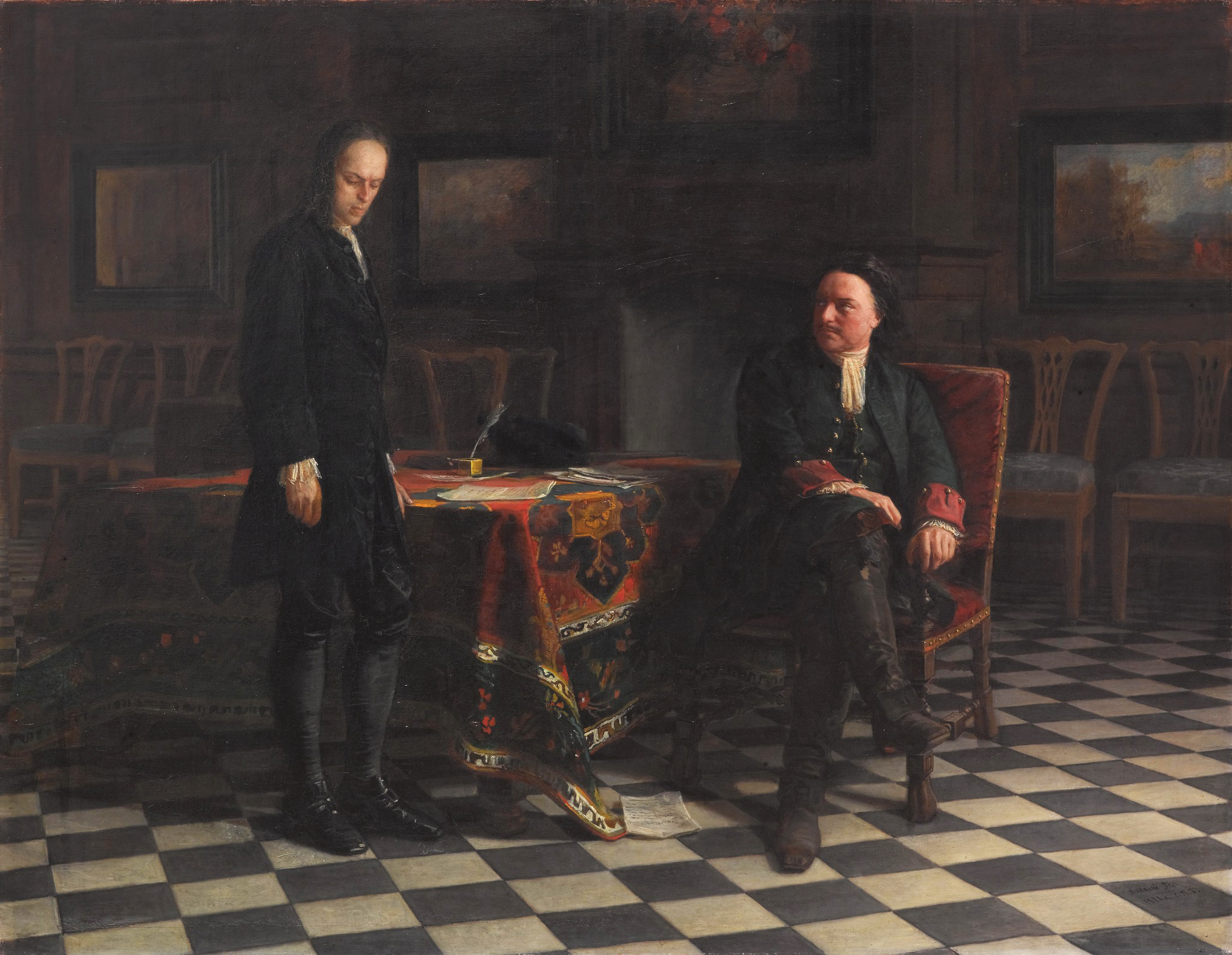
*--In slinks Aleksei, assuming a
pose
made famous in a painting by a Russian nineteenth-century artist Nikolai Nikolai Ge
*--Peter interrogates his son [does he say in German "Sohn" or in Dutch "zoon"].
Aleksei sobs feebly. Peter is almost sympathetic
*--"Syn moi" [my son] he says, now clearly in Russian. Forgive me for bringing
suffering to the people, BUT HELP ME
*--Aleksei does not respond to this appeal. He asks to go abroad instead, to become
an exile, an émigré.
*--Peter loses his composure, again showing an explosive and potentially monstrous
side
*--"Run away!?" Either accept the painful challenge or go to a monastery
*--Katerina sends Aleksei away. She puts Peter's hand to her stomach. She's
pregnant. Another heir was in the offing
Scene twenty-three
Peter is the instructor at his school for naval navigation.
He smokes his long Dutch clay pipe
*--Buinosov's son is a student back from Amsterdam. He is all decked out in wig
and very fine European attire
*--But that superficial "Westernization" is not enough. Furthermore, he spent too much time
in taverns
*--His servant, Abdurakhman, actually learned much more than he
*--Peter recognizes all this. "Well, you son-of-a-bitch", he says of Abudrakhman
and forthwith makes him a naval officer
*--As for aristocrat Buinosov's son, he will serve as a sailor under
Aburakhman's command
Scene twenty-four
Aleksei in bed with Yevrosiniia receives a message from his long-beard
conspirators that Katerina has given birth to a son, in other words, a potential heir to the
throne
*--Aleksei sobs. The couple plans to leave Russia, to go to Rome. Aleksei suggests they murder Peter
Scene twenty-five
Feast with the baby tsarevich. Peter recapitulates the main themes of the film
*--Peter reminds Menshikov of the gloom after Narva. Then the
question was whether Russia would prevail
*--Now we have all this. Peter kisses the baby's rump and proposes a toast to
his
new General-Admiral
Scene twenty-six
Demidov takes possession of criminals he purchased through
Menshikov, Fedka among them
*--Dark clouds still cover the horizon = Aleksei flees by closed carriage into the
black of night.
PART ONE ENDS
PETER THE FIRST
(VT480) D: Vladimir Petrov [after Alexei Tolstoy novel]. 203m
Part one: 1937
Part two: 1939
PART TWO
Scene one
We hear music, faulty trumpet and drums, smoke fills the air
*1709je27:Poltava battle [ID] takes place in daylight and in summer, unlike Narva
at the beginning of part one
*--Another difference, the battle is now not a disorderly and confused skirmish but a massive
clash of disciplined national military forces
*--Peter says the fight is not for Peter but for the state [gosudarstvo] and for the
fatherland [otechestvo]
*--Charles XII of Sweden (who seems to be suffering from gout) says the fight is
for God and King
*--Russia prevails. Peter wipes his forehead. Tough work, but someone's got to do it
*--Swedish commanders are humiliated captives, but Peter embraces them and
shows mercy = He returns their swords
*--Peter greets the troops and gives credit where credit is due
Scene two
Zaporozhian Cossacks ally with Sweden. Charles XII, a young
but dignified king in flight from defeat, is hiding out in a Cossack hut at night
*--Mazeppa advises Swedish King Charles XII about Aleksei = "snake in the grass" (even
his friends say this)
*--Mazeppa advises Charles to cooperate with Aleksei and his co-conspirators, to assassinate Peter
*--Charles refuses = I'm a king, not a murderer [pix]
*--Charles will go to Constantinople where he expects to be put in command of a new Turkish army against Peter
*--The alarm sounds. "The Muscovites are coming!" All flee into the night
Scene three
Formal banquet back in Petersburg
*--Foreigners in attendance are flaky and/or syrupy academics. They will found
a "Russian" Academy of Sciences [ID] and explore Asia
*--Peter reacts in a rage. So, you would turn Russia's attention to the East,
divert us from the West?
*--You would have us pave the road to the Orient with Russian bones for the ease of
German passage there?
*--Katerina calms him. He turns the subject to drinking, but approves the idea of
the Academy
*--A dispatch interrupts the dinner. Peter learns that Demidov is a thief
*--By implication, Peter sought to protect workers from abuse
*--Peter sends Yaguzhinskii to the Urals to investigate
Scene four
The scene shifts to Ural Mountains and the Nev'ianskii factory there
Scene five
Rebelling workers attack Demidov's fine house where Yaguzhinskii is dining
*--Yaguzhinskii takes command of the regiment sent with him and orders the rebels to disperse
*--Among the rebels was an old-timer who appealed to the soldiers not to shoot their "brothers"
*--[The rebellious cause was thus extended from workers to soldiers, and represented a tradition]
*--The old-timer claimed to have been kissed by Stepan Razin [ID]
*--Troop discipline finally holds, however, and they fire
*--[Has the film shown how the military-servitor virtues of Yaguzhinskii trumped the revolutionary virtues
of the workers?]
*--Some rebels escape (first from flood, now from fire), having received weapons
and horses from sympathetic troops
*--They ride through the Siberian woods, out into the open Ural foothills to
freedom, to the wild Cossack steppes
Scene six
Back in Petersburg, Peter's office is something of a workshop. He is busy with
a lathe as a variety of official business is conducted
*--Yaguzhinskii is back and reports to Peter about
instances of corruption connected with Demidov's enterprises
*--Yaguzhinskii directly implicates Menshikov who stands nervously at
Yaguzhinskii's side throughout the report
*--Peter bounds ahead to other business
*--He sends an expedition to the far eastern edges of Siberia to discover whether Asia
and America are linked [EG]
*--He orders the construction of the Ladoga Lake canal, with the aim to open the sea route from the Baltic and down the
Volga [ID]
*--Fiddling with his clay pipe, Peter turns his anger on Menshikov, but the old friendship holds
*--Tolstoy arrives to report that Europe is upset with
Russia. Peter is tickled to hear the phrase "upset with Russia"
*--Europeans are plotting against Russian successes, and Aleksei in Naples exile
has become a pawn in this big game
*--[Aleksei's affection for the old ways now both a domestic and international threat to Peter]
*--Peter twitches in a way we have been growing to dread. All that power, and it
might erupt at any moment
Scene seven
Russian merchants complain = they cannot handle foreign merchants on their own
*--Peter sets off for the tavern with this problem in mind.
*--Note the facade of the tavern with the fresco of a fine ship above the door and
a heart carved in the door itself
*--Mercy, how drunk that pilot is! [A pilot is a sailor familiar with the local
port who takes the helm of
an arriving ship as it comes into harbor.]
*--Peter attended the Christening of the pilot's child a day or so earlier, and the
pilot is still drunk
*--Peter confronts the foreign merchants sitting in one corner, drinking, smoking
Dutch pipes, gaming with dice
*--He's a tough bargainer. Russian merchants may not be up to the task, yet, but
Peter is
*--The foreigners balk, so Peter turns to the peasant Brovkin and makes him a
powerful merchant with a simple wave of the tsarist hand. Of course there is
also the hefty state subvention, the "start up fund" or "venture capital" out of
state coffers. [Demidov has proven a disappointment, but Peter moves ahead to
elevate Brovkin, always trustful of his narod.]
*--Peter asks that Brovkin divulge his fathers name, thus to attach it
to Brovkin as his second name, the Russian "patronymic". Commoners often had no "family name".
Family name in old times was a sign of aristocratic origins. Like the terms "Mister" or "Mistress" in English-language
cultures, the patronymic has become standard for all Russians in our time. Peter
was Petr Alekseevich Romanov (Peter, son of Aleksei, of the Romanov family)
*--Foreigners hop to their feet, but it is too late. Brovkin, rather than they,
will fill this commercial need. Foreigners are no longer needed
*--How sweet this turn of events. Brovkin makes a rude gesture
*--A courier informs Peter that a foreign ship with an important ambassador needs the pilot
*--But the pilot is smashed. What to do? Peter strips the pilot's windbreaker, puts it on, and
bolts for the door
Scene eight
Now we see what a fine pilot Peter is, an accomplished sailor
*--Peter has the foreign sailors clambering up the sheets, even though they are
ignorant of the Russian language.
*--With alarm, the ambassador and his assistant study the well fortified Kronstadt
Island on the sea approaches to St. Petersburg
*--Peter, performing the pilot's duties, overhears the arrogant and threatening
talk of the Ambassador and his assistant
*--Leibnitz has an opinion about Russia = their desire for European culture is
unnatural, a crime against nature
*--The ambassador foolishly lays out the whole plan to block Russia in its desire
to join the global sea routes and world trade
*--As he disembarks, the ambassador tips Peter a few guilders, a moment of great
irony and future embarrassment
Scene nine
Good laugh at expense of European refinement. The
ambassador is made to wait in the reception line for the tsar to appear
*--He notices a tall fellow laughing with friends (Menshikov, for one) in the
corner and remarks how much he looks like their pilot
*--When the ambassador discovers the truth, he is much embarrassed
*--Peter explains how he has "regained our Baltic lands". He takes the ambassador
to an open window to show his huge navy, firing salutes in a great display of
power. The ambassador is humbled. Peter grins
Scene ten
Reception continues. Peter challenges the ambassador = we
can fight or trade. Don't bully us
*--Peter puts ambassador in difficult position [famous in the annals of Russian
diplomacy], handing him a gigantic and potent drink, proposing a toast, drink to
the bottom, of course, in honor of the ambassador's monarch. The ambassador
cannot refuse
*--[Note the black man at the table, very possibly representing A. P. Hannibal,
Peter's servant from Africa (Arap Petra Velikogo) and the great-grandfather of
Russia's greatest writer, Aleksandr Pushkin [ID]]
*--This "multicultural" seating arrangement discomfits the stuffy "Western" ambassador even further
Scene eleven
In Naples, Aleksei dispatches conspiratorial letters to
various of his allies, including foreign governments.
*--He mentions Buinosov and England, among others. Aleksei has become an émigré
conspirator
*--Italian fruit looked luscious to Yevrosiniia, but was tasteless. [Western fruits
are deceptive.]
*--Tolstoy arrives, but Aleksei flees the room in a disordered scramble
*--Tolstoy wheedles and threatens Yevrosiniia before the awesome Italian fireplace.
She spills much useful information
Scene twelve
Later that night, Yevrosiniia and Aleksei argue. He strikes her and calls her "bitch"
*--She misses the gooseberry blossoms and playing on the swings at home
*--Aleksei doesn't know what he misses. Yevrosiniia threatens to leave him
*--She coaxes him into an agreement to return to Russia with Tolstoy
Scene thirteen
Aleksei and Yevrosiniia return to Russia with Tolstoy in a
cushioned carriage. A frontier guard checks their passports at the Russian border
*--In an ambiguous gesture, Aleksei tries to engage the border guard in
conversation, to no avail
Scene fourteen
Peter greets Aleksei with feeling
*--Peter is willing to let Aleksei live in Moscow and live the life he wishes, but
hopes or even expects that Aleksei will not do that
*--Peter explains how evil forces latch onto a person like Aleksei. His analogy is
to the false Dmitries in the Time of Troubles [ID]
Scene fifteen
Aleksei appears in a Moscow church. He opposes the teaching of mathematics
*--Expressing disgust with German sausages, the conspirators nonetheless eat them. These old-timers
are not only reactionaries, they are mendacious about it
*--Aleksei learns that Yevrosiniia has been arrested by the Secret Chancery and
fears she was put on racks
*--Events force Aleksei firmly into the camp of old boyars
*--He arouses the Cossacks with an edict. Church Music in the background
*--The Muscovite conspirators are not ready to put tsar Aleksei Petrovich on the throne
Scene sixteen
Cossack village with dancing and whistling, sunny and warm
atmosphere. We see that Fedka is the Cossack hetman [ataman] here
*--Fedka's old master, Buinosov, arrives to recruit the
Cossacks into the plot against Peter. The Prince is surprised to see Fedka, but
quickly condescends to "forgive him"
*--Fedka clearly feels that Buinosov is in no position to "forgive" him and says he will not
forgive Buinosov and prepares to give him a caning just as Buinosov so often caned his serfs
*--Instead, he drags Buinosov before the whole Cossack village and asks them to decide
*--He explains that Buinosov offers them for their service forgiveness for past
obligations to their masters, the nobility
*--Fedka adds that this may not include forgiveness for future obligations
*--Cossacks have a good laugh and drag Buinosov out of the village for some well
deserved roughhouse
Scene seventeen
Back to Moscow, Aleksei is arrested and taken to the Admiralty Tower and questioned
Scene eighteen
Long pauses in interrogation as Yevrosiniia was brought in to testify: "Tell the
truth", says Tolstoy. She tells all
*--Aleksei is all weakness, sitting beside Peter, who is all strength. Peter casts
a sharp shadow, Aleksei, none
*--Peter is hesitant to accept Aleksei's guilt until he refuses to name his
co-conspirators. The torture begins [ID]
Scene nineteen
Peter's Senate (over twenty in number) gathers at a round
table hear an address from Peter, standing =
*--Europe wants to force the great empire Russia back to the days of scattered
principalities and rule by voevody [ID]
*--Aleksei wants this too. Boyars and priests will support him in this to extend
their parasitic lives
*--The Senate must decide Aleksei's fate [and thus the fate of Russia]
Scene twenty
Peter with Katerina. Peter laments: "my son [syn moi]". He
is flesh of my flesh, yet a snake in the grass
*--Peter needs another window open. He hints at
failing health, "Katya, it's stuffy in here" [Katia, dushno!]
Scene twenty-one
Menshikov questions Senators. Sheremetev, Tolstoy,
Yaguzhinskii, and others
*--The Senate unanimously passes a death sentence on Aleksei
*--[NB! suggestion of formal legal procedures, a noteworthy idea in the era in which the film
was made (EG)]
Scene twenty-two
Peter's last visit to his pitiable son Aleksei. The feelings of a father are subordinated to the ideals of a visionary leader
Scene twenty-three
England sends ships into the Baltic in apparent support of the Swedish fleet, but Russia responds
*--Russian sailors are urged not to spare their lives in defense of their country
Scene twenty-four
The English commander draws back from the battle after
determining that Russia will likely win
*--[The film want to suggest that the English cannot be trusted, but they do understand the meaning of
preponderant power and will act with practicality]
Scene twenty-five
Much high seas derring-do follows. Abdurakhman plays an active role in this victory. Swedish ships are forced to self-destruct, but Russian sailors prevent this. Abdurakhman accepts the sword and surrender of the ultra-European, blond, Swedish commander. Abdurakhman salutes his fallen enemy with great dignity. [A commoner, a non-European foreigner at that, is as capable of nobility as any well-born "western" commander]
Scene twenty-six
The English commander gets the news of the Russian victory and high-tails it
*--[The general manner of the English commander (EG=constant drinking) might be a
portrayal of the Winston-Churchill "type" (ID)]. At this
time Churchill was known for his role as English Admiralty Lord. As WW2 broke out in western Europe and
drew England into the fray, Churchill would become Prime Minister. Then when Hitler Germany
invaded USSR, Churchill became, however reluctantly, an ally of Stalin]
Scene twenty-seven
The war is then over. Now there will be eternal peace
*--Menshikov is a pie-man again, offering
pirozhki to Peter and the jubilant throng
Scene twenty-eight
Peter hugs Abdurakhman as victorious navy comes to the docks. The throng grows suddenly silent =
Scene twenty-nine
Peter delivers a speech in which he admits that he has been severe, but he tells his
audience, it was all for your sake
*--Peter implores Russia [and the film audience as well] to guard and augment the
nation's wealth
FINI
![[pix]](http://en.wikipedia.org/wiki/File:Mazepa2.JPG)