
St. Symeon the Stylite from a 10th cent manuscript |
REL
321: The History of Christianity
|
| Professor: Dr. Stephen Shoemaker
Telephone: 346-4998 sshoemak@darkwing.uoregon.edu |
Office: 813 PLC
(or by appointment) |
Index
|
Expectations and Regulations | Grading Scale |
Internet Resources of General Use: If you have a general question about a particular person, concept, etc., you might try these resources first to find an answer.
Schedule of Assignments and Suggested Internet Resources
Course Description and Objectives
This course is designed to introduce various aspects of Christianity during the first seven centuries of its existence. Although this course focuses to a certain extent on the development of what would later become “orthodox” Christianity within the bounds of the Roman Empire, this is not to the exclusion of rival forms of early Christianity. Considerable attention will also be given to the spread of Christianity along the fringes and outside the borders of the Roman Empire. We will concentrate especially on the historical diversity of the early Christian tradition, in an effort to understand better its contemporary complexity. In the course of the term, students will read and write reflective essays on several primary sources, each selected to represent the historical and confessional diversity of Christian traditions, as well as to present certain basic problems from the history of Christianity. We will conclude in the middle of the seventh century, a period often considered "the end of antiquity," and while this periodization is not unproblematic, the Arab conquests of the eastern Mediterranean that would follow indeed mark a significant historical change.

Textbooks
-
W. H. C. Frend, The Early Church (Fortress Press; ISBN: 0800616154)
-
John Meyendorff, Imperial Unity and Christian Divisions: The Church 450-680 A.D. (St Vladimir’s Seminary Press; ISBN: 0881410551)
Selected
items are xeroxed and on reserve at the Knight Library; others are to be found on the internet, as
indicated below.
Some good resources to learn more about a particular topic (with bibliography for further reading) include:
-
The Oxford Dictionary of the Christian Church: Knight Library Reference, BR95 .O8 1997
-
The Anchor Bible Dictionary: Knight Library Reference, BS440 .A54 1992 (good for first 2 centuries)
Internet Resources of General Use
The Catholic Encyclopedia Although this is an older edition (1907-12), there are many excellent articles on many of the key people, events, concepts, etc. covered in this class, particularly in the early and medieval periods. The articles naturally reflect a particularly Roman Catholic point of view, making it a rich source for information on this tradition. The articles are often lengthy, but are usually worth the read.
Glossary of Theological Terms This glossary, taken from Alister McGrath's Christian Theology (2nd edition) published by Blackwell Publishers, provides succinct definitions for a number of theological technical terms..
The Ecole Initiative This site's Glossary has brief descriptions of several hundred topics (mostly people). The site also has a number of texts, images, and articles relevant to this period.
Internet Ancient History Sourcebook Many of the items used in this class, along with a number of other historical documents, maps, etc., are to be found here and at the related The Internet Medieval Sourcebook.
Encarta Online Concise Encyclopedia This is a good online source for general information on a variety of topics: brief explanations of many people, places, etc.
Assignments
Attendance at all class sessions is expected. Since class sessions will involve a fair amount of student discussion, students should read all the assignments carefully before coming to class. Assignments will generally involve about 100 pages of reading per week. Everyone should be prepared to contribute both ideas and questions to the class discussions. Assignments and grading are as follows:
A. Two exams 10/25 and Monday, 12/4, 10:15 AM (40%)
B. Class attendance and participation (10%)
C. Two 4-5 page (double-spaced: approx. 1200 words) essays (50%), chosen from the following options. Students may also write all three papers, with the option of having their lowest exam or paper grade dropped:
1. Due 10/18. Read the Gospel of Thomas and the Gospel according to Luke and answer the following questions: “What is similar about these two gospels, and what is different? Are they more different than similar? What things are similar and different in their depiction of Jesus? How do they represent similar and/or different understandings of the Christian faith? What, in your view, is the significance of the relationship between these two early gospels for understanding the early history of Christian traditions?
2. Due 11/6. Read Origen’s On First Principles, Book IV and answer the following questions: “How does Origen believe the Scriptures are to be interpreted? What reasons does he give for adopting this approach? Do you think that this is an appropriate way to interpret the Scriptures? What are its strengths and its shortcomings? What do you think about the fact that this was the dominant method of reading the Scriptures in both the early and medieval periods?”
3. Due 11/27. Read Augustine's treatise On the Good of Marriage and On Virginity (selections) together with 1 Corinthians 7, and answer the following questions: "What is Augustine's view of Christian marriage, and how is it related to celibacy (continence/virginity)? What the good things does he find in each? What is Augustine's view of human sexuality? What is the purpose of marriage? What do you think of his understandings of marriage, virginity, and sexuality, and how do they compare to Paul's view?"
Format of Essays: In answering the questions, first of all, briefly summarize the contents of the text(s) regarding the questions asked: what do the texts say? Then, take a clear position in response to the texts and defend it: imagine that your reader believes the opposite and that you are trying to persuade him or her. Also, while you should cite examples from the texts, be sure to explain and contextualize any quotations made, and be sure that your own voice is not lost in a sea of quotations. All quotations must be identified as such, and references to the text should be given parenthetically either a page number or section number, as appropriate.
Expectations and Regulations
Grading Scale1. Preparation: You are expected to come to class having completed the reading assignments for that session. You should be prepared to discuss and ask questions about the assignments. Note also that some material from the readings that is not covered in class may be included on the examinations.
2. Participation and Class Attendance: You should come to class prepared to ask questions and to discuss the readings for that session. Regular class attendance is required, and attendance will be taken. If you expect to miss class doe to illness, observance of religious holy days, or other extenuating circumstances, please notify the instructor in advance at 346-4998 or sshoemak@darkwing.uoregon.edu.
3. Late Papers: Unless an extension has been arranged in advance, late papers will be marked down one full letter grade for each day after the due date. Late papers will not be accepted more than three days after the due date.
4. Make-up or Early Exams: will be allowed only in exceptional circumstances and must be approved by the instructor in advance.
5. Plagiarism or Cheating: Students caught plagiarizing or cheating on any assignment will be reported to the Student Conduct Coordinator in the Office of the Dean of Students. Students who are aware of cheating or plagiarism are encouraged to inform the instructor. If you are uncertain as to what constitutes plagiarism (or other forms of academic dishonesty), please consult the University of Oregon's Policy on Academic Dishonesty.
6. Completion of Assignments: Completion of all required assignments (2 Exams, 2 Papers) is necessary to pass and receive credit for the course. Incompletes will be granted only at the discretion of the instructor and only in case of circumstances beyond the student's control.
7. Special Needs: Students with special needs requiring academic accommodations should 1) register with and provide documentation to Services to Students with Disabilities (SSD); 2) bring a letter to the instructor from the SSD indicating that you need academic accommodations, and we will arrange to meet them. This should be done during the first week of class.
98-100 94-97
91-93
88-90
84-87
81-83
78-80
74-77
71-73
68-70
64-67
61-63
0-60A+ A
A-
B+
B
B-
C+
C
C-
D+
D
D-
F
Course Outline
Week 1
9/25 Introduction
Read: Gospel according to Luke (web)
Web Links
9/27 The Emergence of the Institutional Church
Read: Frend, 24-48; The Epistle of Paul to the Galatians (web; Read at least the first two chapters); Didache (selections; web); Ignatius of Antioch, Letter to the Magnesians (web); Letter to the Trallians (web)
Web Links
- Resource Pages for Biblical Studies A huge site with links to information on the web about the New Testament and its historical background. Also links to many on-line translations of the Biblical texts.
- 1 Clement Clement of Rome's letter to the Corinthian Church.
9/29 Early Persecutions and Martyrdom
Read: Frend, 58-71; Ignatius of Antioch, Letter to the Romans (web); Letters of Pliny and Trajan (web)
Web Links
- Nero's Persecution of the Christians as described by the Roman historian Tacitus.
- The Letters of Ignatius of Antioch.
- Perpetua's Prison Diary Diary kept by a young woman who was martyred in N. Africa, circa 200.
Week 2
10/2 Pagan Criticism and Christian Apology
Read: Justin Martyr, Second Apology (web)
Web Links
-
Justin Martyr, First Apology.
10/4 Early Syriac Christianity: A Different Sort of Orthodoxy
Read: Gospel of Thomas (web); Two brief essays on the Gospel of Thomas
Web Links
- The Synoptic Problem Extensive treatment of the literary relationships between the first three gospels, with discussions of alternative theories and links to other sites.
- The Gospel of Thomas Home Page
10/6 The “Gnostic” Interpretation of Christianity
Read: Frend, 49-57; Apocryphon of John (web)
Web Links
- The Gnosis Archive A collection of web links to sites dealing with gnosticism, broadly defined, from antiquity until the present.
- The Gnosis Archive Same name, different site. This one is maintained by the Gnostic Society, a group of contemporary gnostics: there's a church in Portland. An enormous collection of gnostic texts, this site also has lots of lectures and articles, as well as information on the Ecclesia Gnostica, a contemporary gnostic church. More on contemporary gnostic denominations can be found here.
- The Center for Marcionite Research A collection of texts relevant to Marcionite Christianity.
- The Development of the New Testament Canon A excellent site with lots of charts and other information chronicling the development of the NT canon. See especially the Cross Reference Table, which gives a quick overview of which books, both canonical and apocryphal, different early Christian writers considered a part of the NT canon. Also good brief summaries of a number of apocryphal texts.
- The Noncanonical Hompage A good collection many early Christian writings that were excluded from the NT canon.
Week 3
10/9 The Christian Life and the “Worldly” Life
Read: an Apostolic Debate from the Book of Mary's Repose.
10/11 Tertullian and Montanism
Read: Frend, 72-84; Eusebius, Ecclesiastical History, 5.16-5.20 (web)
Web Links
10/13 Christology in the Early Church: Docetism, Adoptionism, Modalism, and the Logos
Read: Ignatius of Antioch, Letter to the Smyrneans (web); articles on Docetism and Monarchianism at The Ecole Initiative website.
Week 4
10/16 Origen of Alexandria: His Life and Thought
Read: Frend, 85-94; Eusebius of Caesarea, Ecclesiastical History VI, ( selections; web)
10/18 Origen and the Bible in the Early Church
Read: Origen, On First Principles, bk 4.1-3 (web)
Web Links
- Catholic Encyclopedia article on Origen and Origenism.
- Entry on Origen in the Internet Encyclopedia of Philosophy.
10/20 No Class: Instructor away.
Week 5
10/23 Imperial Persecution and the Problem of the “Lapsed”
Read: Frend, 95-125; A Certificate of Having Sacrificed to the Gods (web)
Web Links
- Diocletian's Edicts of Persecution of the Christians.
- The Conversion of Constantine according to Eusebius' Ecclesiastical History.
- The Edicts of Galerius and Milan.
10/25 Midterm
10/27 Constantine, Arius, and Nicea
Read: Frend, 126-42; Athanasius, On the Incarnation, selections (web); Arius, Letter to Alexander of Alexandria (web); The Nicene Creed (web)
See also A Chronology of the Arian Crisis at The Ecole Initiative website, with many hyperlinked documents.
Web Links
- Athanasius' On the Incarnation (complete text).
- Several websites questioning the doctrine of the Trinity. They site can give you a good idea of the many biblical difficulties encountered by the pro-Nicenes as they tried to argue the doctrine of the Trinity against the Arians.
- The Doctrine of the Trinity You will find a clear explanation of this doctrine here, at the Orthodox Church in America's web site.
Week 6
10/30 Rise of Christian Monasticism
Read: Frend, 188-97; Rule of St. Augustine (web)
Web Links
- Athanasius, Life of Antony (complete text).
- The Rule of St. Benedict Benedict of Nursia's influential regulations for the monastic life.
11/1 Women in Early Christianity: Apostles(?), Ascetics, and Patrons
Read: Frend, 146-67; "The Roles for Women" in Early Christianity (web); Acts of Paul and Thecla (web)
11/3 The Veneration of Saints and Relics in Early Christianity
Read: Antonius, Life of Symeon Stylites (xerox)
Week 7
11/6 The Virgin Mary and the Council of Ephesus
Read: Frend, 168-77; 209-218; correspondence of Nestorius and Cyril of Alexandria and Cyril’s 12 Anathemas (web)
Web Links
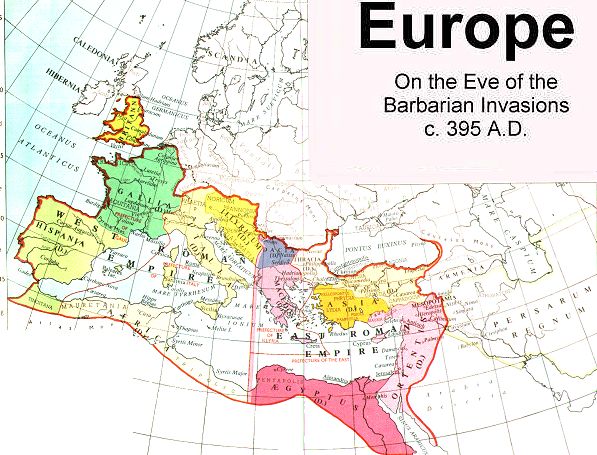
- Map of the Roman Empire ca. 395.
11/8 Augustine of Hippo
Read: Frend, 178-87; 198-208; On the Good of Marriage (web) and On Virginity (selections; web)
Web Links
- A web page devoted to Augustine of Hippo, complete with texts, images, and links to other sites, including the following items:.
- "Christ and the Soul" Chapter 4 of James J. O'Donnell's Augustine, an introduction to Augustine's writings against the Pelagians.
- Augustine's Africa A collection of detailed maps of Roman Africa in Augustine's time.
- Augustine's account of his conversion from his Confessions.
11/10 The Council of Chalcedon
Read: Meyendorff, 165-86; The Tome of Leo (web); the Chalcedonian Definition (web)
Web Links
- Map of Constantinople and surroundings, including Chalcedon.
- The Incarnation This is a good, clear explanation of the development of orthodox Christology at the ecumenical councils. At the Orthodox Church in America's web site.

Week 8
11/13 After Chalcedon: Resistance in Egypt and Syria
Read: Meyendorff, 187-206; 113-27; The Life of Peter the Iberian (web)
Web Links
- The Syrian Orthodox Church (non-Chalcedonian): its history, music, and art.
- The Nicene Creed in Syriac (Aramaic).
- The history of the Coptic (Egyptian) Orthodox Church: here and here.
11/15 Early Christianity in Eastern Syria, the Caucasus, the Persian Empire, and Ethiopia
Read: Meyendorff, 96-120; 280-92; The Life of St. Shushanik (web); Mar (St.) Narsai, An Exposition of the Mysteries (web)
Web Links
- Christianity in India from antiquity to the present.
- A history of the Mar Thoma (Indian) Church.
- The Assyrian Church of the East (non-Ephesian/Persian).
- The Ethiopian Orthodox Church: its history and some religious texts.
- History and overview of the Armenian Apostolic Orthodox Church.
- Christianity in Georgia: history, art, and music.
11/17 No Class: ASOR/AAR/SBL
Week 9
11/20 No Class: ASOR/AAR/SBL
11/22 No Class: ASOR/AAR/SBL
11/24 No Class: Thanksgiving
Week 10
11/27 The “Fall of Rome” and Western Christianity
Read: Meyendorff, 127-58; Augustine, selections from The City of God (web)
Web Links
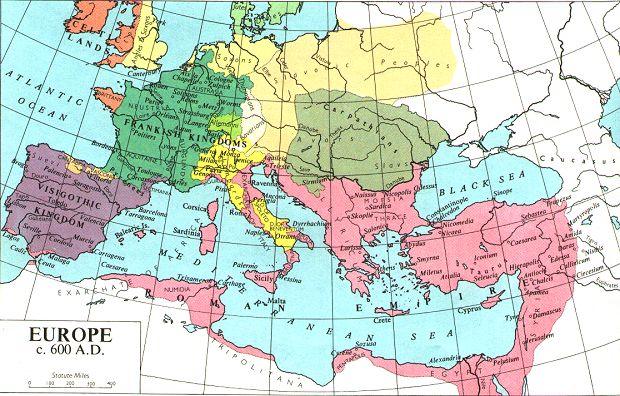
- Maps of the Roman Empire and the Mediterranean world in 476, 526, and 600. The progressive impact of the Barbarian invasions is clearly seen.
- The decadence of Rome just before its fall, according to Ammianus Marcellinus.
- Alaric's sack of Rome in 410, according to Procopius.


11/29 The "New Rome": Christianity in the early Byzantine Empire
Read: Meyendorff, 207-11; 221-50; Emperor Justinian, Dialogue with Paul of Nisibis (web)
12/1 On the Eve of the Islamic Conquests: Heraclius and Monothelitism
Read: Meyendorff, 251-79; 333-48; The Capture of Jerusalem (web)
FINAL EXAM: Monday, 12/4, 10:15 AM