 l
student, he arrived in Paris when he was 25, studied at the Académie
Royale and after five years was received as an associate member of the Académie.
l
student, he arrived in Paris when he was 25, studied at the Académie
Royale and after five years was received as an associate member of the Académie.
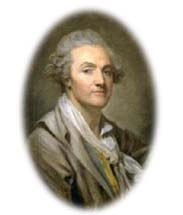
Jean-Baptiste Greuze by John Russell, The New York Times
Jean-Baptiste Greuze had made a quite exceptional start. Born in Tournus in
Burgundy in 1725, he got out and got on. An ideal
student, he arrived in Paris when he was 25, studied at the Académie
Royale and after five years was received as an associate member of the Académie.
Two months later he was showing in the biennial exhibition of the Académie. One of his first entries is now in the Pushkin Museum in Moscow. Another is in the Alte Pinakothek in Munich. A third was bought at the time by a well-known French collector.
Ever fortune's favorite (or so it had seemed), Greuze was then invited to Rome by a wealthy patron. (A drawing at the Frick shows how they were carried across the Alps in wicker armchairs.) Once he was in Rome he was given lodgings in the headquarters of the French Académie.
Before long the Marquis de Marigny wrote from Paris and asked Greuze to paint two pictures for his sister, Madame de Pompadour. This was an undreamed-of commission, but Greuze took years to come across.
So far from being sentimental, Greuze could take difficult and painful subjects,
like "The Paralytic" and "The Father's Curse," 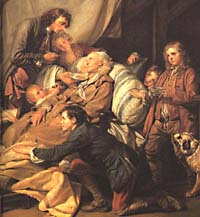 and
give them a wrenching actuality. In his many elaborate subject paintings, he
did not simply stand aside and sum up the facts. As is made clear at the Frick,
he was one of the great poets of involvement.
and
give them a wrenching actuality. In his many elaborate subject paintings, he
did not simply stand aside and sum up the facts. As is made clear at the Frick,
he was one of the great poets of involvement.
He was also a dramatist who knew exactly how to fill the stage to maximum effect. Even in tumultuous scenes, like the compositional studies for "A Marriage Contract" at the Frick, there are no bit parts.
It is clear from his dazzling portrait of the great French actor Baptiste aîné that Greuze had an innate sense of what both acting and actors were like. But whereas Baptiste was the epitome of 18th-century high style, Greuze was the master of what was later called verismo. Total realism in a very high wind was the effect he worked for when his men and women raced from one side of the canvas to the other or died an operatic death.
A fascinating contribution to the book-length catalog is a long article by Irina Novosselskaya on the massive collection of drawings by Greuze in the Hermitage in St. Petersburg. It was Catherine the Great, acting on the advice of Diderot, who in 1766 bought "The Paralytic," a major painting. Shortly after that, no fewer than 223 drawings by Greuze were bought by the president of the Imperial Russian Academy, who was a regular visitor to Paris. Of these 123 were transferred to the Hermitage in 1924. It is also known that the novelist Turgenev and Modest Mussorgsky, the brother of the composer, owned drawings by Greuze.
It's a curious fact about the friendship between Greuze and Diderot that although Catherine the Great and her son, the future Paul I, were admirers of Greuze, Diderot managed to head off any idea that Greuze should go to see her. The message passed was that "Greuze is an excellent painter but a very disagreeable character."
Diderot himself was, as is well known, a fast favorite with Catherine, and she very soon wrote to the French sculptor Falconet, "I do not renounce Greuze's work, but I do renounce Greuze himself."
As is made clear at the Frick, Greuze was not prudish. More than one of his heads of young women can be said to speak for what Diderot called "a moment of ecstasy that is sweet to experience but not appropriate for art."
This page designed and created by Mary Harrsch