Chaotic Cavity News
|
Whispering gallery at the gallery
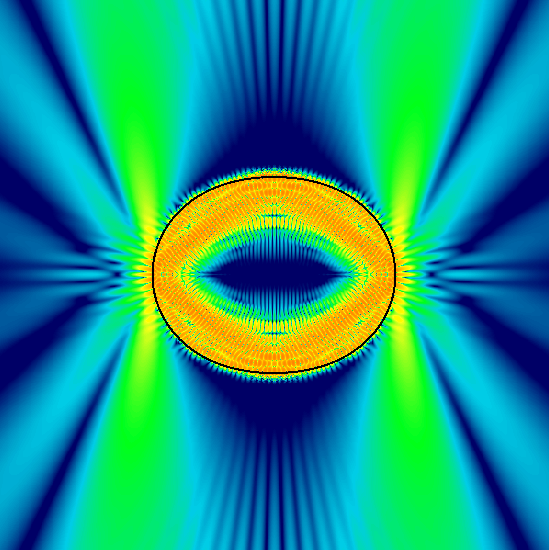
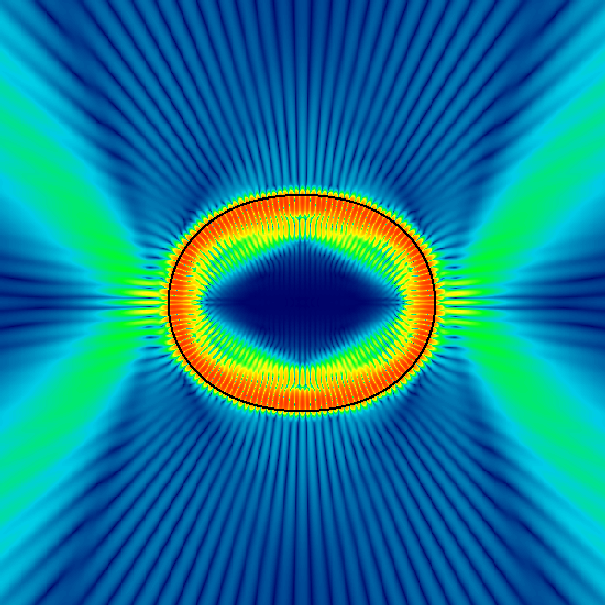
Wave patterns in classically chaotic cavities are often visually striking. A plot of ours, showing a folded chaotic whispering-gallery mode, was chosen as one of the winners in the 2020 ArtSci Oregon competition. All entries can be found at the 2020 Research as Art Exhibition web site.
|
Folding the whispering gallery
|
Beyond the Beam
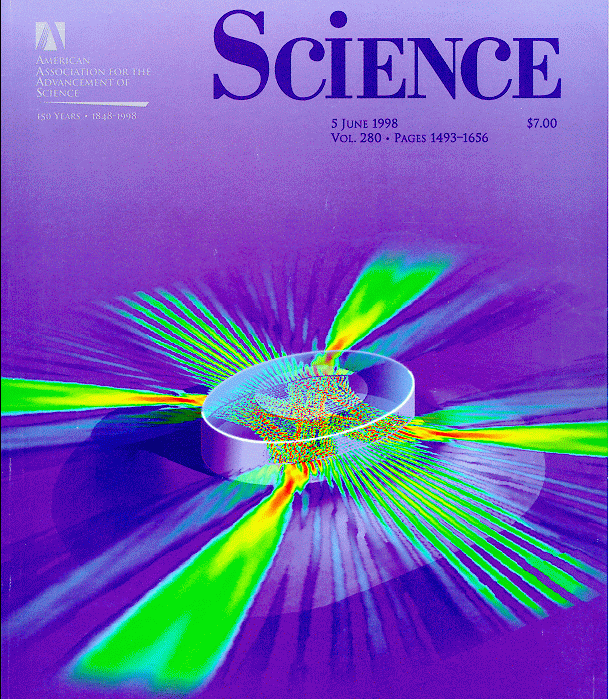
A review of "Multidimensional Lasers" by Z. Horváth in Optics & Photonics News (July 2012) puts our work on chaotic microdisk lasers in the context of a history that's almost as old as laser physics itself but has only recently become a field in its own right: the study of beam shapes that deviate significantly from the pencil-like straight line geometry of conventional lasers.
|
Asymmetric resonant cavities in textbooks


References to our work appear in some standard texts on quantum chaos and semiclassical physics:
"Quantum Chaos — An Introduction" by H.-J. Stöckmann (Cambridge University Press 1999), and "Quantum Signatures of Chaos" by F. Haake (Springer-Verlag Berlin Heidelberg, 2013).
|
 |
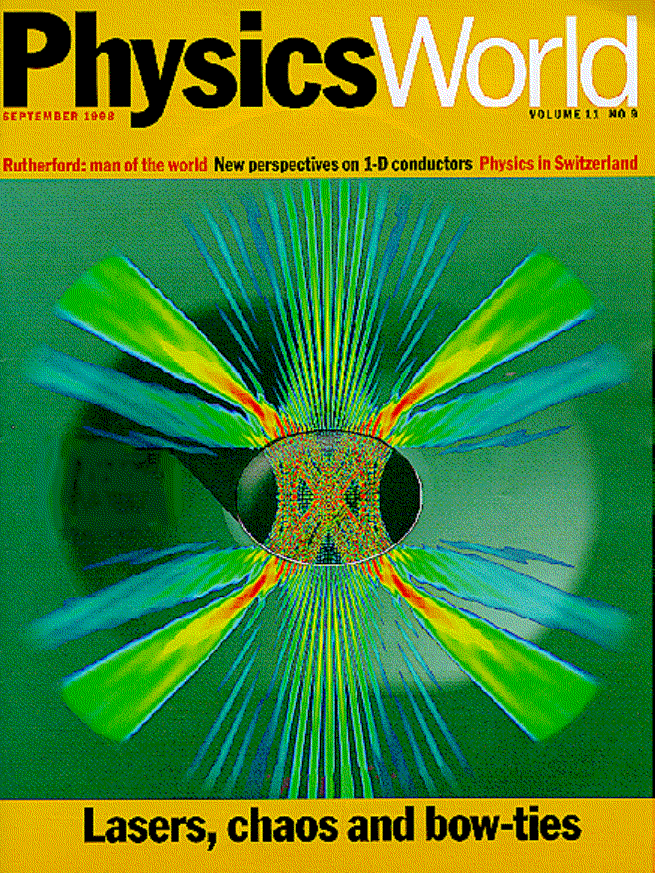
The bowtie laser as a book
coverOne of my microlaser simulations
decorates the cover of this book by
Alisa Bokulich, titled "Reexamining the
Quantum-Classical Relation" (November 2008).
Another book appearance of our
ARC
images is the volume Microcavities
by A Kavokin, J.J. Baumberg, G. Malpuech
and F.P. Laussy, Oxford University Press,
(February 25, 2008)
|
|
Physical Review Focus (3 September
2004) points to the
whispering-gallery microlaser information
collected on this website. |
|
|
|
|
|
|
For the
EXPO 2000 World Fair in Germany, I created a
presentation that has been made part of a
permanent exhibition maintained by the
Max-Planck Society:
The Science
Tunnel
(the exhibit is no longer online). |
My thesis work helped Yale University
recruit graduate students:
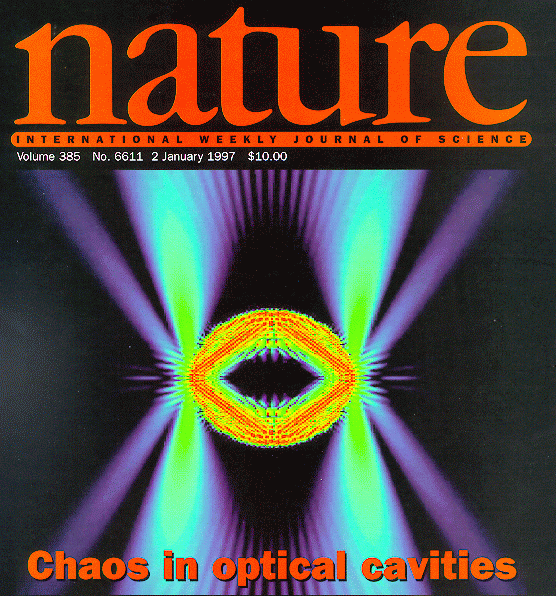
Our 1997 "Nature" cover headed this Yale web
page  (no longer online). (no longer online). |
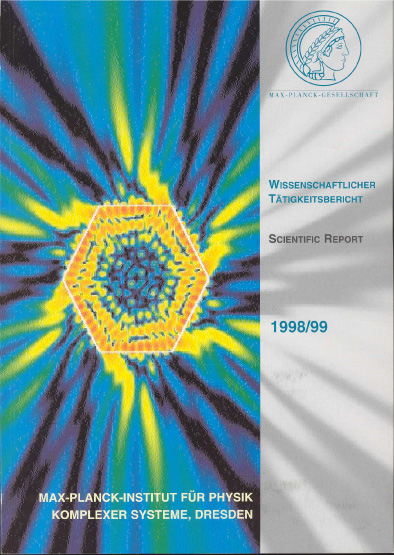
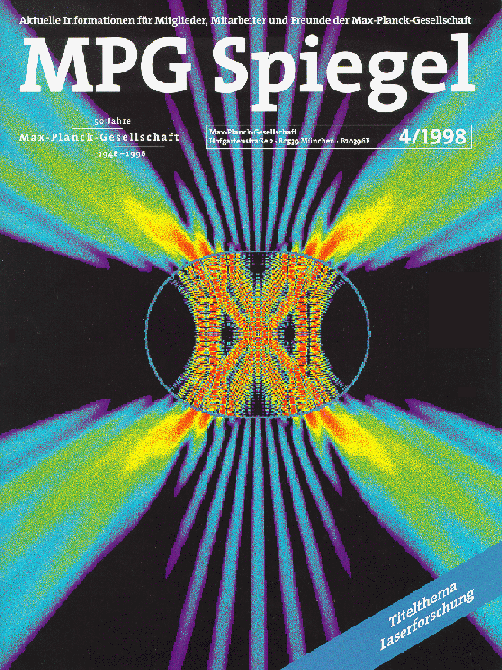
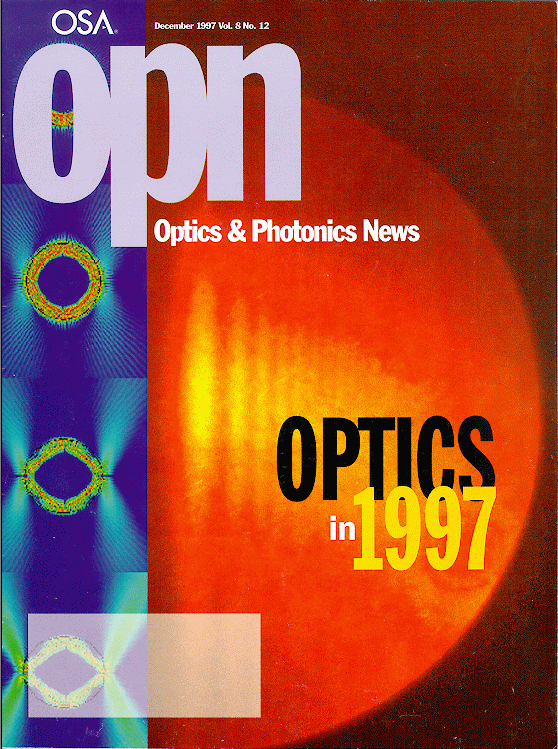
One of the projects I started as a postdoc made
it to the cover of the annual report of the MPI
for Physics of Complex Systems, and also into
the "Optics in 2000" section of OPN, see
below. |
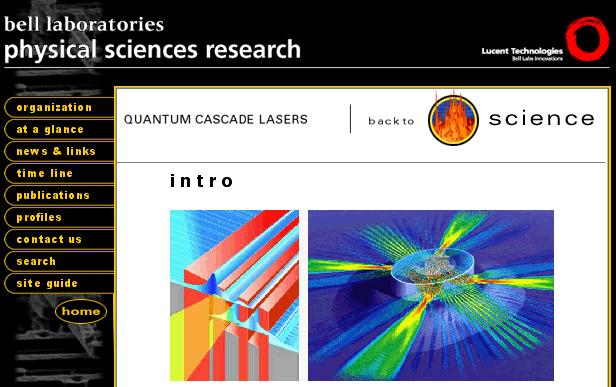
Lucent Technologies' Bell Laboratories (now defunct)
featured one of my plots on their "Physical Sciences" web
page :
|
What is an Asymmetric Resonant Cavity
anyway ?
|
|
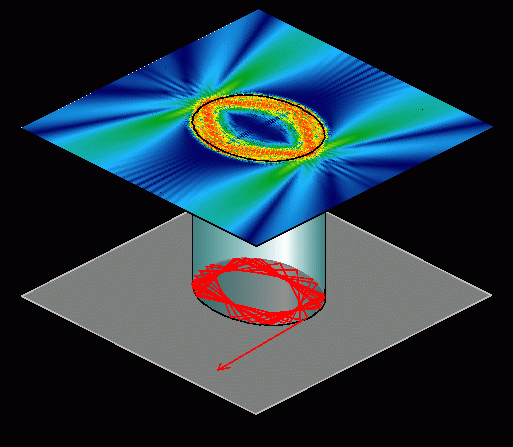
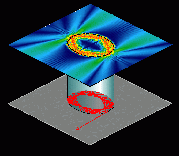
ARCs are
convex resonators whose fractional deformation
is so large that the wave equation cannot be
solved satisfactorily by perturbation
techniques. Shown here as an example is a
dielectric cylinder with an oval cross section.
Such resonators can be used in lasers or other
devices that rely on the existence of
long-lived states. The calculated intensity
distribution of such a resonator mode is shown
here as a false-color image (top of the
picture). The key to understanding the
intrinsic emission properties of these modes
(e.g. their directional emission) is a
one-to-one correspondence between waves and
rays (red arrow, bottom). The wave field is
affected by chaos in the ray dynamics. |
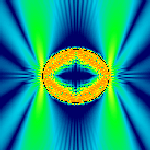 |
Emission from the points of highest
curvature is intuitively expected, and the
tangential orientation follows from Snell's
law of refraction.
|
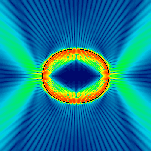
Due to phase space structure, the light
here originates slightly away from the
high- curvature points, but still
tangential to the surface.
|
 |
|
|
This page © Copyright Jens Uwe Nöckel,
06/2003
Last modified: Fri Dec 18 09:56:34 PST 2020
|