Roman Society and Law; the
War with Pyrrhus
- Roman Society and Law
- Many of the laws that
mark different stages of the 'Struggle of the Orders' had to be passed
several times. The repetition indicates that the goals of the plebeians
were consistent and that they did achieve successes, but also that the
implementation could also be frustrated.
- The most important
principle embodied in Table XII and in the Lex Hortensia (287) is that
sovereignty is derived from the people, that all must conform to law.
- Society and the XII
Tables Conclusions:
- The Tables reveal a
society that is primarily agrarian, note how little is said about
commerce or crafts.
- The tables do not
give a vision of justice, but rather provide procedural means to obtain
justice.
- Note the pervasiveness
of the familia in the discussions, the rights of agnates and of
clansmen.
- There is a
distinction between sacral and secular law.
- Pyrrhus
- Background
- The Greek cities in
southern Italy, esp. Tarentum.
- Anticipating further
war with Rome, the Tarantines summoned Pyrrhus, the king of Epirus
(Albania) and one of the most highly regarded Hellenistic generals, to
assist them.
- The War (see Grant for
the details).
- Heraclea (280).
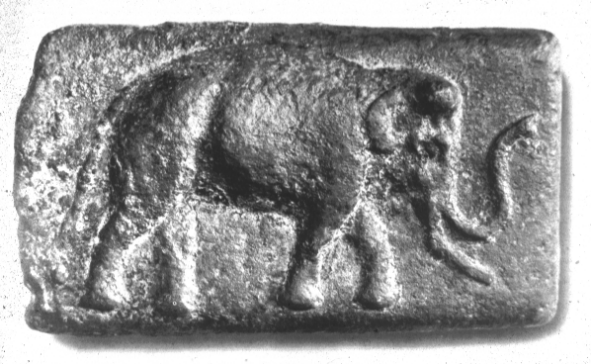
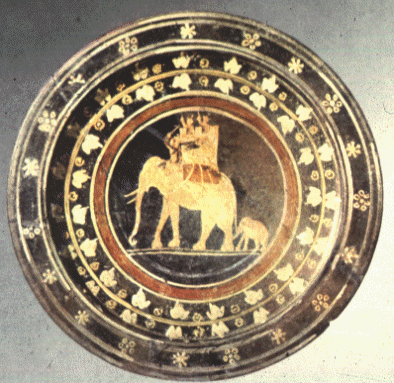
Elephants.
A vase
with elephant representation
- Ausculum (279): 45,000
on each side(!!!)The Pyrrhic victory. Pyrrhus does go off seeking
adventure in Sicily; Rome extends her control deeper in Samnium.
- Maleventum (276).
Decisive Roman victory and two Roman armies converge on Pyrrhus. Forced
to withdraw and in 272 abandons southern Italy to the Romans.
- Significance:
- In terms of military
considerations, Rome's strength, both in manpower and in technique, had
been challenged and dramatically confirmed. Her position in Italy is
secure.
- Rome's allies, when
given the opportunity to abandon Rome, had remained loyal.
- Rome assumed new
responsibilities to protect the Greek cities of southern Italy..
- The Eastern Mediterranean
- The Balkans. Piracy in
the Adriatic.
- The eastern
Mediterranean ruled by number of Macedonian dynasties, by kings who owed
their positions to the fact that the founding member had been one of
Alexander's generals.
- Greece and Macedonia:
classical city state dominated by Macedonia
- Anatolia. The coastal
areas were either Greek or heavily influenced by Greek culture.
- Syria and Palestine,
with a ruling elite consisting primarily of Macedonians, Greeks and some
Hellenized Syrians, occupies a precarious position between the major
powers in Iranian (to the East) and the rival Macedonian kingdom of
Egypt (in the southwest), and contending with minor kingdoms like
Pergamum and Judaea.
- Egypt. The Macedonian
family of the Ptolemies controls and rules; supported by a large number
of Greek immigrants especially to Alexandria.
- All these states of
the eastern Mediterranean and North Africa faced the same problem in that
the ruling elite consisted of foreign conquerors.
-
- Carthage (founded by Tyre)
- A commercial power
(note her concern for trade in the treaties of RC § 13). Between 600 and
300 she had come to dominate the Phoenician colonies on the north coast
of Africa and prevented the Greeks from expanding into the western
Mediterranean. Control points especially at Malta and the western end of
Sicily.
- Income:
- successful and
scientific farming of Baradas valley
- textile manufacture
and purple dying
- revenues from
commerce. rarely penetrates interior, but effective exploitation of
particular spheres. Interest esp in metals, tin and gold, as well as
ivory from Atlantic coast of Africa
- tribute from Punic
and Berber vassals (who gained peace).
- Military
- Citizens served in
fleet which was efficient and extensive.
- army: mercenary
armies (a common practice in Hellenistic world) recruited throughout
Mediterranean, but led by a professional and hereditary Carthaginan officer
corps (among them, the Barcids).
- Its potential
undermined because the home government was suspicious of the intentions
of army commanders and systematically failed to provide for pay and
benefits.
- Government
- Like that of Rome,
noted for its stability. Like Rome an oligarchy, but this one of wealthy
merchants. An annually elected double magistracy that did not lead army.
- Policy: limited
territorial aspirations; avoided annexation, preferring vassal kings.
Cautious; use of diplomacy and treaty to achieve ends. Tenacious when
she perceived her interests at stake.
On early literature, read this material on Ennius
For a game, try Age
of Empires: the rise of Rome
On Roman arms, try Armamentarium
An early Roman play, the Menaechmus
of Plautus. Here complete with texts and scenes from a presentation.