Factorial Analysis of Variance


I.  Why do a multifactor experiment?

            A.  Add precision to predictions

            B.  Explain effects


II.  Two-way fixed effects ANOVA:  SR(GF X DF)

            A.  Format


Drug


Group

1

2

3


    Bipolar

    Unipolar


            B.  Sums of Squares

                                            p  _    _

                        SSGroup= nq S (Yi.-Y..)2

                                          i=1

                                          q   _    _

                        SSDrug= np S (Y.j-Y..)2

                                         j=1

                                        p   q    _    _    _      _   

                        SSGXD= n S   S (Yij-Yi.-Yj. +Y..)2

                                      i=1 j=1

                                                           _

                        SSS(GXD) = S S S (yijk-Yij.)2

                                          i  j  k

                                                         _

                        SSTotal = S S S (yijk-Y...)2

                                       i  j   k


Note the meaning of the interaction sum of squares: the effects on the dependent variable of drugs and group membership that are not predictable from the overall mean or the main effects of drug or group. 


For example, the overall mean is   (what you would predict if you only knew that the subject was depressed and receiving some drug). 

The effect of being bipolar is         B=-

The effect of receiving drug 1 is     D=-

So, the effect of being bipolar    and receiving drug 1 is:  - -B-D

                                                                                        - - (- ) - (-)

                                                                                        - -  +  - +

                                                                                         -  - +

Which is one iteration of the SSGXD summation above.


C.  Effect Size

Several measures of effect size are in common use.  All are designed to give the user a summary statistic describing the spread between the groups relative to some standard.  The most common is Eta-squared (h2).  Unfortunately, two h2 ‘s are in common use.  One is the proportion of variance explained by a predictor (SSA/Sstotal).  This h2 is identical to the R2 commonly reported in regression analyses.  Another h2 is the partial h2:


Partial h2 = SSA /(SSA+SSerror)


Thus, partial h2 does not depend on the variance explained by other factors in a multifactor experiment.  The partial h2’s also do not sum to 1.0 as will R2 (and the identical h2 measure).  SPSS reports partial h2 under the label “Eta-squared”.


D.  Expected Mean Square Table


    Source                     E(MS)                                      df                          Error line

1.  Group         ndsG2  + ss(G X D)2                                 g-1                               4

2.  Drugs          ngs D 2+ ss(G X D)2                                 d-1                               4

3.  G X D         ns G D 2+ ss(G X D)2                          (g-1)(d-1)                          4

4.  S(GXD)      ss(G X D)2                                           (n-1)gd                            


E.  Example


1. Data

                                                                    Drug

            Group                   1                             2                          3

            Bipolar             8   4  0                     10  8  6                 8  6   4

            Unipolar           14 10  6                      4  2  0               15 12  9


            2. Means


Drug


Group

1

2

3


Bipolar

4

8

6

6

Unipolar

10

2

12

8


7

5

9

7


            3. Analysis


Source             SS        df         MS        F           p         h2

Group              18        1          18        2.04     ns         .145    

Drug                 48        2          24        2.72     ns         .312

GXD                144      2          72        8.15     <.01     .576

S(GXD)           106      12        8.83                

Total                316      17


F.  What if we had ignored the groups?


Source             SS                                df                     MS                    F                    p

Drug                 48                                2                      24                    1.34                 ns

S(D)                 268                              15                    17.87  


III.  Analysis of Interactions


A.  Plot the data.


B.  Conceptual types of interactions: disordinal (cross-over) and ordinal


Note difference in interpretations.  In ordinal case, general summary of data given by overall pattern of means applies to all groups.  In the disordinal case it does not.


            C.  Interaction numbers.


1.  Subtract effects of independent variables from cell means (i.e., subtract row mean and column mean and add grand mean).

            2.  Example yields:                                -2         4         -2

                                                                         2         -4         2

D.  Decomposition by contrasts

            1.  Convert interaction numbers into contrast weights.

            2.  Example yields:                                -1         2         -1

                                                 1         -2         1

which can be considered to be the product of a "linear" contrast [-1 1] on groups and a quadratic [1 -2 1] on drugs:


Drugs (quadratic)

Groups

-1

 2

-1

 1

-1

 2

-1

-1

 1

-2

 1


to obtain the interaction contrast (cell entries) multiply the top row by the first column.

                                                      _

3.  Remember that SScontrast= n (SciYi)2

                                                      Sci2


                        Source             SS                    df                     MS                    F                    p

                        Group              18                    1                      18                    2.04                 ns

                        Drugs               48                    2                      24                    2.72                 ns

                          Linear             12                      1                      12                  1.36                 ns

                          Quad               36                    1                      36                  4.08                 ns

                        GXD                144                  2                      72                    8.15                 <.01

                          G X L               0                     1                       0                   0                      ns

                          G X Q            144                    1                    144                 16.31               <.01

                        S(GXD)           106                  12                    8.83                

                        Total                316                  17


E.  Simple Effects        

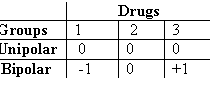
1.  Simple effects are essentially contrasts involving only one level of one or more factors in multifactor designs.

            2.  For example, for      simple effect of             use contrast


                                                            Group @ Drug 1         


Drugs

Groups

1

 2

3


Unipolar

 +1

0

0


 Bipolar

 -1

0

0


                                                            Group @  Drug 2        


Drugs

Groups

1

 2

3


Unipolar

 0

+1

0


 Bipolar

 0

-1

0


Group @   Drug 3  


Drugs

Groups

1

 2

3


Unipolar

 0

0

+1


 Bipolar

 0

0

-1


For the simple effect                 use this contrast                        and                   this contrast

                                                            (and add the sums of squares)
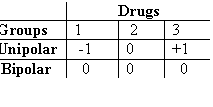
Text Box: 	Drugs
Groups	1	 2	3
Unipolar	 -1	0	+1
 Bipolar	  0	0	  0

Rounded Rectangle: 	Drugs
Groups	1	 2	3
Unipolar	 -1	2	-1
 Bipolar	  0	0	 0

            Drug @ Group 1         


Text Box: 	Drugs
Groups	1	 2	3
Unipolar	 0	0	0
 Bipolar	 -1	0	+1

Text Box: 	Drugs
Groups	1	 2	3
Unipolar	 0	0	0
 Bipolar	 -1	2	-1

            Drug @ Group 2         


3.  A simple effect is a combination of a main effect and an interaction; e.g.:

                                                                        S SSG @ Di = SSG + SSGXD

                                                  and                 S dfG @ Di = dfG + dfGXD

So, when analyzing for more than one set of simple main effects, consider setting new alpha levels for significance tests, just as one would with any other set of non-orthogonal contrasts.


4.  Example

            Source                              SS               df                     MS                     F         p

            Group                          162                  3

                        @ Drug 1              54                 1                    54                    6.12     <.05

                        @ Drug 2              54                 1                    54                    6.12      <.05

                        @ Drug 3              54                 1                    54                    6.12      <.05

            Drugs                           192                  4

                        @ Group 1            24                 2                    12                    1.36        ns

                        @ Group 2          168                 2                    84                    9.51      <.01

            S(GXD)                       106                12                      8.83


By estimating the error variance more precisely, a simple effects analysis on one factor may be more powerful than a one-way ANOVA performed at each level of the interacting factor (see above).


III.  Multi-way Fixed Effects ANOVA

A.  Nothing new

B.  Example: SR(GFXTFXDF);  Group (Bi/Unipolar) X Treatment (Behavioral/Psychodynamic) X Drug (Lithium, Prozac, Ativan) n=5


            Source                   E(MS)                                df                    

            Group              ntdsg2+ss(gtd)2              (g-1)=1

            Drugs               ntgsd2+ ss(gtd)2             (d-1)=2

            Treatment         ngdst2+ ss(gtd)2             (t-1)=1

            G X D              ntsgd2+ ss(gtd)2              (g-1)(d-1)=2

            G X T              ndsgt2+ ss(gtd)2             (g-1)(t-1)=1

            D X T              ngsdt2+ ss(gtd)2             (d-1)(t-1)=2

            G X D X T       nsgdt2+ ss(gtd)2              (g-1)(d-1)(t-1)=2

            S(G X D X T)  ss(gtd)2                          (n-1)gtd= 48

            Total                                                    59