
Long-term Historical Reflection on
the Rise of Military-Industrial, Managerial Statism
or
"Military-Industrial Complexes"
Table of Contents =
SAC Editor's Introduction
Early chronology
WW2 and the Cold War = From Lasswell to Eisenhower
1960s:1991; The era of the disarmament game
Cold War over? How can we tell? "New World Order"
*2008+: Chronology
BYD [boneyard]
SAC Editor's Introduction
When USA President Dwight Eisenhower popularized the term "military-industrial
complex" [ID], he had in mind the tight relationship forming between ostensibly
"free-enterprise" industries and the Pentagon. Eisenhower feared that the economy was increasingly locked into a "procurement"
relationship with the military and thus to some degree was bound with vested financial interests in war-preparedness and in
competition with nationally funded civilian projects. He feared the growing power of this complex in shaping US policy,
and not just foreign policy [EG].
Eisenhower's meaning can be distinguished from another that weaves in and out of the "military-industrial"
discussion, namely, use of the military to promote and protect certain economic enterprises abroad [EG].
It's not that these two meanings are at odds with one another, simply that greater clarity is obtained by making the distinction.
The “political-economy” of military-industrial complexes was based on state
revenue, rather than free-market contracts, and was administered by coalitions
of military and civilian governmental figures and corporate or enterprise managers [EG].
Military-industrial complexes have a role in the global market via international arms sales and other forms of
military contracting, often involving sale for private profit of goods and sometimes services funded
publicly [EG].
<>2016: Defense News published details of the world's top 100 military hardware
vendors [E-TXT]
The military-industrial political-economy arose simultaneously with
industrial modernization [EG], but it first bulked large in
Europe and North America during WW1 [SAC LOOP
on "military-industrial"].
Military-industrialism might have dried up at the end of WW1 were it not for the
failure of the League of Nations and the world-wide collapse (temporarily) of capitalism.
It might have dried up at the end of WW2
if the USSR had been willing or able to demobilize and
if the USA military-industrialism had not managed by the 1950s to regain a big part of its
wartime share of the USA budget. The Cold War allowed military/security/police procurement
expenditure [EG] and the groups most invested in it --
and increasingly dependent upon it -- to thrive again as they had during WW2.
The failure of the USSR and then the USA to demobilize after 1945 must
be given full attention as a central element in the history of the Cold War. The
Cold War served the interests of those who benefited from the military budgets
of the two “superpowers” and their various associated clients, dependent
nation-states and corporate enterprises (some were “free-market” corporations,
some were state companies). It is best to define “military budget” more broadly
than either USA or USSR wished. We cannot exclude espionage, secret police,
pseudo-diplomatic representation, foreign aid, massive
cooperative construction projects, GULag factory prisons, and
semi-entrepreneurial enterprise abroad. It is useful to include all agencies
funded or contracted in state budgets, producing commodities and services
associated with the nation-state in the wider world and involved in projection
of nation-state power or reaping benefit abroad. Thus the "space programs" of both
USA and USSR, with their increasingly awesome "rocket science", must be brought
into the calculation. Those in charge were an executive and managerial elite, directly or indirectly
dependent on the budgets, authorities and opportunities generated by the
contingencies of Cold War. The priorities of military/industrial complexes
directed to some degree the fate of all contenting parties, their allies and
subordinated peoples, and all those who were the targets or within the arena of their
competition. [Rosen TXT]
Ironically, the official doctrinal justification for the actions of the USA military/industrial complex,
for example in Guatemala [ID], was to prevent the Soviet military/industrial complex
from taking similar action. The equation was reversed in other areas, for example
in Cuba [ID].
The dominant USA contention was that the USSR military/industrial complex was
dedicated to global expansion and the subversion of legitimate governments
around the world, especially in areas known as “The Third World”
[ID]. USSR suspicions of
USA mirrored USA suspicions of USSR [CF=The first
paragraph of the Soviet Ambassador's warning to the Kremlin about what the USA
intended now that WW2 was over]. At least one commentator concluded that all the action generated out of this
bi-polar USA/USSR contest was a conscious and cooperative deception of the rest of the
world [EG].
Wartime military/industrial administrative culture was lampooned in US author Joseph
Heller’s Catch 22 [Kimball TXT comparing USSR and
USA memory of WW2]. The lampoon might be thought outrageous, but Heller was pointing
his finger at one anatomical feature of the very same elephant that his contemporaries,
Serbian statesman and theorist Milovan Djilas[ID]
and English pundit George Orwell [ID] described.
Heller saw that the actions of those in charge were motivated not by the widely evoked ideals
of “freedom” or “democracy” or “equality” or “liberation”, but by the sordid and laughably
petty interests embedded in his characters’ military/industrial institutions and authority.
Without any of Heller’s satire, Milovan Djilas defined a new managerial elite in
the middle of the 20th century. The new world was coming under the command of a
managerial elite, some in suits, some in uniforms.
In the previous generation, French pundit Elie Halévy [ID] blamed his
“Era of Tyrannies” on those who sought to realize Saint-Simon’s hope that “savants” would come to dominate the
modern world (technicians, engineers, businessmen, intellectuals and all others who knew how to do the things essential
to a mechanized and scientific age) [ID]. This technocratic elite was
not strictly speaking “an owning class”. It was a bureaucratic, administrative or managerial class.
The military/industrial complex was but one part of that larger beast which lumbered onto the historical scene
with the rise of the modern industrialized and militarized nation-state and its closely associated corporate power.
Its vital interests lay in protecting salaries, power over massive sums of money gathered as taxes and/or investment,
control over increasingly productive economies, and the myriad opportunities in graft and corruption associated with
their largely unrestrained bureaucratic, managerial or command authority.
“New Class” perspective asks us to combine our thinking about Communist Party apparatchiki, “cadre-party” operatives
(whether a one-party or two-party political environment [EG]), KGB and CIA “assets”,
corporate executives (especially transnational executives, and particularly those dependent on governmental “procurement” contracting
and other forms of insider advantage with public officials), and commanders of vast strategic military forces. It asks us to
consider them as variations on the same theme. Under conditions of Cold War, the military/industrial complex was a central component
of this “New Class”, wherever one met it, “East” or “West”, in Communist or capitalist regions, whatever language it spoke.
It was Orwell who saw its violent potential. O’Brien says to Winston in Orwell's novel 1984 (ch. 3, pt. 3),
“If you want a picture of the future, imagine a boot stamping on a human face -- forever”. Does this highly
interpretive perspective help explain what happened in the past half century in Guatemala [ID],
or more recently in Ukraine [ID]?
This disturbing topic has not been given a whole lot of serious "social scientific" study. Steven Rosen has edited a wide ranging effort to "test" the the theory of the military industrial complex [TXT]. Was it really a feature of Cold War international relations?
One other question often seems to be left unanswered in the dissent literature of the Cold War = How does a citizen absorb the often gruesome truth dished up by history, and then avoid becoming a cynic? How does one acknowledge devastating truths about one's own nation and yet maintain an active life of productive citizenship? May I say that these seem to me the greatest public moral questions of the 21st century [SAC entry on dissent and cynicism].
Yet one further question rises. What is the influence of
global militarism on domestic "police" and law enforcement?
\\
*2016se30:The Guardian| "Do Not Resist: new film shows how US police have become an occupying army
[YouTube]
First, some deep historical background =
Hop to Tilly.Coercion for two sources of modern European nation-state political economies
Here are several SAC entries that trace the 19th-century background =
<>1790:Alexander Hamilton
<>1802jy:Powder works of Pierre Samuel Du Pont de Nemours and son
<>1856de01:Jefferson Davis, USA Secretary of War (1853-57)
<>1873:Carnegie Steel
<>1876:Russian "Nobel Brothers Company"
<>1898fe15:Cuba, Havana Harbor | USA Battleship Maine
Now, GO TO SAC LOOP on "military-industrial".
For now take just 3 hops relating to WW1, then reverse-hop
[CONTROL+left-pointing arrow] back here
<>1934ap12:1936wi; USA Senate Special Committee on
Investigation of the Munitions Industry just got up to speed with spectacular hearings
[Senate history website |
Wki]
<>1935: USA retired General Smedley D. Butler [ID] published bluntly titled War Is A Racket [E-TXT]
War is a racket. It always has been. It is possibly the oldest, easily the most profitable, surely the most vicious [racket]. It is the only one international in scope. It is the only one in which the profits are reckoned in dollars and the losses in lives. A racket is best described, I believe, as something that is not what it seems to the majority of the people. Only a small 'inside' group knows what it is about. It is conducted for the benefit of the very few, at the expense of the very many. Out of war a few people make huge fortunes.
I spent 33 years and four months in active military service and during that period I spent most of my time as a high class muscle man for Big Business, for Wall Street and the bankers. In short, I was a racketeer, a gangster for capitalism. I helped make Mexico and especially Tampico safe for American oil interests in 1914 [ID]. I helped make Haiti and Cuba a decent place for the National City Bank boys to collect revenues in [ID]. I helped in the raping of half a dozen Central American republics for the benefit of Wall Street [EG]. I helped purify Nicaragua for the International Banking House of Brown Brothers in 1902-1912 [ID]. I brought light to the Dominican Republic for the American sugar interests in 1916 [ID]. I helped make Honduras right for the American fruit companies in 1903. In China in 1927 I helped see to it that Standard Oil went on its way unmolested [ID]. Looking back on it, I might have given Al Capone [ID] a few hints. The best he could do was to operate his racket in three districts. I operated on three continents.
The Japanese, a proud people, of course will be pleased beyond expression to see the United States fleet so close to Nippon's shores. Even as pleased as would be the residents of California were they to dimly discern, through the morning mist, the Japanese fleet playing at war games off Los Angeles.In this way Butler identified the significance of "threat inflation" [ID] as well as militarist provocation, all for the maintenance of publicly supported military-industrialism. He felt that the US military buildup in the Pacific provoked the fear among the US public that "the great fleet of this supposed enemy will strike suddenly and annihilate 125,000,000 people
1940s:1950s
Interest in modern industrialized militarism took a big leap forward with Harold Lasswell's dense article =
<>1941ja:AJS#46,4:455-68| Harold D. Lasswell, "The Garrison State" [TXT]. Here is Lasswell's summary, written almost a year before USA entered WW2. Lasswell writes in his characteristic highly "scientized" style. The general reader could, in fact, simply skip the first sentence which is aimed at fellow social "scientists", but the general reader could gain a great deal from a very careful read of the narrative that follows the first opaque sentence =
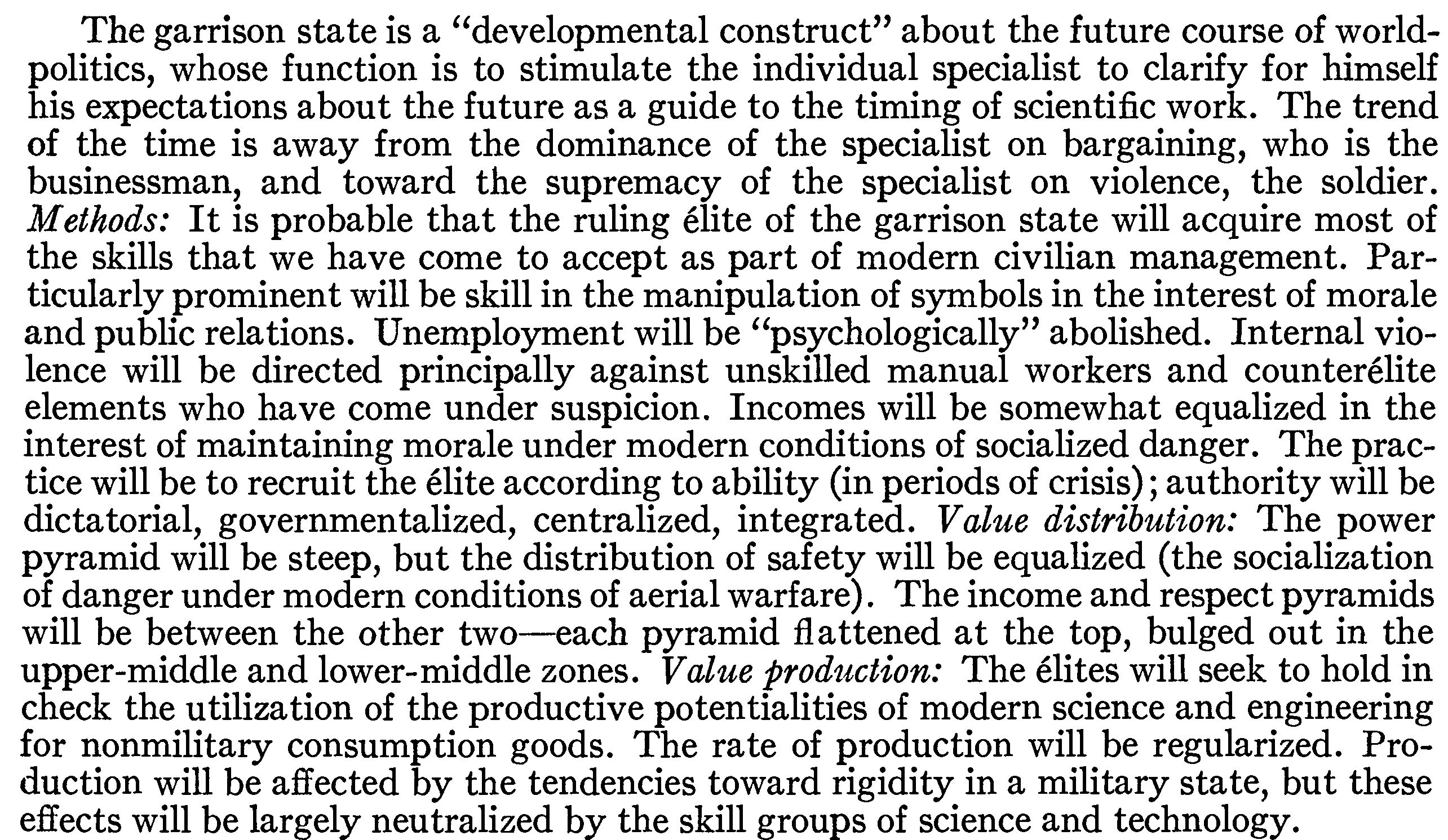
NB! Lasswell's startling prediction of decline in traditions
of laissez faire entrepreneurialism. He later fleshed out a theme clearly central to
the paragraph above = the rise of managerial elitism [ID]
Lasswell was under the spell of the global move toward "statism" in the 1930s
[ID]
Now, GO TO SAC LOOP on
the four phases of WW2, then reverse-hop back here
<>1957:As Cold-War militarization
intensified, 12 years after WW2 ended, 16 years after Lasswell's premonition of the
"garrison state", Samuel Huntington [LOOP on Huntington]
sought to refute the darker implications of Lasswell's vision
\\
*2008oc26:Michael Healey looked back a half-century in an effort to balance the picture
[E-TXT]
<>1957no21:WDC|
Soviet Progress vs. American Enterprise, a report on debate among USA businessmen, military officers and
government officials about procurement vs. laissez faire [TXT excerpts]
Now, CONTINUE SAC LOOP on "military-industrial",
13 hops, from WW2 to Eisenhower's 1961 warning, then reverse-hop back here
1960s:1980s
<>1970:Proxmire,William,USA Senator,
picked up tradition of the Nye Committee [ID]
when he published Report from
Wasteland: America's Military-Industrial Complex
<>1970:Melman,Seymour (Professor of industrial engineering at Columbia
University)|
Pentagon Capitalism: The Political Economy of War| Argued that the
military-industrial complex is far more than "a loose collaboration, mainly
through market relations, of senior military officers, industrial managers, and
congressmen" = It has become a system of "state-management". Free market has
been replaced. A newly arisen management group "by the measure of the scope and
scale of its decision-power [...] is the most important single management in the
United States". From 1949 to 1969, USA spent one trillion dollars on
"defense", leaving serious deficiencies in housing, food, education and medical
care. The rest of the world over these two decades spent on the military an
amount equal to US expenditures over that period. Melman asks what else of value
those two trillion dollars might have financed for the world in those crucial
post-WW2 years
<>1970:Lens,Sidney (labor union organizer)|
The Military-industrial Complex
<>1970:Baumgartner,John Stanley|
The Lonely
Warriors: Case for the Military Industrial Complex| The military-industrial complex is made up of people "who are working so hard to
save us in spite of ourselves". They are people of "integrity, devotion, selflessness and tremendous collective abilities". He
writes further, that "these are the Silent Warriors who provide the protective cover for us and for much of the free
world". Baumgartner singles out General Douglas MacArthur as an exemplary representative of
these "Silent Warriors", and he reproduces as an appendix MacArthur's 1962my12:Farewell speech at West
Point [TXT], rather than
his more apropos 1951my15:Lansing, Michigan, speech [ID]
<>1970my24:NYT
Book Review, sct.7, pt1| Harrison Brown
[ID] wrote a review of four major studies devoted to the question of
military-industrialism [Proxmire, Melman, Lens, and
Baumgartner]
*--The review article was titled "The Most Dangerous
Organism Ever Created by Man -- Created, in fact, By Men of Good Will". Brown
opened with a recollection of how, in 1945, he and others who had worked to
invent and develop the first atomic bombs struggled to prevent the control of
nuclear programs under the Pentagon. They won, and the civilian Atomic Energy
Commission was created. But, he continued =
Not in our wildest imaginings did we foresee the extent to which our armed services would eventually influence our foreign policy, our domestic economy and our internal politics. In spite of our Founding Fathers' clear intent that the military should be subservient to the civilian government, the Department of Defense has become de facto the primary executive body of the Federal Government. It comes close to being the primary legislative body as well. Numerous decisions, which have been made in large measure by men of good will, have narrowed the area within which Congress and the President can effectively maneuver to one which is very small when compared with that which is dominated by the Pentagon -- the largest and most generously financed organization ever created by man.
*--The President, members of Congress, and Senators set military/diplomatic
policies. The Pentagon puts out contracts. Big industrial giants -- e.g.,
General Dynamics, Lockheed, General Electric, United Aircraft, McConnell Douglas
and AT&T -- compete most successfully for those contracts, and to some degree
become dependent upon procurement contracts for extraordinary profits. The big
industrial giants lobby the President, members of Congress and Senators. They
give financial support or do not give financial support to these political figures who rise and
fall via expensive electoral campaigns. Political survival hangs in large measure on the degree
of compliance with procurement interests. Brown summarizes, "the symbiotic link-up comes full
circle with each component feeding upon the others".
*--From the four books under review, Brown calculated that during the period
1949-1969, from the year NATO was created
[ID] and into the final years of the
Vietnam War [EG], with some minor ups and downs, "the United States military budget
increased by a factor of four in constant dollars while that of the Union of
Soviet Socialist Republics increased by about a factor of two, according to
United States intelligence estimates. World-wide military expenditures rose by a
factor of three...."
Growth of USA military expenditures
1949 = $13.5B
1953 = 50.0B
Harrison Brown ended his review with two main recommendations =
(1) "Department of Defense must be brought under control"
(2) "There is also a crying need to transfer the function of foreign-policy
determination back from the Pentagon to the Secretary of State"
<>1973:Rosen,Steven, ed|
Testing the Theory of
the Military-industrial Complex | [E-TXT of introduction
with general summary]
<>1977:Piadyshev,Boris|
The Military-Industrial
Complex of the USA| How does this Soviet account square with the Rosen account just
above, or with other "Western" accounts?
<>1980:Koistinen,Paul|
The
Military-Industrial Complex: A Historical Perspective
<>1986:De Porte,A.W|
Europe between the Superpowers: The
Enduring Balance
<>1987:Paul Kennedy
The Rise and Fall of Great Powers
<>1988au07:MGW:17-18 (reprint from the
Washington Post)| Oregon Republican Congressman Denny Smith, a member of the
Congressional Military Reform Caucus, delivered a scathing critique of the USA
military procurement system. Weapons are designed and built in haste. "To put it
bluntly, the testing is rigged to make the weapons look better than they
are...." They are sold at inflated prices backed by accounting fraud. "The
problem is not that there is fraud in defense procurement. The problem is that
defense procurement has itself become a fraud. It has little or nothing to do
with defense of the nation and armed forces that can win in combat." [...] "The
system is sick."
<>1990jy01:Associated Press reported
defense expenditure of $999 for each pair of pliers purchased for Tinker Air
Force Base in Oklahoma, $117 per soap dish cover stored in a Columbus OH defense
supply center, $1,500 for a hydraulic hand jack for the Navy Aviation Supply
Office in Philadelphia, $1,868.15 for a toilet seat cover for the C-5 cargo plane
<>1990jy13:NYT| Christopher Lasch
[ID#1]
[ID#2],
"The Costs of Our Cold War Victory"| George Frost Kennan and other critics of US
cold-war policies were concerned about the impact of militaristic forms of
"containment", not only on Soviet but also on USA society. "[A] protracted,
single-minded, global struggle against Communism might cripple democratic
institutions at home."
At the beginning of the cold war, Walter Lippmann [ID] predicted that containment would force the U.S. to piece together a global network of client states, and that the clients would end up calling the tune. The need to sustain its credibility as a protector of anti-Communist regimes would lead the U.S. into police actions, even full-scale wars, that were inconsistent with its own national interests. The war in Vietnam, a national disaster from which the U.S. has never really recovered, bears out the accuracy of this insight.
Thanks to its willingness to support corrupt and repressive regimes in a global crusade against Communism -- to ally itself with the most reactionary forces in the Third World -- the North American colossus is now widely regarded as a colonial power whose verbal championship of freedom, democracy and social reform cannot be taken any more seriously than that of the Soviet Union.
Critics of American foreign policy also pointed out that containment would cause serious distortions in the American economy. Military spending would deflect investment from plant expansion and modernization, making the U.S. weak in exports and more and more vulnerable to imports.
Experience has confirmed this insight as well. Nations unburdened by large military expenditures, notably West Germany and Japan, have shot ahead of us in their productive capacity, taken over markets formerly dominated by American exports and invaded the domestic market -- the final indignity. [Consider these 2010:tables]
The diplomatic and economic costs of containment merely scratch the surface. The cold war inflicted much deeper wounds on American society. Preoccupation with external affairs led to the neglect of domestic reforms, even of basic services. The development of secret police organizations, the erosion of civil liberties, the stifling of political debate in the interest of bipartisan consensus, the concentration of decision-making in the executive branch, the secrecy surrounding executive actions, the lying that has come to be accepted as routine in American politics -- all these things derive either directly or indirectly from the cold war.
Their worst effect has been to undermine confidence in government, to weaken our public culture and to destroy the delicate fabric of trust on which civic life depends. If the West won the cold war, the U.S. can hardly be said to have shared in the fruits of that victory. I would be close to the truth to say that the Soviet Union and the U.S. have destroyed each other as major powers, just as many critics of the cold war predicted.
<>1990no12:NYT reported that 25 of the 100 largest Pentagon contractors had been found guilty of procurement fraud in the last seven years, some more than once. Yet not one had been barred from government contracting. The number of convictions and guilty pleas had accelerated since the Reagan Administration. Among the guilty parties = Boeing, Grumman, Teledyne, Rockwell International, Emerson Electric, Fairchild Industries, and Northrop
Now, CONTINUE SAC LOOP on "military-industrial", from US Vietnam War to the 1991 collapse of the USSR, then reverse-hop back here
Cold War Over? Post-Soviet era, aka "New World Order" [ID]
<>1995su:US Air Force
Captain Westermann on civilian/military relations as a possible threat to the
republic [TXT]
<>2004:Stockholm International Peace
Research Institute report on recent growth of world military-industrial
expenditures [TXT]
<>2005ja13:NYR | Jonathan Raban article, "The Truth about Terrorism"
[ID]
<>2006:Julian Cooper's
[ID] statistical assessment
of changes in Russian military-industrial procurement, 1990-2005, posted on The Secret Internet
Protocol Router Network (SIPRNet), "a system of interconnected computer networks used by the
United States Department of Defense and the U.S. Department of State to transmit classified
information" [TXT]
<>2007:Lewis, Adrian R| The American culture of war : the
history of U.S. military force from World War II to Operation Iraqi Freedom
((SUMMIT, on order for UO))
2008+: =
<>2008:Texas Republican Representative to the US House of Representatives Ron Paul [ID] delivered a 5-minute appeal to bring an end to the "racket of war" [YouTube] NB! Ron Paul's reference to USA General Butler's 1935 book War is a Racket [ID]
<>2008se14:NYT| Eric
Lipton, “U.S. pushing through dozens of foreign weapons deals”
[SOURCE]
WASHINGTON: The Bush administration is pushing through a broad array of foreign weapons
deals as it seeks to re-arm Iraq and Afghanistan, contain North Korea and Iran, and solidify ties with
[nation states that were] onetime Russian allies.
From tanks, helicopters and fighter jets to missiles, remotely piloted aircraft and even
warships, the Department of Defense has agreed so far this fiscal year to sell or transfer more
than $32 billion in weapons and other military equipment to foreign governments, compared
with $12 billion in 2005.
The trend, which started in 2006, is most pronounced in the Middle East, but it reaches into
northern Africa, Asia, Latin America, Europe and even Canada, through dozens of deals that senior
Bush administration officials say they are confident will both tighten military alliances and combat terrorism.
“This is not about being gunrunners,” said Bruce Lemkin
[ID], the air force
deputy under secretary who is helping coordinate many of the biggest sales. “This is about building a more secure world.”
The surging American arms sales reflect the foreign policy tides, including the wars in Iraq and
Afghanistan and the broader campaign against international terrorism, that have dominated the
Bush administration. Deliveries on orders being placed now will continue for several years, perhaps
turning out to be one of President George W. Bush's most lasting legacies.
The United States is far from the only country pushing sophisticated weapons systems: It is facing
intense competition from Russia and elsewhere in Europe, including continuing contests for
multibillion-dollar deals to sell fighter jets to India and Brazil.
In that booming market, U.S. military contractors are working closely with the Pentagon, which acts as
a broker and procures arms for foreign customers through its Foreign Military Sales
[FMS (ID)] program.
Less-sophisticated weapons, and services to maintain these weapons systems, are often bought
directly by foreign governments. That category of direct commercial sales has seen an enormous surge
as well, as measured by export licenses issued this fiscal year covering an estimated $96 billion, up
from $58 billion in 2005, according to the State Department, which must approve the licenses.
About 60 countries get annual military aid from the United States, $4.5 billion a year, to help them
buy these American weapons. Israel and Egypt receive more than 80 percent of that aid. The United States
has also recently given Iraq and Afghanistan large amounts of weapons and other equipment and has begun
to train fledgling military units at no charge; this military assistance is included in the tally of
rising foreign sales. But most arms exports are paid for by the purchasers without U.S. financing.
The growing tally of international weapon deals, which started its sharp increase in 2006, is now
provoking questions among some advocates of arms control and some members of Congress.
“Sure, this is a quick and easy way to cement alliances,” said William Hartung, an arms control
specialist at the New America Foundation, a public policy institute. “But this is getting out of hand.”
Congress is notified before major arms sales deals are completed between foreign governments and
the Pentagon. While lawmakers have the power to formally object and block any individual sale, they
rarely use it.
Representative Howard Berman, Democrat of California and chairman of the House Committee on
Foreign Affairs, said he supported many of the individual weapons sales, like helping Iraq build
the capacity to defend itself, but he worried that the sales blitz could have some negative effects.
“This could turn into a spiraling arms race that in the end could decrease stability,” he said.
The United States has long been the top arms supplier to the world. In the past several years,
however, the list of nations that rely on the United States as a primary source of major weapons systems
has greatly expanded. Among the recent additions are Argentina, Azerbaijan, Brazil, Georgia, India, Iraq,
Morocco and Pakistan, according to sales data through the end of last month provided by the
Department of Defense.
Cumulatively, these countries signed $870 million worth of arms deals with the United States from 2001 to 2004.
For the past four fiscal years, that total has been $13.8 billion.
In many cases, these sales represent a cultural shift, as nations like Romania, Poland and Morocco,
which have long relied on Russian-made MIG-17 fighter jets, are now buying new F-16s, built by Lockheed Martin.
At Lockheed Martin, one of the largest U.S. military contractors, international sales last year
brought in about $6.3 billion, or 15 percent of the company's total sales, up from $4.8 billion in 2001.
The foreign sales are credited with helping keep alive some production lines, like those of the F-16
fighter jet and Boeing's C-17 transport plane.
Fighter jets made in America will now be flying in other countries for years to come, meaning continued profits for American contractors that
maintain them, and in many cases regular interaction between the U.S. military and foreign air forces, Lemkin, the air force official, said.
Sales are also being driven by the push by many foreign nations to join the once-exclusive club of countries whose arsenals include
precise, laser-guided missiles, high-priced U.S. technology that the country displayed during its invasions of Iraq and Afghanistan.
In the Gulf region, much of the re-armament is driven by fears of Iran. The United Arab Emirates, for example, are considering spending
as much as $16 billion on U.S.-made missile defense systems, according to recent notifications sent to Congress by the Department of Defense.
The Emirates also have announced an intention to order offensive weapons, including up to 26 Black Hawk helicopters and 900 Longbow
Hellfire II missiles, which can knock out enemy tanks.
Saudi Arabia, this fiscal year alone, has signed at least $6 billion worth of sales agreements to buy weapons from the U.S.
government -- the highest figure for that country since 1993, which was another peak year in U.S. weapons sales, after the Gulf War.
Israel, long a major buyer of U.S. military equipment, is also increasing its orders, including planned purchases of perhaps as many as
four American-made coastal warships, worth $1.9 billion.
In Asia, as North Korea has conducted tests of a long-range missile, American allies
have been buying more U.S. equipment. One
ally, South Korea, has signed sales agreements with the Pentagon this year worth $1.1 billion.
The flood of sophisticated U.S. military equipment pouring into
the Middle East has evoked concern among some members of
Congress, who fear that the Bush administration may be compromising the military edge Israel has long maintained
in the region. Particular concern was expressed about the proposed sale this year to Saudi Arabia of devices that
can convert “dumb bombs” into precision-guided weapons.
Not surprisingly, two of the biggest new arms customers are Iraq and Afghanistan.
In the past two years, Iraq has signed more than $3 billion of sales
agreements -- and announced plans to buy perhaps as much
as $7 billion more in U.S. equipment, financed by its rising oil revenues.
Among the products on the shopping list are 140 Abrams tanks, armed
helicopters, C-130J transport planes and more than 100 million rounds of
ammunition, Defense Department documents show. Iraq also is considering requesting
its own fleet of F-16s, although no such deal has been approved.
Lieutenant Colonel Almarah Belk, a Pentagon spokeswoman, said making these
sales served the interests of both Iraq and the United States
because “it reduces the risk of corruption and assists the Iraqis in getting
around bottlenecks in their acquisition processes.”
Over the past three years, the U.S. government, separately, has agreed
to buy more than $10 billion in military equipment and weapons on behalf of
Afghanistan, according to Defense Department records, including M-16 rifles
and C-27 military transport aircraft.
Even before this new round of sales got under way,
the country's share of the world arms trade was rising, from 40 percent of arms
deliveries in 2000 to nearly 52 percent in 2006, the latest year for which the Congressional Research Service
has compiled data. The next largest seller was Russia, which in 2006 accounted for 21 percent of global deliveries.
<>2009oc02:Portland Oregonian| David Sirota,
a nationally syndicated columnist with the Creators Syndicate, raised the question about who makes the decisions about US
foreign policy, civilian or military leaders? [Boldface and hypertext links inserted by SAC Editor]
The war in Afghanistan poses two important questions: What should be done and who should be "the deciders"?
Congressional Republicans say the answer to the first query is military escalation. But according to polls, most Americans disagree.
At the same time, many experts wonder "whether or not we know what we're doing," as President George W. Bush's former deputy
national security adviser said last week.
One thing's for sure: The U.S. commander in Afghanistan, Gen. Stanley McChrystal, says he wants more troops. His new memo
calling for a bigger Afghanistan deployment prompted President Barack Obama to begin carefully considering different ways forward --
and prompted Washington to hammer the White House for entertaining any alternative to McChrystal's request.
Republicans lambasted Obama for letting "political motivations ... override the needs of our commanders," as
Sen. Kit Bond, R-Mo., said. Likewise, the Washington Post insisted that Obama's failure to promptly back McChrystal's
surge proposal could "dishonor" America, while The New York Times said no matter what the president wants,
"It will be very hard to say no to General McChrystal."
[Here is a website [W]
that surveys this issue and questions the possible historical parallel with General Douglas MacArthur
vs. President Harry Truman [ID]]
The coordinated assault sharpens that question about who "the deciders" should be -- elected officials or the military?
The Washington establishment clearly believes the latter, and that's no surprise. The war-mongering political class has
called for presidential and congressional deference to military demands since Hollywood movies and anti-communist ideologues
began countering the public's "Vietnam syndrome" by blaming that quagmire in Southeast Asia on elected officials. In the
purest articulation of the argument, Ronald Reagan asserted in 1980 that Vietnam was lost not because of flaws in mission or strategy,
but because politicians allegedly forced soldiers to fight "a war our government (was) afraid to let them win."
[SAC LOOP on "Vietnam"]
Avoiding another Vietnam, says this school of thought, requires a figurehead government -- one that delegates all military
decision-making power to generals and effectively strips it from elected civilians who will supposedly be too "politically motivated"
(read: influenced by voters). This authoritarian ideology explains not only today's vitriolic reaction to the president's Afghanistan
deliberations (including the conservative Web site Newsmax fantasizing about a military "coup" to "resolve the Obama
problem" [W]) but also some of the most anti-democratic statements ever uttered by
American leaders. It explains, for instance, former Vice President Dick Cheney's assertion that public opinion "doesn't matter"
when it comes to military policy [W], and President George W. Bush saying
Iraq "troop levels will be decided by our commanders on the ground, not by political figures
in Washington." [W]
Of course, the Constitution deliberately gives "political figures in Washington" final say: Article I empowers Congress to
declare and finance wars; and Article II states that while the White House "may require the opinion" of military officers,
ultimately "the President shall be Commander in Chief."
Those provisions were no accident. By separating political from military power, and vesting our elected representatives
with ultimate authority, the founders purposely constructed a democracy that seeks to prevent the dictatorial juntas that
often arise when no such separation exists.
In that way, the Constitution doesn't worry about elected officials' "political motivations" as Sen. Bond does,
nor does it fret about "a disconnect ... between the military leadership and the White House," as Sen. John McCain, R-Ariz.,
lamented. It views "political motivations" and a "disconnect" as democratic forces guaranteeing that public opinion, via
elected "deciders," is somewhat involved in military policy.
Certainly, Obama and Democratic congressional leaders may still end up defying public will by making the lamentable choice
to escalate the Afghanistan war. But after recent quagmires justified by knee-jerk subservience to military prerogative,
America should at least applaud these lawmakers for refusing to immediately rubber stamp that course of action. In exploring
all options, they are honoring the Constitution's separation of powers -- and our nation's most democratic principles.
<>2010:Penguin| US historian and pundit, Garry Wills, Bomb Power:
The Modern Presidency and the National Security State, raised question about how Cold-War nuclear weaponry
undermined the US constitution [Thomas Powers review of Wills.BOMB TXT]
<>2010mr04:Eugene Weekly| Stan Taylor, “Confronting Militarism:
Lane Peace Symposium Looks at Democracy vs. Empire” [TXT]
EXCERPTS =
*--War as a way of life dominates our economy, our politics and our culture
*--In 2010 the U.S. military budget is $728 billion, roughly equaling the rest of the world combined. The U.S. has
approximately 800 military bases or military installations in 130 countries. The U.S. is the largest arms producer and
purveyor of weapons in the world, with its $40 billion share of arms sales in 2009 constituting more than two-thirds of
all foreign armaments deals
*--We have normalized perpetual war. Military commanders refer to the war on terror as the “long war” and have expressed
their expectations that we will be fighting for the next 50 years in the greater Middle East and parts of Africa and Central
and South Asia [only Central and South America is missing from this list which would otherwise precisely duplicate the
regions implied in the Cold-War concept of "Third World" (ID)]. Today we are
fighting two declared wars in Afghanistan and Iraq as well as undeclared wars in Pakistan and Yemen
*--At home, politics is captured by the economics of the Military Industrial Complex. With weapons production or industry
providing support systems for the weapons industry in every state, members of Congress are unwilling to make any cuts
in military spending. When Secretary of Defense Gates proposed to limit future production of the F-22 because it is not
strategically needed, members of Congress fought the cuts
*--In the decade from 2000 to 2010, U.S. military spending increased more than 125 percent from $323 billion to $728 billion —
an increase of $405 billion. Meanwhile, social programs and safety nets are cut. Tax dollars from our pockets are reprioritized for war
*--President Obama’s new budget will freeze or cut domestic spending, yet spending for the military and for prisons will not be subject
to the freeze. Internationally, this means more military ventures to protect U.S. and multinational [?transnatinal] corporate interests.
Domestically, this means greater inequality and more unmet needs
<>2010mr13:NYT| James Glanz, "New Fraud Cases Point to Lapses in Iraq Projects"
[E-TXT]
<>2010je26:ERG:A9 | Internationally syndicated columnist
for the International Herald Tribute William Pfaff published the following summary of the past 65 years accomplishments of
the US "war machine" =
Americans [IE=USA tax payers] have, during the 65 years since the Second World War, been spending more than the military spending of all the rest of the world combined, with the avowed intention of pacification and global democracy.
It has fought wars or carried out military interventions in Korea, China (via Kuomintang mercenary forces and Tibetan tribesmen), Cuba (via exiles), Laos, Vietnam, Cambodia, Lebanon, Libya, Iraq (twice), Iran, Somalia, Afghanistan (twice), Pakistan (with drones and special forces), Nicaragua (via "Contras"), Grenada, Panama, Dominican Republic, Sudan and Kosovo (with NATO). It also has been involved with coups in Guatemala, Chile, Greece and elsewhere. [...]
The point of the list is a fact that no one seems to understand: Battles were won, but not a single war was won by the United States. There is not one victory (except as noted below), and not one of the interventions had a positive outcome except in Kosovo.
The sole clear-cut military victories were in Grenada over a Cuban construction crew, and in Panama, where 500 civilians (the U.N. estimate) were killed in order to seize President Manuel Noriega and put him into a Miami jail cell. He has now served his term.
There have been previous efforts to create actual list of US projection of military power =
*2016:USA Congressional Research Service compiled a list of the instances in which USA deployed its military forces abroad,
1798-2016 [E-TXT]
*1999:Another (mildly angry) list [E-TXT]
And another "blackboard style" set of slides on history of USA foreign policy, titled "America vs. the World"
[
E-TXT]
<>2011ap24:ERG (original pbc = The Plain Dealer) Charles V. Pena, "A good military
a terrible thing to waste"| Excerpt =
Even before the United States went to war in Afghanistan and Iraq, nearly a quarter of all U.S. active duty forces -- 250,000 of the more than 1 million men and women in the active duty military -- were deployed overseas.
They're virtually everywhere -- with installations in dozens of countries, including Greenland, Bulgaria, Kosovo, Qatar and Kyrgyzstan. In less enlightened times, some would call this an "empire."
Although the Cold War is long since over and there is no threat of Soviet tanks bursting through the Fulda Gap, one of the military fault lines that separated the former East and West Germany, the United States still has 50 Army installations and four Air Force bases in Germany. Elsewhere in Europe, we also have bases in Spain, Portugal, the Netherlands, Italy, Bulgaria, Greece and Turkey. Who are we defending against what enemy and at what cost?
In East Asia, the United States has upward of 70,000 troops, mostly in Japan and South Korea. We also have bases in Singapore, Australia, the Philippines and in the British territory of Diego Garcia in the Indian Ocean (not to mention the U.S. territory of Guam). In addition, one of our Navy's 11 carrier groups is based in Japan.
The problem with such a sprawling global military footprint, which also includes six U.S. "carrier groups" that typically are on deployment at any given time (each including an aircraft carrier, its air wing, cruise-missile armed cruisers, destroyers and attack submarines) is that it can encourage U.S. intervention by making it easy.
[...]
To a president with a hammer as large as America's military, every problem can readily look like a nail. Employing military force becomes easy and the temptation to do so great.
<>2014ap07:MSNBC news report on Vice President
Cheney supporting war with Iraq for purposes of Halliburton profit
[YouTube]
*--More on same topic
*--And yet more [an angry and
profane critique by Jesse Venturi]
<>2014no03:
TRUTH-OUT.ORG
angry opinion piece by William Rivers Pitt on the growth of US military-industrial complex since WW2
Here's the real challenge = Can you say what's wrong with Pitt's argument
(aside from Pitt's needlessly cute "one-sentence" claim)?
If it appears that much is wrong in Pitt's account, how can the USA citizen refute it?
If it appears that very little is wrong, then what should the USA citizen do? What can one do?
Well, at the very least, we can make ourselves informed citizens
Make sure that you can identify the main events cited in the article
Try FIND searches [ID] for Pitt's keywords in these three SAC pages =
*1921+:SAC | *1946+:SAC |
*1983+:SAC
<>2016: Center for Public Integrity| "The Gift Economy"
[E-TXT]
<>2016my28:Salon.com| "The Defense Department is ruining America: Big budgets,
militarization and the real story behind our Asia pivot"
[
E-TXT]
<>2016je28: Sputnik News| "Russian Military Industry Set to Become Driver of Civilian Economy"
[E-TXT]
<>2016jy27: The Guardian| "Revealed: the £1bn of weapons flowing from Europe to Middle East"
[E-TXT]
<>2016au19: Reuters| "USA Army fudged its accounts by trillions of dollars, auditor finds"
[E-TXT]
<>2016se09:Независимая газета| Семь
российских компаний
вошли в топ-100
крупнейших оборонных
компаний мира
(Russian-language article includes a sortable English-language data table about the world's 100 biggest
"defense companies")
[E-TXT]
<>2016oc26:The Nation| "Militarized Police Are Cracking Down on Dakota Access Pipeline Protesters"
[E-TXT]
<>2016no:Literary Hub| "Are
Video Games Teaching Children to Kill?"
<>2016no:Defense News| Thirtieth-anniversary edition of authoritative military-industrial publication
[E-TXT]
<>2016no02:Defense News| "Pentagon Moves Forward — Unilaterally — on $6.1B Contract
for Ninth F-35 Lot
[E-TXT]
<>2016no02:Reuters| "US militia girds for trouble as presidential election nears"
[E-TXT]
<>2016de26:The Guardian| "USA increased weapons sales in 2015 despite slight drop
in global arms trade" [
E-TXT]
<>2017fe10:Accessed
"List of
countries with overseas military bases"
<>2017fe10:POLITICO| "Former Pentagon chief Perry: 'Tragic mistake' not to extend
arms treaty with Russia" [E-TXT]
<>2017mr20:The Guardian| Thomas Hedges, "The Pentagon has never been audited. That's astonishing"
[E-TXT]
Some specialists =
Hugel,Eric, an analyst from Stephens Inc
Nisbet,Paul, an analyst from JSA Research
Singer,Peter, an analyst from Brookings Institution
Some bzn tUt~ =
Lockheed Martin Corp (biggest MIC contractor) Patriot missile
Northrup Grumman Corp
Boeing Co. (Joint Direct Attack Munitions JDAMs)
Raytheon (Tomahawk cruise missile)
Alliant Techsystems (bullets)
Newport News Ship building
General Dynamics Corp
“Hodgepodge of military services and support firms [private
businesses] that transport troops & equipment to the Middle East”
Wki article
with section about literary and other media representations of the "war
profiteer"